14 marks
Outline Hebb’s theory of learning and neuronal growth.
Was this exam question helpful?
Exam code: 8182
Outline Hebb’s theory of learning and neuronal growth.
Was this exam question helpful?
The psychologist Carol Dweck developed a theory about the way in which our mindset affects learning. Donald Hebb was a neuropsychologist who developed the theory of learning and neuronal growth.
Explain what Dweck means by ‘fixed mindset’ and ‘growth mindset’.
Briefly describe Hebb’s theory.
Discuss whether or not Hebb’s theory supports the idea that having a growth mindset is an advantage when learning.
Was this exam question helpful?
Which one of the following statements about neurons is correct? Shade one box only.
Motor neurons carry information to the spinal cord
Relay neurons carry information from motor neurons
Sensory neurons always have longer axons than motor neurons
Sensory neurons carry information to the brain
Was this exam question helpful?
Below is a diagram of a motor neuron.
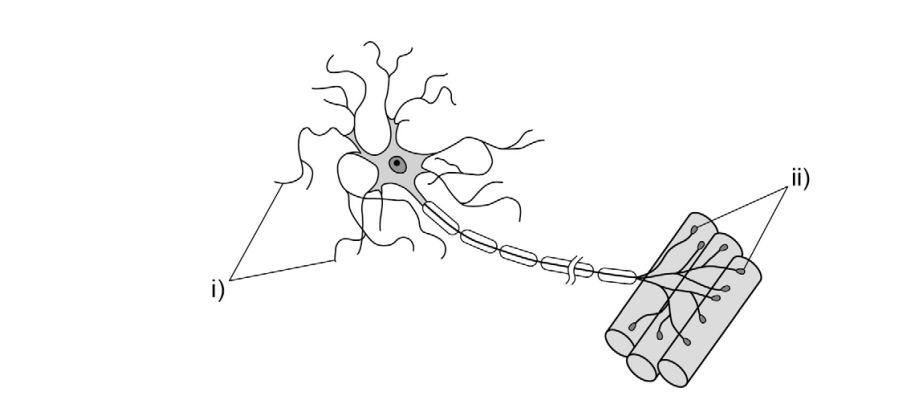
Identify the parts labelled i) and ii).
Briefly explain the function of a motor neuron.
Was this exam question helpful?
Read the item and then answer the questions that follow.
Sam was walking home at night alone. Suddenly, he heard a sound behind him. His heart started to beat faster and he began to run to the bus stop. He then heard a voice shouting, ‘Wait for me Sam!’ Sam turned to see his friend Neil running along the street, trying to catch up with him. Sam stopped and his breathing slowed as he waited for Neil. ‘I am glad to see it’s you, Neil,’ said Sam. |
Draw a diagram of a synapse. On your diagram label the following: vesicle, neurotransmitter, synaptic gap (synaptic cleft), receptor, direction of impulse.
Was this exam question helpful?
The following diagram of a sensory neuron is not complete.
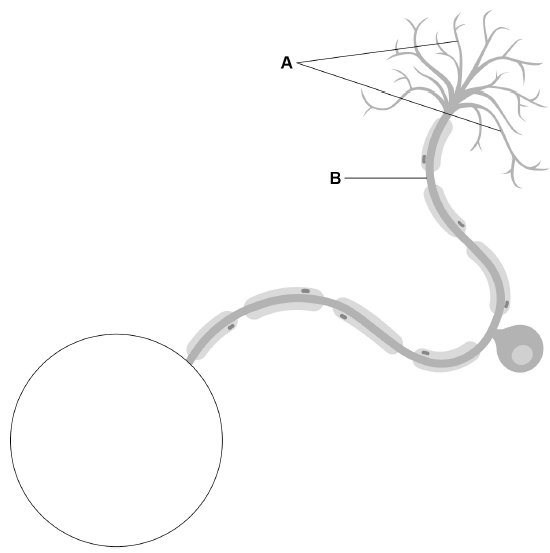
Complete the diagram by drawing the missing part(s) within the circle.
Identify the parts labelled A and B.
Briefly explain the function of a sensory neuron.
Was this exam question helpful?
Read the following information.
Sophia and Nickolas were at an amusement park with their mum. They enjoyed the taste of candy floss and the smell of freshly popped popcorn. They screamed with excitement and waved their arms in the air as they rode on the roller coasters. They had so much fun that they didn’t want to leave! |
From the information, identify two examples of situations where sensory neurons would have been involved and identify two examples of situations where motor neurons would have been involved.
Write your answers in the correct boxes.
Sensory neuron examples | Motor neuron examples |
|---|---|
Was this exam question helpful?
Complete the following sentence.
Sensory neurons carry information...
both to and from the central nervous system.
both to and from the peripheral nervous system.
to the central nervous system.
to the peripheral nervous system.
within the central nervous system.
Complete the following sentence.
Relay neurons carry information…
both to and from the central nervous system.
both to and from the peripheral nervous system.
to the central nervous system.
to the peripheral nervous system.
within the central nervous system.
Was this exam question helpful?
Explain how excitation and inhibition are involved in synaptic transmission.
Was this exam question helpful?
Neurons are nerve cells that carry messages.
Explain the specific function of a sensory neuron.
Give one example of a situation that would cause the sensory neuron to send a message.
Was this exam question helpful?
Read the following information.
Vijay passed his driving test 6 months ago. When he first started having lessons, he had to concentrate really hard to steer the car and change gear. Now he can do these things almost without thinking. |
Use your knowledge of Hebb's theory of learning and neuronal growth to explain Vijay’s behaviour.
Was this exam question helpful?
Describe and evaluate Hebb’s theory of learning and neuronal growth.
Was this exam question helpful?