Designing Research Methods (AQA GCSE Psychology): Exam Questions

Exam code: 8182

4 hours43 questions
1
6 marks

You have been asked to investigate the effect of emotion on perception.

Explain how you would design an experiment to do this.

You need to include the following information in your answer:

  • what you would ask the participants to do and what data you would collect

  • the experimental design you would choose and why this would be suitable

  • the results you would expect to find from your experiment including both conditions of the independent variable.

2
6 marks

A researcher wants to investigate the most common behaviours displayed by children during the sensorimotor stage of development.

The researcher and an assistant decide to carry out a controlled observation study.

One behaviour being observed is ‘shaking a rattle’.

Describe how you would carry out this controlled observation study.

You need to:

  • identify a suitable age range of the target population

  • suggest two suitable behaviour categories that could be used during the observation. Do not include ‘shaking a rattle’ as one of your categories

  • briefly describe two ways the researcher could make sure there is interobserver reliability

  • identify one way the researcher could make sure her study is carried out in an ethical manner.

3a
4 marks

At the end of the 14-day study, the researcher interviewed 10 participants about their experiences of using the DinoCatch app. She wanted to find out if there was a correlation between time spent outdoors and improvement of mood.

She asked the participants how many hours they had spent outdoors playing DinoCatch during the 7-day period after the app was released. She also asked participants to rate how much their mood had improved on a scale of 0–10.

A rating of 0 meant that their mood had not improved at all.

A rating of 10 meant that their mood had improved a lot.

The results are shown in Table 3.

Table 3 Number of hours playing DinoCatch and mood improvement rating

Participant

Hours spent outdoors playing DinoCatch

Mood improvement rating

1

7

5

2

3

5

3

12

6

4

15

7

5

4

4

6

24

10

7

27

9

8

2

2

9

22

10

10

12

7

Sketch a scatter diagram to display the results shown in Table 3.

You must include:

  • a suitable title for your scattergram

  • a label for the x-axis.

3b
1 mark

Estimate the mood improvement rating for someone who played the app for 20 hours.

Use the results from the study to help you.

3c
2 marks

The researcher concluded that playing DinoCatch caused participants’ mood to improve.

Suggest why the researcher is not correct to draw this conclusion.

4
6 marks

Outline and evaluate the use of interviews in psychological research.

5
3 marks

Read the following article.

A psychology researcher’s shocking findings about obedience!!!

The results of a psychology experiment show that most people will obey someone who gives them orders – even if that means giving someone else a life-threatening electric shock!!! The shocks were actually fake – but the participants didn’t know that.

The researcher carried out different versions of the experiment. He changed the method to test the effect on obedience levels. In every version, participants were ordered by the researcher to give shocks of increasing voltage. The highest possible voltage was 450.

In the original experiment, 65% of the participants were willing to give the highest shock. The participants could not see the person being ‘shocked’ but they could hear fake screams.

Obedience levels fell when the researcher wore everyday clothes instead of a lab coat.

Obedience levels were also lower when the experiment was carried out in an office instead of a scientific lab.

Only 19% of the participants were willing to give the highest shock when the orders were given by telephone rather than in person.

The experimental design used in all of the versions of the described obedience research was independent groups.

Using your knowledge of how to plan and conduct psychological research, discuss the reliability and validity of using independent groups.

6
6 marks

Research has been carried out with different cultures to see whether or not non-verbal behaviour is innate.

The results show that the facial expressions of anger and happiness are commonly recognised by most cultural groups around the world.

Outline how you would design a study to investigate whether or not the facial expression of surprise is also commonly recognised.

In your answer:

  • identify who your participants would be and explain why you would choose these participants

  • describe what you would ask your participants to do and what data you would collect

  • identify whether the data you collect would be qualitative or quantitative and explain your answer.

7
4 marks

Read the following information.

Some social psychologists believe that men and women react differently to highly stressful social situations.

They believe that men are more likely to have a ‘fight or flight’ response.

However, women are more likely to do something called ‘tend and befriend’.

‘Tending’ behaviours would include protecting vulnerable others, such as children. ‘Befriending’ behaviours include spending time with friends and asking for help.

You have been asked to investigate possible gender differences in the fight or flight response to a highly stressful social situation.

Describe how you would design a study to do this.

You need to include the following information in your answer:

  • what you would ask your participants to do

  • what data you would collect and a justification for why this should be collected

8a
6 marks

A researcher wanted to investigate the effect of context on the accuracy of memory.

Describe how she could design a laboratory experiment to do this.

You need to include the following information in your answer:

  • a task that she could ask participants to carry out and a description of the data she would collect

  • what the conditions of the independent variable would be

  • one extraneous variable that could affect the results and how the researcher could control this variable.

8b
4 marks

The researcher considered different experimental designs when planning her experiment.

Identify and explain one strength and one weakness of an independent groups design.

9a
1 mark

Read the following information.

At a school sports day, students were asked to run 100 metres on the running track as quickly as they could before and after drinking 150 ml of an energy drink. The researcher recorded the times taken to run 100 metres for each student.

Identify the type of experiment used in this study.

  • Field

  • Independent groups

  • Laboratory

  • Matched pairs

  • Repeated measures

9b
1 mark

Identify the experimental design used in this study

  • Field

  • Independent groups

  • Laboratory

  • Matched pairs

  • Repeated measures

10a
4 marks

Read the following information.

In a sixth form centre, students have independent study lessons as well as subject lessons.

Students use the sixth form learning area during their independent study lessons. They are expected to use their study lessons to finish work related to their subjects.

Teachers are concerned that some students spend more time chatting to friends than finishing work during study lessons. A researcher is asked to investigate how students are using study lessons.

The researcher asked 30 students to fill in a questionnaire about how they spend their study lessons. They selected participants using stratified sampling.

Sketch a frequency table the researcher and their assistant can use to collect information about the types of learning activity participants do during study lessons.

Include two categories of behaviour about types of learning activity in your frequency table.

Do not include ‘chatting to friends’ and ‘completing work’ as categories of behaviour.

10b
2 marks

The psychologist and their assistant had high interobserver reliability in their observation study.

Define what is meant by ‘interobserver reliability’ in observational research.

11a
4 marks

Read the following information

Researchers wanted to find out how personality traits affect whether or not people will say something when they witness anti-social behaviour (eg littering or vandalism).

Participants were given a questionnaire to rate themselves on a number of different personality traits. The personality traits included confidence, extraversion, respect and self-control.

Participants were also asked how likely it is that they would say something if they saw someone doing something anti-social.

The researchers’ results showed a number of correlations between the likelihood of saying something and the bystander’s dispositional factors.

Outline one strength and one weakness of using correlations in psychological research.

11b
4 marks

Participants were asked to rate their confidence levels on a scale.

The scale went from 1 (low) to 5 (high).

Participants used a similar scale to rate how likely they are to say something when they see someone dropping litter.

The results are shown in Table 1.

Table 1 Ratings for participants’ confidence and the likelihood of saying something when witnessing littering.

Participant

Confidence rating 1–5

Rating for the likelihood of saying something when witnessing littering 1–5

A

5

4

B

3

3

C

2

1

D

4

3

E

4

5

F

1

1

G

3

2

H

5

5

I

2

3

J

4

4

Use the results in Table 1 to sketch a suitable graph to show the ratings for participants’ confidence and the likelihood of them saying something when witnessing littering.

Also include in your answer:

  • a label for the Y axis

  • a scale for both axes

  • a suitable title for your graph

11c
4 marks

The researchers who carried out the described questionnaire would like you to do a follow-up study.

The participants who took part in the questionnaire have also agreed to be participants for your study.

You are also able to use the ratings they gave themselves for the different personality traits.

Describe how you would design a field experiment to find out more about how personality affects whether people would say something when witnessing anti-social behaviour.

In your answer include:

  • a description of the procedure you would use

  • what your dependent variable would be

12a
2 marks

The ‘One day at a time’ research study asked people with a diagnosed mental health problem to regularly answer the question ‘What did you find difficult to deal with today?’

On 6 days, spread throughout the year, people were asked to write about their day.

An analysis of the answers was carried out and the difficulties most commonly mentioned by the participants were identified.

Many participants mentioned more than one of these common difficulties.

The results are shown in Table 2.

Table 2 Difficulties most commonly mentioned by females and males.

Difficulties

Number of females who mentioned difficulty

Number of males who mentioned difficulty

Physical health issues

143

70

Relationship issues

95

43

Experiences of mental health services

105

60

Sleep issues

126

71

Experiencing stigma about their mental health problem

128

67

Work issues

97

Outline one strength of using questionnaires to carry out psychological research.

12b
3 marks

Imagine you have been asked to carry out a follow up study to the ‘One day at a time’ research.

One of the individual effects of having a mental health problem is the negative impact on physical wellbeing.

The researchers have asked you to find out more about how the negative impact on physical wellbeing affects people with a mental health problem.

You have decided to carry out your study by doing a questionnaire. You plan to use opportunity sampling to select your participants.

In your answer:

  • explain how you will select your opportunity sample

  • write one question that will help you to collect relevant quantitative data

  • write one question that will help you to collect relevant qualitative data.

13
6 marks

You have been asked to conduct an experiment to investigate the effects of serial position when learning a list of words. Describe how you would conduct this experiment.

You need to include:

  • the experimental design you would choose, and why this would be suitable

  • the task participants would be required to do and the data that you would collect

  • the results you would expect to find from your experiment.

14
1 mark

Read the item and then answer the questions that follow.

A teacher asked her students to record how long they spent on social media and how long they spent reading for pleasure over a 14 day period. This is what she found.

Table 3: Table to show the time spent on social media and the time spent reading for pleasure

Participant number

Variable A (hours on social media)

Variable B (hours reading for pleasure)

1

2

18

2

16

7

3

14

9

4

6

17

5

10

11

6

20

3

7

9

13

8

12

10

9

17

5

10

7

15

Identify the type of correlation the teacher found.

  • Negative correlation

  • No correlation

  • Perfect correlation

  • Positive correlation

15
1 mark

Which of the following is a strength of using an independent groups design in psychological research?

  • Fewer participants are required for the study.

  •  Individual differences between participants are controlled.

  •  Order effects such as practice or fatigue are avoided.

  •  Participants are more likely to succumb to demand characteristics.

16
2 marks

Explain what is meant by counterbalancing and why it is used in repeated measures designs.

17
1 mark

Professor Sharma is conducting an experiment to test whether eating chocolate before a psychology test affects the results students achieve.

Half of the 40 students were randomly allocated to condition A: eating 50 g of milk chocolate 30 minutes before the test. The other half were allocated to condition B: eating no chocolate before the test.

The test score (out of 100) was recorded for all students.

Professor Sharma randomly allocated the participants to Condition A and Condition B.

Briefly explain one reason why random allocation was used in this experiment.

18
6 marks

Outline and evaluate the use of questionnaires in psychological research.

19a
1 mark

Read the following information.

A neuropsychologist carried out an observational study to investigate language function in patients who had suffered neurological damage to Wernicke's area.

10 patients with Wernicke's aphasia (difficulty understanding speech) had their brain scans rated for extent of damage to Wernicke's area (1 = minimal damage; 10 = extensive damage), and were also assessed for speech comprehension difficulty using a rating scale (1 = low difficulty; 10 = high difficulty).

Patient

Damage severity

Comprehension difficulty

1

2

3

2

4

5

3

5

5

4

6

6

5

6

7

6

8

7

7

8

9

8

9

10

9

9

10

10

10

10

Name the type of correlation this finding represents.

19b
2 marks

When the neuropsychologist saw the results, she claimed to have found that damage to Wernicke’s area causes speech comprehension difficulties.

Explain why the results do not show that neurological damage causes language difficulties.

20
9 marks

Briefly outline what is meant by ‘laboratory experiments’ and by ‘field experiments’.

Use your knowledge of one published experiment to discuss the strengths and weaknesses of either laboratory experiments or field experiments.

21
6 marks

Research findings show that different types of praise can affect learning. You have been asked to carry out an experiment to test these findings.

You will use two groups of 17-year-olds who have booked 20 lessons at a local driving school.

In Group 1 the driving instructor will praise students’ effort during lessons.

In Group 2 the driving instructor will praise students’ driving ability during lessons.

All students will complete a driving test after their 20th lesson.

Imagine you carry out the experiment using the method that has been described.

Identify the following information:

  • the experimental design and the type of experiment you will be using

  • one ethical issue you will need to consider and how you will deal with this

  • the results you will expect to find from your experiment.

22
2 marks

In psychological research, what is meant by a ‘case study’?

23a
2 marks

Read the following information.

A psychologist designed a study to investigate whether happiness is linked to social media use.

For one week, participants recorded the amount of time they spent on social media and a happiness score from 1–10. 1 is very unhappy, 10 is very happy.

The mean scores for each participant are shown in Table 3.

Table 3 The mean daily use of social media and happiness score for each participant

Participant number

Mean daily social media use (minutes)

Mean daily happiness score (1–10)

1

110

5

2

70

7

3

100

6

4

200

3

5

150

5

6

20

9

7

140

4

8

30

8

9

120

5

10

190

4

11

10

9

12

160

5

Use Table 3 to calculate the fraction of participants who had a mean daily social media use of less than 40 minutes. Write this fraction in its simplest form.

23b
4 marks

Sketch a scatter diagram to display the results shown in Table 3.

Provide a suitable title and labels for your diagram.

23c
1 mark

Identify the type of correlation the psychologist has found between happiness and social media use.

  • Negative correlation

  • No correlation

  • Perfect correlation

  • Positive correlation

23d
6 marks

Explain the strengths and weaknesses of using correlations in psychological research.

In your answer, refer to the study investigating whether happiness is linked to social media use.

24
4 marks

Briefly explain two strengths of field experiments.

Refer to Piliavin’s subway study in your answer.

25
3 marks

Imagine that you have been asked to conduct a study to investigate the use of postural echo in a conversation. Use your knowledge of psychology to describe how you would do this.

In your answer:

  • give a description of the procedure you would use

  • name the type of data you would collect.

26
6 marks

Hebb’s theory of learning and neuronal growth suggests that repeating the same task allows us to develop stronger cell assemblies.

You have been asked to conduct an experiment to investigate Hebb’s theory. You need to do this without the use of brain-scanning techniques.

In your answer, outline the following information:

  • a description of the task you will use

  • an appropriate hypothesis for your experiment

  • the sampling method you will use and a description of how you will carry this out.

27
4 marks

Kaij used questionnaires in his twin study of alcohol abuse.

Explain one strength and one weakness of using questionnaires in psychological research.

28
6 marks

You have been asked to investigate the effect of interference on the accuracy of memory.

Describe how you would design an experiment to do this.

You need to include:

  • what participants would be asked to do

  • a suitable hypothesis for your experiment

  • the results that you expect to find.

29
1 mark

Which one of the following is a feature of an interview?

  • Changing an independent variable in a controlled environment

  • Directly asking people questions

  • Investigating a specific group in depth

  • Watching the behaviour of a group of people

30
6 marks

Evaluate the use of correlations in psychological research.

31
6 marks

Imagine that you have been asked to conduct a study to investigate the idea that non-verbal behaviour is learned. Use your knowledge of psychology to describe how you would do this.

In your answer include:

  • who your target population would be

  • a description of the procedure you would use and what data you would collect

  • one ethical consideration you would need to consider and how you would deal with this.

32
5 marks

You have been asked to compare the different scanning techniques used to identify brain functioning. To do this, you are going to interview people who use scanning techniques to carry out their jobs.

You need to:

  • write one appropriate question that you could ask your participants

  • explain whether the data you collect from the interview will be quantitative or qualitative and why this type of data would be suitable

  • identify one ethical issue you would need to consider and how you would deal with this issue.

33
6 marks

You have been asked to compare the effects of using different learning styles to revise the structure of the brain. Describe how you would design an experiment to do this.

You need to include:

  • the tasks participants would be asked to do to revise the structure of the brain using a verbaliser and a visualiser learning style

  • one example of a standardised procedure that you would use and a justification for why this should be used

  • one ethical consideration you would need to address and how you would deal with this.

34a
1 mark

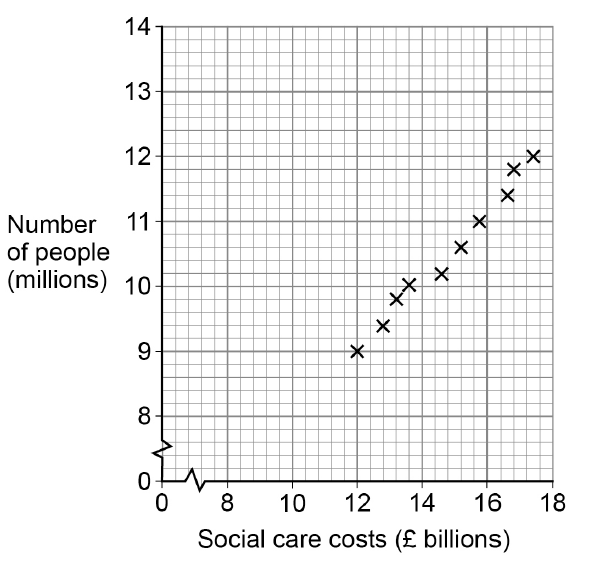
A researcher wanted to find out if there was any relationship between the number of people diagnosed with significant mental health conditions and the amount of money needed to pay for social care costs. He looked at the statistics published by the Office of National Statistics for the past 10 years. The scatter graph in Figure 1 shows the results of his research.

Figure 1: The annual number of people diagnosed with significant mental health conditions and the amount of money needed to pay for social care costs for each of the past 10 years.

Scatter graph of ten paired values: social care costs from £12 to £17.5 billion and diagnosed people from 9 to 12 million. The horizontal axis runs 0–18 billion; the vertical axis runs 0, then 8–14 million.

Identify the type of correlation the researcher found.

  • Negative correlation

  • No correlation

  • Positive correlation

  • Weak correlation

34b
2 marks

State whether the data collected by the researcher was primary or secondary.

Explain your answer.

34c
4 marks

Outline two weaknesses of correlations.

35a
1 mark

Read the following information.

A researcher wanted to investigate whether the timing of the school day affected student attendance. The head teacher at a local school allowed him to carry out an experiment with all 190 Year 9 students over an eight-week period.

In the first part of the experiment, the school day began at 8.30 am and finished at 3.30 pm for four weeks (the early start condition).

In the second part of the experiment, the school day began at 10.00 am and finished at 5.00 pm for four weeks (the late start condition).

The researcher recorded the total number of school days missed for Year 9 students during the first and second parts of the experiment.

Identify the independent variable in this experiment.

35b
1 mark

Identify the dependent variable in this experiment.

35c
2 marks

Write a null hypothesis that the researcher can use in this experiment.

35d
2 marks

Table 2: Total number of days missed by 190 Year 9 students in the early and late start conditions.

Early start condition

Late start condition

Total number of days missed

266

76

Table 2 shows the total number of days missed by 190 Year 9 students in the early and late start conditions.

Calculate the mean number of days missed by students in the late start condition.

Show your workings.

35e
4 marks

The mean for the early start condition was 1.4

Use this mean and your calculated mean from question 35d to sketch a suitable graph to show the mean number of days missed by each student in the early and late start conditions.

Label the axes and provide a suitable title for your graph.

35f
2 marks

The researcher used a repeated measures experimental design. He also used counterbalancing.

Explain why researchers often use counterbalancing with a repeated measures experimental design.

35g
5 marks

This study is an example of a field experiment.

Evaluate the use of field experiments in psychological research.

35h
6 marks

The psychologist wanted to interview a sample of the students in his experiment to find out how they felt about starting school earlier and later in the day. He thought about using either opportunity or systematic sampling to get his sample of students.

Outline both opportunity and systematic sampling.

Compare the use of these sampling methods using your knowledge of their strengths and/or weaknesses.

36a
4 marks

You have been asked to research the effectiveness of self-management programmes as an intervention for addiction.

Explain how you would use interviews to do this research.

You need to include the following information in your answer:

  • who your target population would be

  • what your sampling method would be and how you would select your sample using this method

  • an appropriate interview question you could use in your research.

36b
1 mark

Anonymity means that a person cannot be identified and the information they share cannot be connected to them. Self-management programmes for addiction usually allow the people who attend them to be anonymous.

People often do not want to take part in research if their identity is going to be revealed.

Identify an appropriate way of dealing with the ethical issue of anonymity in the research you described in 36a.

37a
6 marks

You have been asked to design an experiment to investigate the effect of anonymity on conformity.

In your answer outline the following information:

  • what your independent and dependent variables would be

  • one thing you would do to standardise your procedure and why this would benefit your research

  • the results you would expect to find from your experiment.

37b
4 marks

When carrying out the experiment you have outlined in your answer to Question 37a, you should consider ethical issues.

Identify two ethical issues that you would need to consider.

Suggest one appropriate way of dealing with each of the issues you identify.

38
6 marks

You have been asked to investigate the effect of context on the accuracy of memory.

Describe how you would design an experiment to do this.

You need to include the following information in your answer:

  • what you would ask participants to do and what data you would collect

  • one extraneous variable that could affect your results and how you could control it

  • the results you would expect to find from your experiment.

39
2 marks

Explain one strength of using laboratory experiments in research.

40
2 marks

Which two of the following are commonly understood to be advantages of case studies?

A

The conclusions drawn are objective.

B

The findings can be easily generalised to the behaviour of other people.

C

They are easy for others to replicate.

D

They can be used to study rare and unusual behaviours.

E

They provide rich and detailed information.

41
9 marks

Outline what is meant by independent groups and repeated measures.

Discuss the strengths and weaknesses of both of these types of experimental design.

42
6 marks

You have been asked to investigate the effect of motivation on perception.

Explain how you would design an experiment to do this.

You need to include the following information in your answer:

  • the experimental design you would choose and why this would be suitable

  • what you would ask the participants to do and what data you would collect

  • the results you would expect to find from your experiment.

43
4 marks

A researcher is going to carry out a questionnaire to find out if university students are addicted to harmful substances. All the students have been given full details about the study and have consented to take part.

Use your knowledge of psychology to:

  • write one appropriate question that the researcher could ask the university students

  • identify one ethical issue, apart from informed consent, that the researcher needs to address in this study. Explain how he could deal with the issue you identify.