I–V Graphs (AQA GCSE Combined Science: Trilogy: Physics): Revision Note
Exam code: 8464

Ohm's Law
Ohm's law states that:
The current through an ohmic conductor is directly proportional to the potential difference across it, provided the temperature stays constant
Electrical conductors that obey Ohm's Law are referred to as ohmic conductors
Examples of ohmic conductors are:
Fixed resistors
Wires
Ohm's Law is represented by the equation V = IR
If V and I are directly proportional, this means that the resistance R remains constant
Ohm's Law is relevant only at constant temperatures
An ohmic conductor will have a current-voltage (I–V) graph that is a straight line through the origin

Reversing the potential difference (and direction of the current) makes no difference to the shape of the line; the potential difference and current values will just be negative
If the axis labels are swapped around (the current on the x-axis and p.d. on the y-axis), the graph will still be a straight line through the origin
Filament Lamps
A filament lamp is an example of a non-ohmic conductor
This means that the current and potential difference are not directly proportional
This is because the resistance of the filament lamp increases as the temperature of the filament increases
The I–V graph for a filament lamp shows the current increasing at a proportionally slower rate than the potential difference
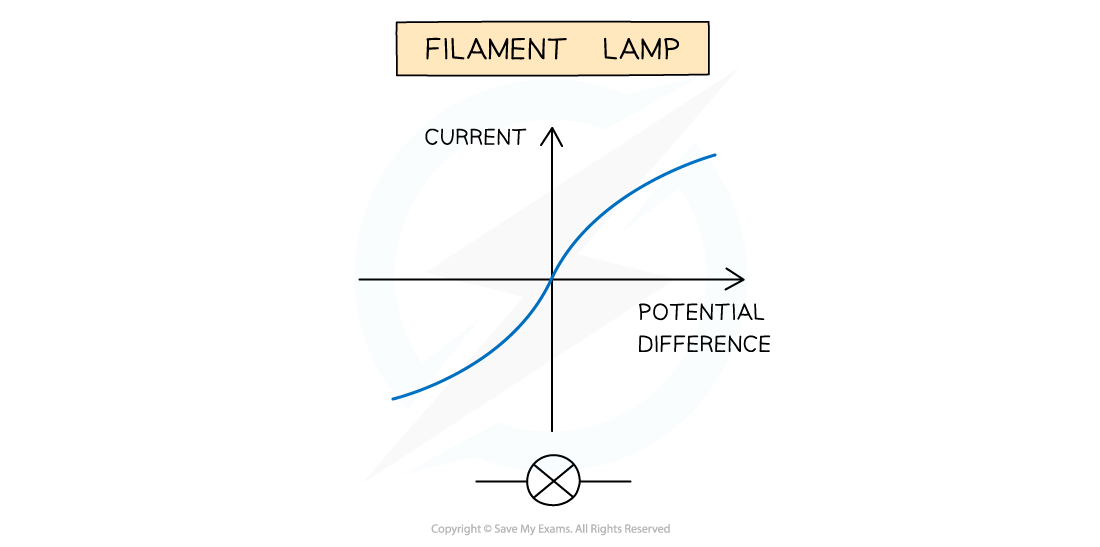
This is because:
As the current increases, the temperature of the filament in the lamp increases
The higher temperature causes the atoms in the metal lattice of the filament to vibrate more
This causes an increase in resistance as it becomes more difficult for free electrons (which carry the current) to pass through
Resistance opposes the current, causing the current to increase at a slower rate
Where the graph is a straight line, the resistance is constant
The resistance increases as the graph curves
On an I–V graph with current on the y-axis, a lower gradient means a higher resistance
Reversing the potential difference reverses the current
The curve for negative values is the same shape turned through the origin (a smooth curve that gets less steep as it moves away from the origin, in the opposite direction)
To find the resistance at a point, read the current and potential difference at that point and use
To compare two components, the one with the lower current for the same potential difference has the higher resistance
For example, a potential difference of 1.0 V and a current of 0.08 A gives
Resistance & Temperature
All solids are made up of vibrating atoms
The higher the temperature, the faster these atoms vibrate
Electric current is the flow of free electrons in a material
The electrons collide with the vibrating atoms more often, which impedes their flow
So, for the same potential difference, the current is smaller, and the resistance is larger (from )
Therefore, an increase in temperature causes an increase in resistance
Examiner Tips and Tricks
If you are asked for the resistance at a point on a filament lamp graph, read off the current and potential difference at that point and use . Don't use the gradient of the curve, because that won't give you the right answer.
When you draw the curve for negative values, make sure it passes through the origin and keeps curving in the opposite direction. A line that becomes horizontal won't get you the mark.
Diodes
A diode is a non-ohmic conductor that allows current to flow in one direction only
This is called forward bias
In the reverse direction, the diode has very high resistance, and therefore no current flows
This is called reverse bias
The I–V graph for a diode is slightly different:
When the current is in the direction of the arrowhead symbol, this is forward bias
This is shown by the sharp increase in potential difference and current on the right side of the graph
When the diode is switched around, this is reverse bias
This is shown by the current staying at zero (the graph lies along the potential difference axis) for all negative potential differences

An LED is a specific type of diode that emits light and works the same way as a normal diode
Examiner Tips and Tricks
If a question tells you an LED doesn't light because the cells in a torch are the wrong way round, explain that the LED has a very high resistance in the reverse direction, so there is no current. Don't say there is a gap in the circuit, because you won't get the mark for that.
Linear & Non-Linear Graphs
Circuit elements can be linear or non-linear
In maths, linear means the graph is a straight line
To know whether a circuit element is linear or non-linear, check whether its I-V graph is a straight line or not
Linear components have an I-V graph that is a straight line through the origin
Non-linear components have an I-V graph that is not a straight line
Linear components are said to obey Ohm's Law and have a constant resistance, whilst non-linear do not
Some components may be linear at low currents, then become non-linear as the current increases (and therefore a change in temperature)
For example, a fixed resistor at room temperature is linear, but when it becomes very hot it will become non-linear

Linear elements include:
Fixed resistors
Wires
Non-linear elements include:
Filament lamps
Diodes & LEDs
LDRs
Thermistors

Unlock more, it's free!
Join the 100,000+ Students that ❤️ Save My Exams
the (exam) results speak for themselves:

Was this revision note helpful?
Build on this topic
