Elastic Potential Energy (AQA GCSE Combined Science: Trilogy: Physics): Revision Note
Exam code: 8464

Elastic Potential Energy
What is Elastic Potential Energy?
Energy in the elastic potential store of an object is defined as:
The energy stored in an elastic object when work is done on the object
This means that any object that can change shape by stretching, bending or compressing can store energy in its elastic potential store (for example springs and rubber bands)
When a spring is stretched (or compressed), work is done on the spring which results in energy being transferred to the elastic potential store of the spring
When the spring is released, energy is transferred away from its elastic potential store
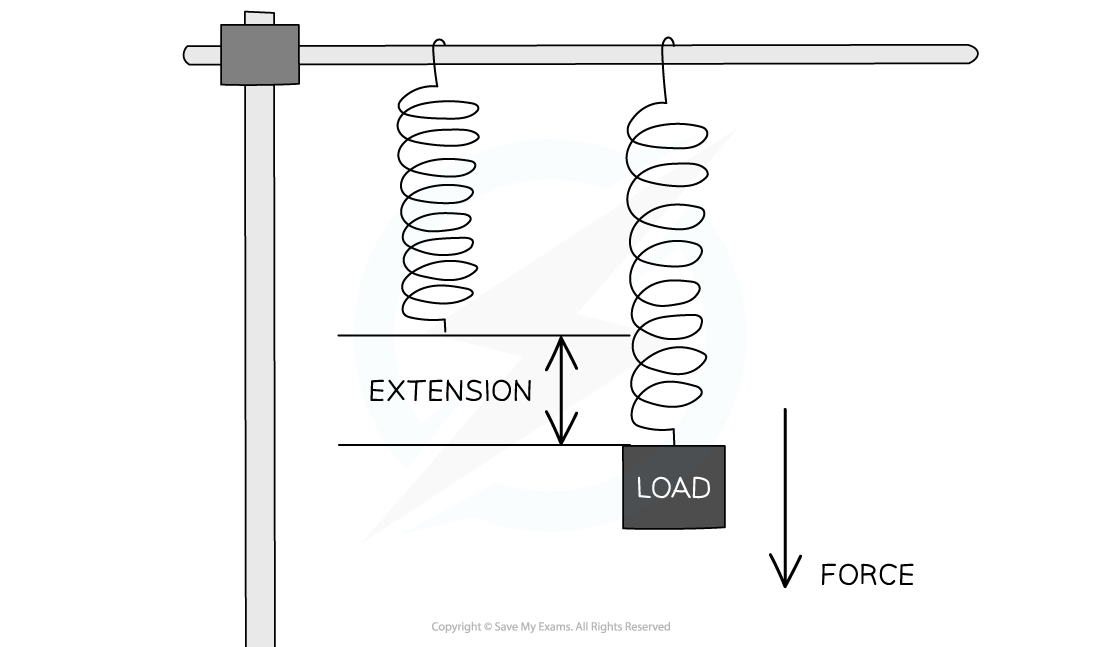
How to determine the extension, e, of a stretched spring
How to Calculate Elastic Potential Energy
The amount of elastic potential energy stored in a stretched spring can be calculated using the equation:
Where:
Ee = elastic potential energy in joules (J)
k = spring constant in newtons per metre (N/m)
e = extension in metres (m), where extension = stretched length − original length
The above elastic potential energy equation assumes that the spring has not been stretched beyond its limit of proportionality

The spring on the right has been stretched beyond the limit of proportionality
Worked Example
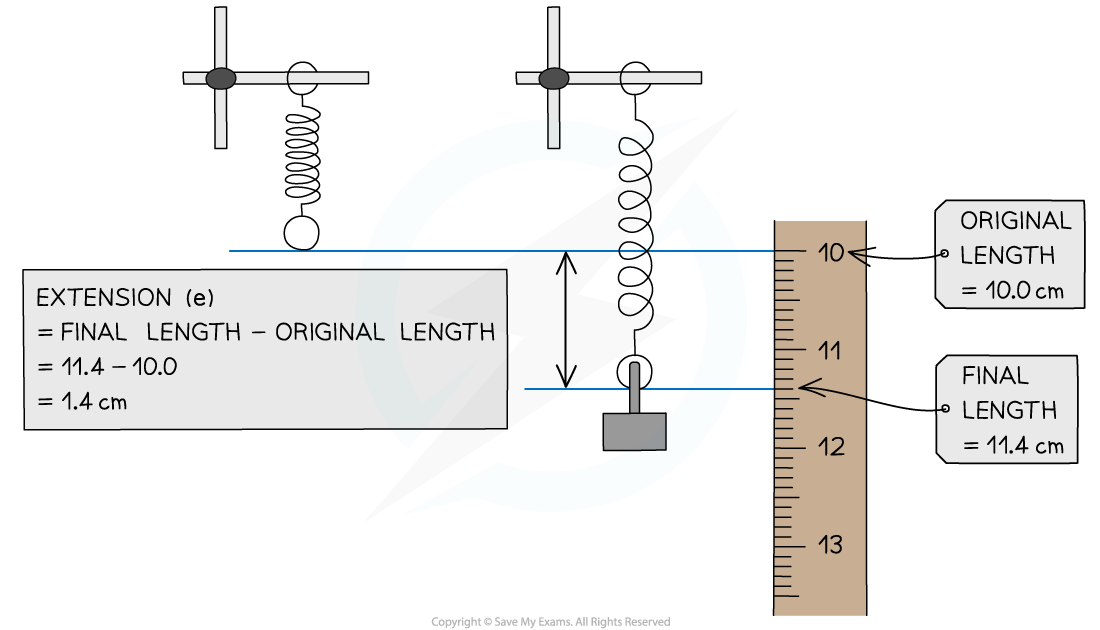
A mass is attached to the bottom of a hanging spring with a spring constant of 250 N/m. It stretches from 10.0 cm to 11.4 cm.
Calculate the elastic energy stored by the stretched spring.
Answer:
Step 1: Determine the extension of the spring
The extension is how much longer the spring is than its original length:
Step 2: List the known quantities
Spring constant, k = 250 N/m
Extension, e = 1.4 cm
Step 3: Convert the extension into metres
The spring constant is in N/m, so the extension must be in metres. There are 100 cm in 1 m:
Step 4: Write down the elastic potential energy equation
This equation is given on the Physics Equations Sheet
Step 5: Substitute the known values and calculate the elastic potential energy
Square the extension first, then multiply by the spring constant and by ½
Step 6: Round the answer to 2 significant figures
The extension is given to 2 significant figures, so the answer is given to the same degree of accuracy
Examiner Tips and Tricks
Look out for units. If the question gives the extension in cm, you must convert it into metres for the calculation to be correct.
Remember to square the extension before multiplying by the spring constant. Only e is squared, not k or ½. Forgetting to square e is the most common mistake in this calculation. If you substitute the values first and then work out the answer, you still gain the substitution mark even if the final answer is wrong
To change the shape of an object, two contact forces must be acting on the object in different directions. In this case, the spring is attached to the arm of the clamp providing a contact force, and the mass is attached to the spring providing a contact force. These forces pull the spring in opposite directions and this is the reason that the spring stretches. The forces and energy topics are linked by the concept of work done which is a force acting over a distance, and also the energy transferred. Making links between concepts is an important way to fast-track your understanding.

Unlock more, it's free!
Join the 100,000+ Students that ❤️ Save My Exams
the (exam) results speak for themselves:

Was this revision note helpful?
Build on this topic