Kinetic Energy (AQA GCSE Combined Science: Trilogy: Physics): Revision Note
Exam code: 8464

Kinetic Energy
Energy in the kinetic store is defined as:
The amount of energy an object has as a result of its mass and speed
This means that any object in motion has energy in its kinetic store
If an object speeds up, energy is transferred to its kinetic store
If an object slows down, energy is transferred away from its kinetic store
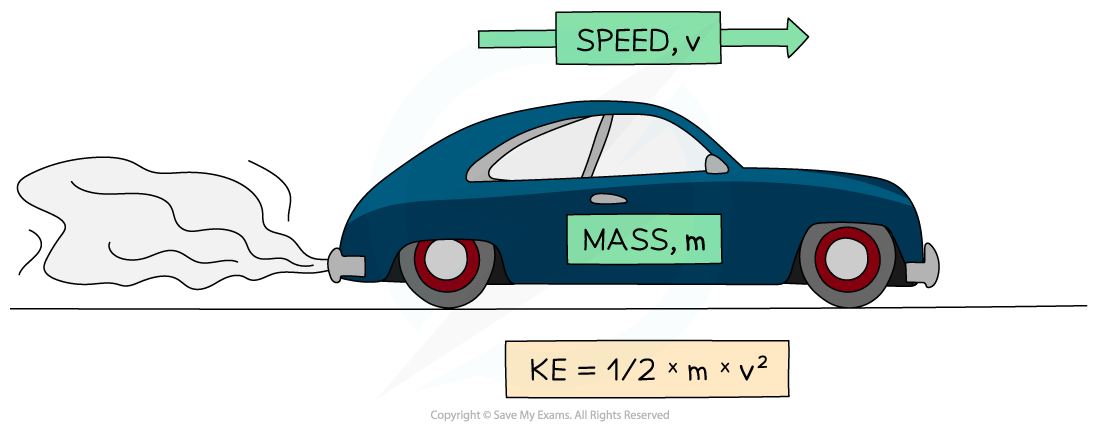
Kinetic energy can be calculated using the equation:
Where:
Ek = kinetic energy in joules (J)
m = mass of the object in kilograms (kg)
v = speed of the object in metres per second (m/s)
Kinetic energy is proportional to the square of the speed
If the speed doubles, the kinetic energy increases by a factor of four
If the speed halves, the kinetic energy decreases by a factor of four
Kinetic energy is directly proportional to mass
If the mass doubles at the same speed, the kinetic energy doubles
Worked Example
Calculate the kinetic energy stored in a vehicle of mass 1200 kg moving at a speed of 27 m/s.
Answer:
Step 1: List the known quantities
Mass of the vehicle, m = 1200 kg
Speed of the vehicle, v = 27 m/s
Note: Both values are already in the units the equation needs (kg and m/s), so no conversions are needed
Step 2: Write down the equation for kinetic energy
This equation is given on the Physics Equations Sheet
Step 3: Substitute the known values and calculate the kinetic energy
Square the speed first, then multiply by the mass and by ½
Step 4: Round the final answer to 2 significant figures
The input values are given to 2 significant figures, so the answer can only be given to the same degree of accuracy
Worked Example
A skateboarder has a kinetic energy of 270 J and a speed of 3.0 m/s. Calculate the mass of the skateboarder.
Answer:
Step 1: List the known quantities
Kinetic energy, Ek = 270 J
Speed, v = 3.0 m/s
Step 2: Write down the equation for kinetic energy
Step 3: Rearrange the equation to make mass the subject
Multiply both sides by 2:
Divide both sides by v2:
Step 4: Substitute the known values and calculate the mass
Remember to square the speed before you divide
Examiner Tips and Tricks
When performing calculations using the kinetic energy equation, always double-check that you have squared the speed. Forgetting to do this is the most common mistake that students make. Two other common slips are leaving out the ½ and writing kinetic energy as mass × speed. The equation is given on the Physics Equations Sheet, so copy it carefully.
Always square the speed before you multiply by the mass
Do not leave out the ½ and do not use Ek = m × v
If the question gives you the kinetic energy, substitute it into the equation and solve for the unknown
Check the unit of each value before you substitute

Unlock more, it's free!
Join the 100,000+ Students that ❤️ Save My Exams
the (exam) results speak for themselves:

Was this revision note helpful?
Build on this topic
