KE, GPE & EPE (AQA GCSE Combined Science: Trilogy: Physics): Revision Note
Exam code: 8464

KE, GPE & EPE
When a mass on a vertical spring oscillates up and down, energy is transferred between stores
Although the total energy of the mass-spring system will remain constant, it will have changing amounts of energy in its:
Elastic potential energy (EPE) store
Kinetic energy (KE) store
Gravitational potential energy (GPE) store
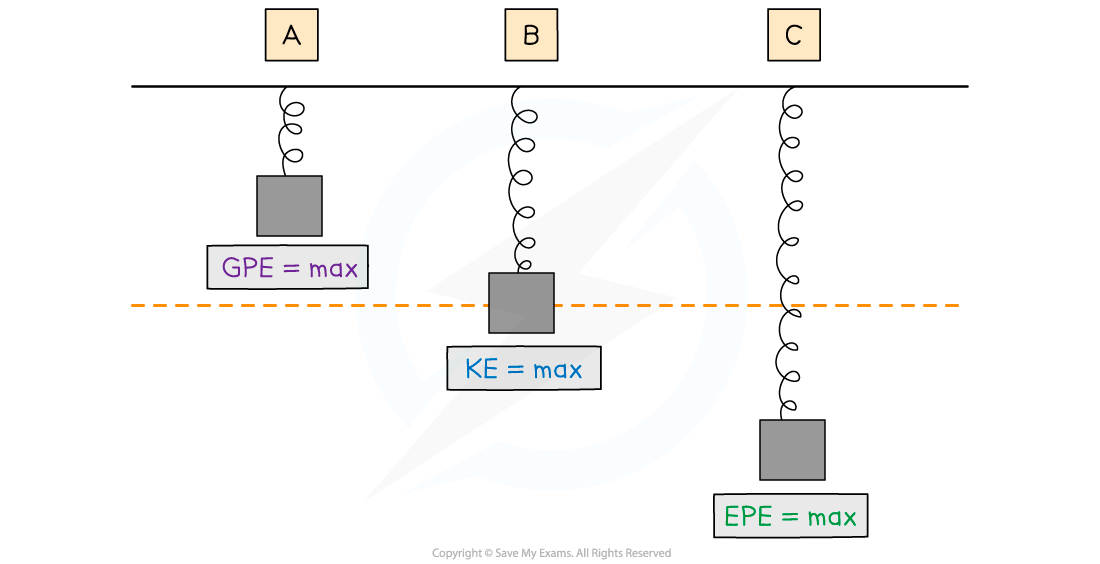
Energy changes when a spring is stretched
At position A:
The spring has some energy in its elastic potential store since it is slightly compressed
The spring has zero energy in its kinetic store since it is stationary
The amount of energy in its gravitational potential store is at a maximum because the mass is at its highest point
At position B:
The spring has some energy in its elastic potential store since it is slightly stretched
The energy in its kinetic store is at a maximum as it passes through its resting position at its maximum speed
The spring has some energy in its gravitational potential store since the mass is still above its lowest point in the oscillation
At position C:
The energy in the elastic potential store of the spring is at its maximum because it is at its maximum extension
The spring has zero energy in its kinetic store since it is stationary
The energy in the gravitational potential store of the spring is at a minimum because it is at its lowest point in the oscillation
Calculations involving KE, GPE and EPE
Energy is conserved, so the energy transferred away from one store is equal to the energy transferred to the other stores
This means the equation for one store can be set equal to the equation for another, then rearranged to find an unknown such as a speed, a height or a spring constant
Always check whether all of the energy is transferred or only a fraction of it
If only a fraction is transferred (for example 90%), multiply the energy by that fraction (0.9) before you use it in the next equation
The rest is dissipated to the surroundings, for example by air resistance or friction
A falling object: GPE → KE
As an object falls, energy is transferred from its gravitational potential store to its kinetic store
If all the energy is transferred (ignoring air resistance and friction):
The mass m cancels on both sides, so:
The speed depends on the vertical height fallen and the gravitational field strength, not on the mass
Any differences in real speeds are due to air resistance or friction
An object thrown upwards: KE → GPE
As an object rises, energy is transferred from its kinetic store to its gravitational potential store
At its maximum height it is momentarily stationary, so all the energy from its kinetic store has been transferred (ignoring air resistance):
Rearranging gives the maximum height for a launch speed v:
A spring launching an object: EPE → KE
When a stretched or compressed spring is released, energy is transferred from its elastic potential store to the kinetic store of the object it launches
The object reaches its maximum speed when all the energy in the elastic potential store has been transferred:
Find the elastic potential energy first, then rearrange the kinetic energy equation to find the speed
A falling object stretching a spring or cord: GPE → EPE
When a falling object is stopped by a spring or an elastic cord (for example a bungee jump), energy is transferred from its gravitational potential store to the elastic potential store of the cord
At the lowest point, the object is momentarily stationary, so (ignoring air resistance):
h is the total height fallen, but e is only the extension of the cord (the stretched length minus the unstretched length)
Worked Example
The diagram below shows a student before and after a bungee jump. The bungee cord has an unstretched length of 30.0 m.

The mass of the student is 60.0 kg. The gravitational field strength is 9.8 N/kg.
Calculate:
a) The change in gravitational potential energy of the student at 30.0 m
b) The maximum change in the gravitational potential energy of the student
c) The speed of the student after falling 30.0 m if 90% of the energy in the student's gravitational potential store is transferred to the student's kinetic store
d) The spring constant of the bungee cord if all the energy in the gravitational potential store of the student is transferred to the elastic potential store of the bungee cord
Answer:
Part (a)
Step 1: List the known quantities
Mass of the student, m = 60.0 kg
Gravitational field strength, g = 9.8 N/kg
Change in height, h = 30.0 m
Step 2: Write down the equation for gravitational potential energy
Step 3: Substitute the known values and calculate the change in gravitational potential energy
Part (b)
Step 1: List the known quantities
Mass of the student, m = 60.0 kg
Gravitational field strength, g = 9.8 N/kg
The maximum change in height is the distance from the bridge to the lowest point of the jump, h = 75.0 m
Step 2: Substitute the known values into the same equation and calculate the maximum change in gravitational potential energy
Part (c)
Step 1: List the known quantities
Mass of the student, m = 60.0 kg
Change in gravitational potential energy after falling 30.0 m, Ep = 17 640 J (from part (a))
Step 2: Calculate the energy transferred to the kinetic store
Only 90% of the energy in the gravitational potential store is transferred to the kinetic store, so multiply by 0.9 (90% as a decimal):
Step 3: Write down the equation for kinetic energy
Step 4: Rearrange the equation to make speed the subject
Multiply both sides by 2:
Divide both sides by m:
Take the square root of both sides:
Step 5: Substitute the known values and calculate the speed
Part (d)
Step 1: List the known quantities
Maximum change in gravitational potential energy, Ep = 44 100 J (from part (b))
All of this energy is transferred to the elastic potential store of the cord, so at the lowest point Ee = 44 100 J
Step 2: Determine the extension of the bungee cord
The extension is the stretched length minus the unstretched length of the cord:
Step 3: Write down the equation for elastic potential energy
Step 4: Rearrange the equation to make the spring constant, k, the subject
Multiply both sides by 2:
Divide both sides by e2:
Step 5: Substitute the known values and calculate the spring constant
Worked Example
A toy car is launched by a spring with k = 64 N/m compressed by 0.075 m. The car has mass 0.052 kg.
Calculate the maximum speed of the car.
Answer:
Step 1: List the known quantities
Spring constant, k = 64 N/m
Compression, e = 0.075 m
Mass of the car, m = 0.052 kg
Step 2: Calculate the energy stored in the elastic potential store of the spring
The elastic potential energy equation works for a compression in the same way as for an extension
Step 3: Link the elastic potential energy to the kinetic energy
The car has its maximum speed when all the energy in the elastic potential store of the spring has been transferred to the kinetic store of the car:
Step 4: Rearrange the kinetic energy equation to make speed the subject
Step 5: Substitute the known values and calculate the speed
Examiner Tips and Tricks
Check how much of the energy is transferred before you copy a value across. If all the energy in the gravitational potential store is transferred to the kinetic store, the two values are equal. If only a fraction is transferred (for example 80%), multiply the energy transferred by that fraction. Use your answer from the previous part and show it, because marks can be awarded for following your own earlier answer through
Square the extension. Substitute the numbers first, then rearrange. Show every step: an answer with no working does not score full marks

Unlock more, it's free!
Join the 100,000+ Students that ❤️ Save My Exams
the (exam) results speak for themselves:

Was this revision note helpful?
Build on this topic
