Required Practical: Investigating Specific Heat Capacity (AQA GCSE Combined Science: Trilogy: Physics): Revision Note
Exam code: 8464

Required Practical 1: Investigating Specific Heat Capacity
Aims of the Experiment
The aim of the experiment is to determine the specific heat capacity of a substance, by linking the amount of energy transferred to the substance with the rise in temperature of the substance
Variables:
Independent variable = Time, t
Dependent variable = Temperature, θ
Control variables:
Material of the block
Mass of the block, m
Current supplied, I
Potential difference supplied, V
Equipment List

Resolution of measuring equipment:
Thermometer = 1 °C
Stopwatch = 0.01 s
Voltmeter = 0.1 V
Ammeter = 0.01 A
Note: Resolution is the smallest change an instrument can show (the scale division) and is different from the range of the scale
Method
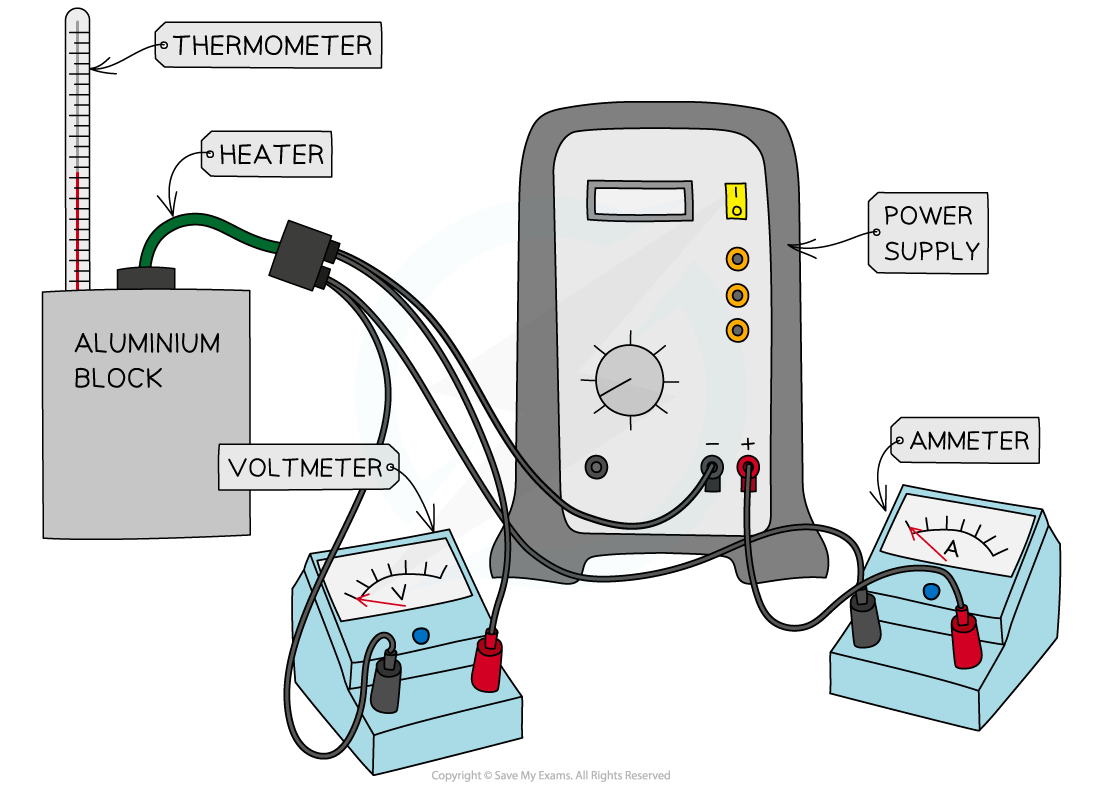
Apparatus to investigate the specific heat capacity of the aluminium block
Measure the mass of the aluminium block using a balance
Start by assembling the apparatus, placing the heater into the top of the block
Leave the thermometer in the block for a few minutes so that it reaches the same temperature as the block, then measure the initial temperature
Turn on the power supply and start the stopwatch
Whilst the power supply is on, the heater will heat up the block. Take several periodic measurements, e.g. every 1 minute, of the voltage and current from the voltmeter and ammeter, respectively, calculating an average for each at the end of the experiment up to 10 minutes
Switch off the power supply, stop the stopwatch, and leave the apparatus for about a minute. The temperature will still rise before it cools
Monitor the thermometer and record the final temperature reached for the block
Record the temperature at regular intervals (e.g. every minute) and plot a temperature–time graph
For the water variant, measure the mass of the empty beaker, add water and measure the mass again, then calculate:
Mass of water = total mass − mass of beaker
An example table of results might look like this:

Analysis of Results
The thermal energy supplied to the block can be calculated using the equations:
and
Where:
E = thermal energy, in joules (J)
Q = charge, in coulombs (C)
I = current, in amperes (A)
V = potential difference, in volts (V)
t = time, in seconds (s)
To combine the equations, first rearrange E = QV to make Q the subject
Substitute this into the Q = It equation
Rearrange to make E the subject
The change in thermal energy is defined by the equation:
Where:
∆E = change in energy, in joules (J)
m = mass, in kilograms (kg)
c = specific heat capacity, in joules per kilogram per degree Celsius (J/kg °C)
∆θ = change in temperature, in degrees Celsius (°C)
Rearranging for the specific heat capacity, c:
To calculate ∆θ:
Where:
θf = final temperature
θi = initial temperature
To calculate ∆E:
Where:
I = average current, in amperes (A)
V = average potential difference, in volts (V)
tf = final time, in seconds (s)
ti = initial time, in seconds (s)
These values are then substituted into the specific heat capacity equation to calculate the specific heat capacity of the aluminium block
Comparing your result with the accepted value:
Examiner Tips and Tricks
If you use a graph, take ∆θ for the time interval given or used for the energy calculation (final temperature − initial temperature over that interval), not the total rise from the start of the graph.
Evaluating the Experiment
Improving the accuracy of the result:
Make sure the voltmeter and ammeter are initially set to zero to avoid zero error
Not all the energy transferred from the heater will be transferred to the block; some will be dissipated to the surroundings, and some will be transferred to the thermometer (also part of the surroundings)
This means the measured value of the specific heat capacity is likely to be higher than what it actually is
To reduce this effect, make sure the block is fully insulated
A joulemeter could be used to calculate energy directly
This would eliminate errors from the voltmeter, ammeter and the stopwatch
Make sure the temperature value is read at eye level from the thermometer to avoid parallax error
Extending the experiment:
The experiment can also be repeated with a beaker of water of equal mass, the water should heat up slower than the aluminium block
Safety Considerations
Hazard: the heater and hot water or hot block
Risk: burns or scalds to skin
Run any burns immediately under cold running water for at least 10 minutes
Allow time for all the equipment, including the heater, wire and block to cool before packing away the equipment
Keep water away from all electrical equipment
Wear eye protection if using a beaker of hot water
Examiner Tips and Tricks
This required practical is examined often, so make sure you understand the equipment, the set-up and how each measurement is taken. If you have not done it hands-on, work through the method and the measurements step by step
The main idea is that the measurements of current and potential difference allow you to calculate the energy transferred to the metal block, and from there you can use the change in temperature and the energy supplied to calculate the specific heat capacity of the metal.
When asked for a hazard, name the object or situation (hot water, heater, spilt water). A risk (burn, scald, electric shock) or a precaution on its own would not score the mark.

Unlock more, it's free!
Join the 100,000+ Students that ❤️ Save My Exams
the (exam) results speak for themselves:

Was this revision note helpful?
Build on this topic