11 mark
Which row compares the ionic radius and atomic radius of sodium and sulfur?
ionic radius | atomic radius | |
|---|---|---|
A | Na+ < S2- | Na < S |
B | Na+ < S2- | Na > S |
C | Na+ > S2- | Na > S |
D | Na+ > S2- | Na < S |
Was this exam question helpful?
Exam code: 9701
Which row compares the ionic radius and atomic radius of sodium and sulfur?
ionic radius | atomic radius | |
|---|---|---|
A | Na+ < S2- | Na < S |
B | Na+ < S2- | Na > S |
C | Na+ > S2- | Na > S |
D | Na+ > S2- | Na < S |
Was this exam question helpful?
The trends in three physical properties of the elements of Period 3 are shown in the graphs.

Which physical property is not shown?
Electrical conductivity
Atomic radius
Melting point
First ionisation energy
Was this exam question helpful?
Which graph shows the electronegativity of the elements Na, Mg, Al and Si, from Period 3, plotted against their first ionisation energies?


Was this exam question helpful?
Consecutive elements X, Y and Z are in Period 3. Element Y has the highest first ionisation energy and the lowest melting point of these three elements.
Which row identifies elements X, Y and Z?
silicon, phosphorus, sulfur
sodium, magnesium, aluminium
aluminium, silicon, phosphorus
magnesium, aluminium, silicon
Was this exam question helpful?
Which row correctly describes the physical properties of the substance?
substance | melting point | conductivity of solid | conductivity when added to water | |
|---|---|---|---|---|
A | Al | high | good | good |
B | NaCl | high | good | good |
C | SiO2 | high | poor | good |
D | SO3 | low | poor | good |
Al
Was this exam question helpful?
Which metal has the highest melting point?
Na
Mg
K
Al
Was this exam question helpful?
The graph shows the values of log ionisation energy for the first eight ionisation energies of an element X from Period 3.
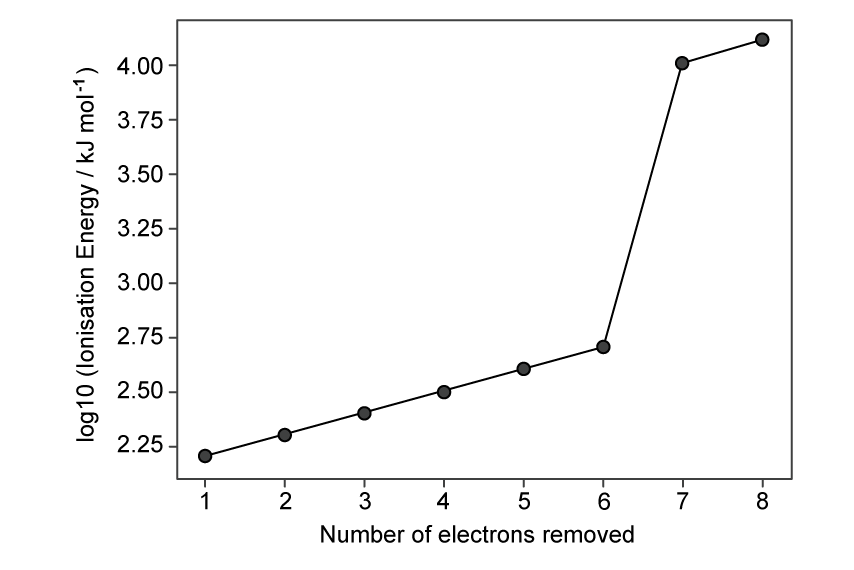
Which statement about element X is correct?
it reacts with excess hot NaOH (aq) to produce hydrogen gas
its highest oxidation state in a compound is +6
it forms a giant covalent oxide that is insoluble in water
its first ionisation energy is higher than that of the element immediately to its right in the Periodic Table
Was this exam question helpful?
A student investigated the chloride of a Period 3 element and made the following observations:
The compound was a white crystalline solid.
It dissolved easily in water to give a solution of pH 12.
When placed in a test-tube and heated in a roaring Bunsen flame, the compound melted after several minutes of heating.
What can be deduced from these observations?
At least one of the recorded observations is incorrect
The compound is sodium chloride, NaCl
The compound is silicon tetrachloride, SiCl4
The compound is phosphorus pentachloride, PCl5
Was this exam question helpful?
Which element has the third lowest first ionisation energy in its period and the third smallest atomic radius in its group?
magnesium
boron
sodium
calcium
Was this exam question helpful?
Which row describes a substance with a giant covalent structure?
conductivity of solid | MP / K | BP / K | |
|---|---|---|---|
A | poor | 388 | 718 |
B | good | 923 | 1363 |
C | good | 3031 | 2943 |
D | poor | 1986 | 2950 |
Was this exam question helpful?