Structure & Function of the Nervous System (AQA GCSE Psychology): Exam Questions

Exam code: 8182

56 mins13 questions
1
4 marks

Read the following conversation.

Arun: Today, we learned that the central nervous system is made up of the brain and spinal cord. Did you know that even though the brain is only 2% of the total body mass, it uses 20% of the oxygen that we breathe in?

Dad: I didn’t know that. What else did you learn?

Arun: We learnt that damage to the central nervous system can cause lots of different problems including difficulty concentrating and making decisions. Other signs of damage would be numbness and difficulties in moving the arms or legs.

Dad: It sounds like the central nervous system has some very important functions.

Briefly outline the basic functions of the central division of the human nervous system.

Refer to the conversation to support your answer.

2
6 marks

Describe and evaluate the James-Lange theory of emotion.

3
1 mark

Which one of the following statements about the human nervous system is correct? Shade one box only.

  • The autonomic nervous system is responsible for thinking

  • The central nervous system is part of the peripheral nervous system

  • The peripheral nervous system consists only of relay neurons

  • The somatic nervous system consists of sensory and motor neurons

4
6 marks

Read the item and then answer the questions that follow.

Sam was walking home at night alone. Suddenly, he heard a sound behind him. His heart started to beat faster and he began to run to the bus stop. He then heard a voice shouting, ‘Wait for me Sam!’ Sam turned to see his friend Neil running along the street, trying to catch up with him. Sam stopped and his breathing slowed as he waited for Neil. ‘I am glad to see it’s you, Neil,’ said Sam.

Use your knowledge of the actions of both the central nervous system and the autonomic nervous system to explain Sam’s experience.

5
6 marks

Outline the structure and function of the central nervous system (CNS) and the peripheral nervous system (PNS).

6
4 marks

Read the following information.

A researcher wanted to investigate the James–Lange theory of emotion, which suggests that physiological reactions happen before we experience an emotion. You have been asked to design a study to investigate if a physiological response occurs before a conscious emotional response when viewing a scary image.

Describe how you would design a study to do this. You need to include the following information in your answer:

  • what you would ask your participants to do

  • what data you would collect and a justification for why this should be collected

7
2 marks

Which two of the following statements about the James-Lange theory of emotion are correct?

A

The theory can be disproved by the real-life examples of phobias and panic disorders.

B

The theory does not suggest physiological changes are experienced at the same time as emotions.

C

The theory is based on results of laboratory experiments carried out by James Lange himself.

D

The theory suggests that our interpretation of physiological changes causes the emotions we experience.

E

The theory suggests we can experience emotion without any physiological changes.

8
4 marks

Outline two differences between the autonomic nervous system and the somatic nervous system.

9
4 marks

Imagine that one afternoon as you are walking along looking at your phone, you go to cross the road without looking and the driver of a car narrowly avoids you. As you step back onto the safety of the pavement, you realise that your mouth is very dry, you are sweating and your breathing and heart beat are both very fast.

Using your knowledge of the nervous system, explain why you are likely to be experiencing the described physical effects.

10
3 marks

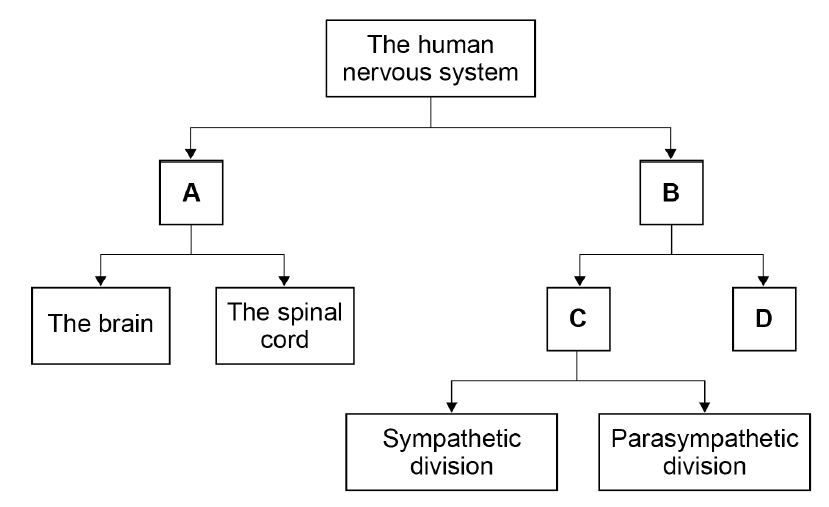
Look at the diagram of the divisions of the human nervous system in Figure 2 and answer the question that follows.

Figure 2

Flow diagram of the human nervous system: it branches to A and B; A branches to the brain and spinal cord, while B branches to C and D, and C branches to the sympathetic and parasympathetic divisions.

In Figure 2, four divisions of the human nervous system are labelled with the letters A, B, C and D.

Identify each of the divisions by placing the correct letter in the appropriate box in Table 2.

Use each letter only once.

Table 2

Name of the division of the human nervous system

Letter given in Figure 2

The autonomic nervous system

The central nervous system

The peripheral nervous system

The somatic nervous system

11
4 marks

Evaluate the James-Lange theory of emotion.

12
4 marks

Read the following information.

Rhys was walking to school on the morning of his psychology exam. He realised that he was breathing faster than normal and wondered if that was because he was in a hurry, or because he was worried about his exam. As he reached the school gates, Rhys noticed someone from his class he thought was really attractive. Even though he felt his heart start to beat faster and he started to sweat, he tried to look confident by smiling and standing up straight.

From the information, identify two examples of functions of the autonomic nervous system and two examples of functions of the somatic nervous system.

13a
2 marks

Read the following information.

Researchers wanted to understand more about how the fight or flight response affects heart rates. They asked 10 participants to wear heart monitors and to go on a roller coaster ride. The researchers recorded the beats per minute (bpm) of the participants’ heart rates at three different times. The first time was 20 minutes before the ride, the second time was halfway through the ride and the last time was just as the ride finished. The results from all three times are shown in Table 1.

Table 1: bpm recorded at each point of the roller coaster ride.

Participant

Before the ride

Halfway through the ride

As the ride finished

1

80

125

100

2

70

140

115

3

90

135

110

4

70

115

95

5

80

135

100

6

70

145

100

7

70

140

105

8

60

130

110

9

90

150

125

10

80

135

105

Calculate the mean for the participants’ bpm recordings taken 20 minutes before the ride. Show your workings.

13b
1 mark

What is the median for the participants’ bpm recordings taken when they were halfway through the ride?

13c
1 mark

Identify the mode for the participants’ bpm recordings taken when the ride had just finished.

  • 100

  • 105

  • 110

  • 115

13d
4 marks

Look at the changes in the heart rates recorded in Table 1. Use your knowledge of the fight or flight response to explain these changes.