Refractive Index (Oxford AQA IGCSE Physics): Revision Note
Exam code: 9203

Refractive Index
The refractive index is a number which is related to the speed of light in the material
The refractive index is:
always larger than 1
always less than the speed of light in a vacuum
different for different materials
has no units because it is a ratio
Objects which are more optically dense have a higher refractive index
For example, the refractive index is about 2.4 for diamond
Objects which are less optically dense have a lower refractive index,
For example, the refractive index is about 1.5 for glass
Calculating Refractive Index
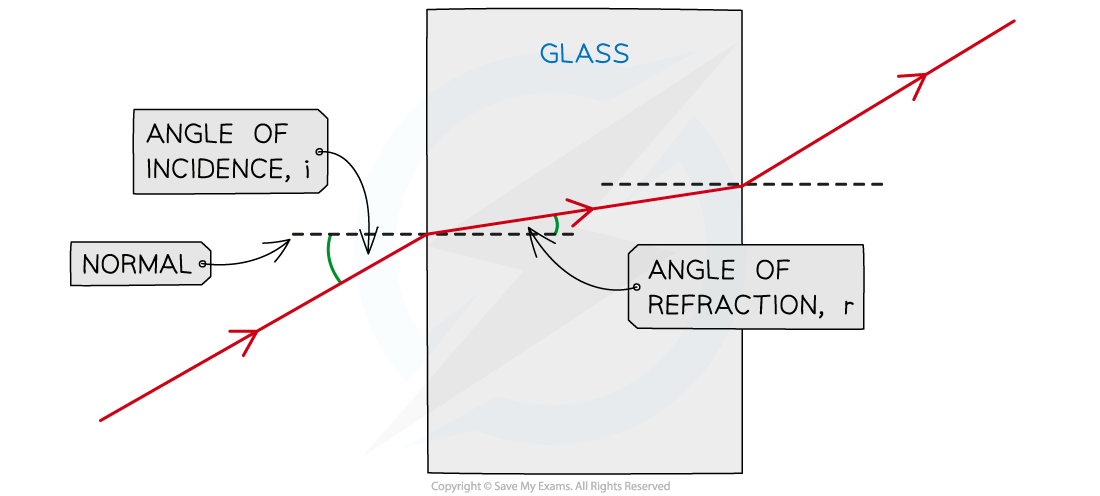
The refractive index can also be determined using the angle of incidence and the angle of refraction
Also known as Snell's law
Where:
n = the refractive index of the medium
i = the angle of incidence measured in °
r = the angle of refraction measured in °
Refraction ray diagram
Worked Example
A ray of light approaches a glass block with a refractive index of 1.53. The ray meets the glass at an angle of 15° to the normal.
Calculate the angle between the ray and the normal after it enters the glass block.
Answer:
Step 1: List the known quantities
Refractive index of glass, n = 1.53
Angle of incidence, i = 15°
Step 2: Write out the appropriate equation
Step 3: Rearrange the equation to make sin r the subject
Step 4: Find the angle of refraction by using the inverse sine function
Examiner Tips and Tricks
There are a lot of common errors that students make when performing these types of calculations. Here are some things to check if you got the wrong answer:
is not the same as
You cannot cancel the sine term
When multiplying or dividing with sine terms, make sure you close the bracket on your calculator to ensure you get the correct answer
Your calculator is in degrees and not radians mode
The inverse sine function, sin-1, is usually found by pressing 'shift' then 'sin' on your calculator

Unlock more, it's free!
Join the 100,000+ Students that ❤️ Save My Exams
the (exam) results speak for themselves:

Was this revision note helpful?