Cumulative Probability Distributions for Discrete Random Variables (College Board AP® Statistics): Study Guide

Discrete cumulative probability distributions
What is a discrete cumulative probability distribution?
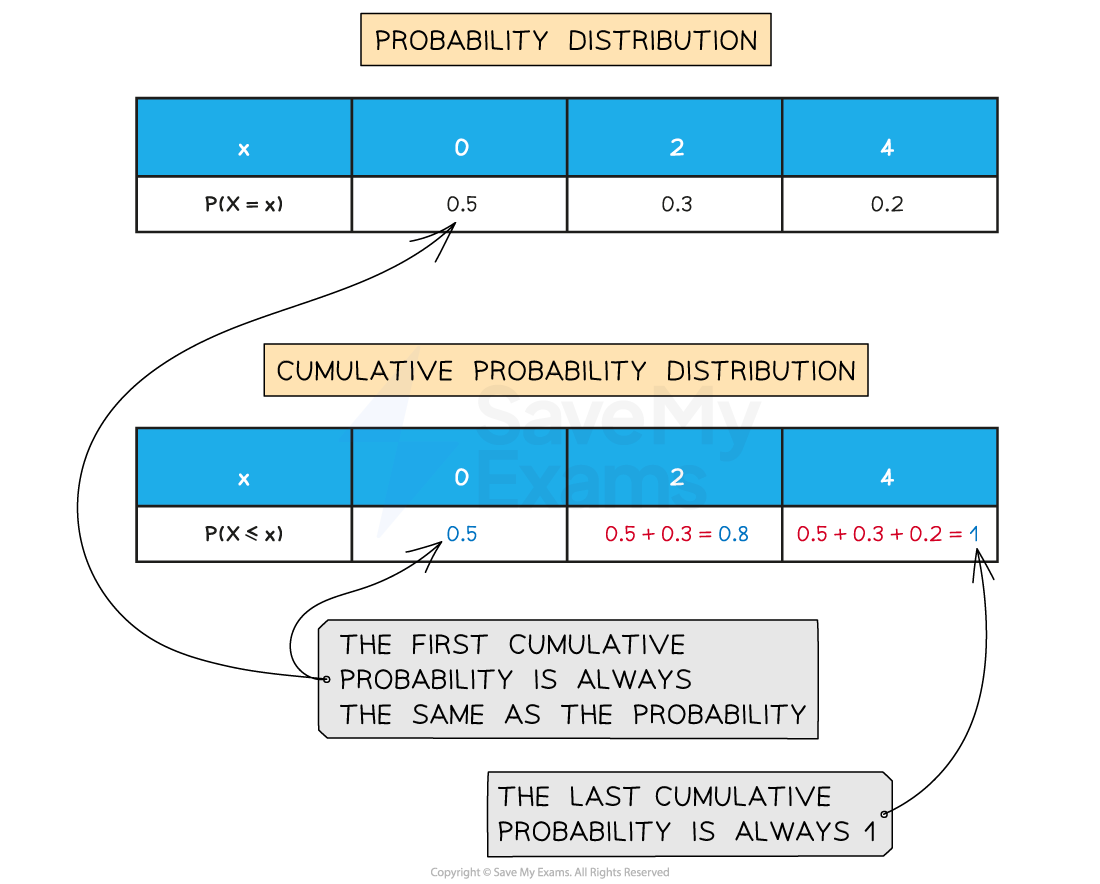
A discrete cumulative probability distribution shows the probability that a discrete random variable is less than or equal to each of its possible values
A discrete cumulative probability distribution can be given as either a table or a function
To find the cumulative probability
identify the values of the random variable that are less than or equal to the
add together the probabilities of these values
The cumulative probability of the smallest value is always equal to the probability of that value
e.g. if can only take the values 0, 2 or 4, then
The cumulative probability of the largest value is always equal to 1
e.g. if can only take the values 0, 2 or 4, then
How can I find probabilities using a cumulative probability distribution?
To find
if can take the value
read directly from the distribution
if cannot take the value
find the biggest value of that is less than
find the cumulative probability of this value
e.g. if can take the values, 1, 2, 3 or 5 then
To find
find the biggest value of that is less than
find the cumulative probability of this value
e.g. if can take the values, 1, 2, 3 or 5 then
To find use the identity
To find use the identity
To find use the identity
Note that is not included in the second inequality
To find
find the biggest value of that is less than
find the cumulative probability of this value
subtract this probability from
e.g. if can take the values, 1, 2, 3 or 5 then
Worked Example
is a discrete random variable that can take any positive integer value. The cumulative probability distribution is given by the function , where is a positive integer.
(a) Find .
(b) Find .
(c) What is the value of ?
(A)
(B)
(C)
(D)
Answer:
(a)
1 is the first positive integer and so is the smallest value that can take
Therefore
Substitute into the function
(b)
Use the identity
4 is the largest value that can take that is also less than 5
Substitute into the function
This is also so substitute into
(c)
cannot take the value of 3.5
3 is the largest value that can take that is also less than 3.5
Substitute into the function
The correct answer is B

Unlock more, it's free!
Join the 100,000+ Students that ❤️ Save My Exams
the (exam) results speak for themselves:

Was this revision note helpful?
Build on this topic