Estimating Probability using Relative Frequency (College Board AP® Statistics): Study Guide

Probability language & notation
What are trials, outcomes and events?
Key term | Definition | Examples |
|---|---|---|
Trial | An experiment that can be repeated | Rolling a biased dice and recording the number it lands on |
Outcome | The result of a trial | The possible outcomes of rolling a standard six-sided dice are 1, 2, 3, 4, 5, and 6 |
Event | A collection of any number of outcomes, it could contain none, one or all of the outcomes |
|
What is probability?
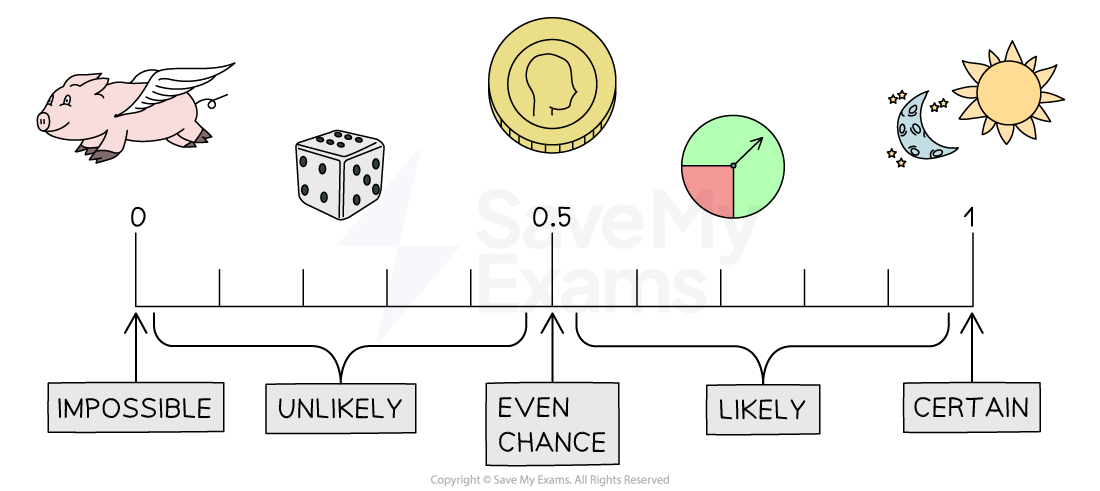
Probability is the likelihood of an event occurring
The probability of an event is denoted as
for any event
Probability is given as a numerical value between 0 and 1
means the event will definitely occur
means the event will definitely not occur
Relative frequency & the law of large numbers
How can probabilities be estimated?
If the actual probability of an event is unknown then it can be estimated using trials
The trials can be real-life observations or simulations
The probability is estimated by dividing the number of times an outcome in the event occurred by the total number of trials
This value is also called the relative frequency of the event or the empirical probability
Worked Example
A biased dice with faces labeled 1 to 6 is repeatedly rolled. The following table shows the number of times the dice landed on each face.
Label | 1 | 2 | 3 | 4 | 5 | 6 |
|---|---|---|---|---|---|---|
Frequency | 66 | 31 | 28 | 17 | 12 | 6 |
Find the relative frequency of the dice landing on a face labeled with a prime number.
Answer:
Identify the outcomes that are in the event
The event that the dice lands on a face labeled with a prime number contains the outcomes 2, 3 and 5
Find the number of times the dice landed on a face labeled with a prime number
Find the total number of times the dice was rolled
Find the relative frequency by dividing the number of times the dice landed on a face labeled with a prime number by the total number of times the dice was rolled
The relative frequency of the dice landing on a face labeled with a prime number is 0.44375
What is the law of large numbers?
The law of large numbers states that
as the number of trials increases
the relative frequency of an event tends to get closer to the actual probability of the event
One way to improve the estimate for a probability is to use more trials
Worked Example
Kai is investigating the probability that a surfer falls off their surfboard in Pe'ahi, Hawaii, during a big wave. Kai calculates the relative frequency for different numbers of attempts.
Number of attempts | 10 | 100 | 200 | 500 |
|---|---|---|---|---|
Relative frequency | 0.4 | 0.32 | 0.35 | 0.34 |
Which relative frequency is most likely to be the best estimate for the probability that a surfer falls off their surfboard during a big wave?
(A) 0.4
(B) 0.32
(C) 0.35
(D) 0.34
Answer:
The law of large numbers states that the relative frequency with the highest number of trials is most likely to be the best estimate for the probability
The correct answer is D
Simulations
How can I run a simulation?
STEP 1
Identify the random process and possible outcomesSTEP 2
Assign numerical values (from a random number generator, digit table, or fair die) to each outcomewith probabilities matching the real-world scenario
STEP 3
Run trials and record countsSTEP 4
Use the relative frequency as the estimated probability
Worked Example
A local coffee shop runs a promotional game where 30% of scratch-off tickets reveal a "Free Drink" prize, while the remaining 70% reveal "Please Play Again." A regular customer receives 5 scratch-off tickets during a given week.
Describe how to use a table of random digits to conduct a simulation to estimate the probability that the customer wins at least 2 free drinks from their 5 tickets.
Answer:
To properly simulate this random process using a table of random digits, follow these steps:
1. Assign digits to outcomes:
To represent the 30% chance of winning a free drink, assign the digits 0, 1, and 2 to represent a "Free Drink" winning ticket
Assign the remaining 70% of the digits (3, 4, 5, 6, 7, 8, and 9) to represent a "Please Play Again" losing ticket
2. Define a single trial:
Select a row in the random digit table and read 5 consecutive digits from left to right to represent the 5 tickets the customer receives
Because each ticket's outcome is an independent chance event, random digits can be repeated (sampling with replacement)
3. Define the recorded variable:
For each trial of 5 digits, count the number of winning tickets (the number of 0s, 1s, and 2s)
Record a "Success" if the count is 2 or more, and a "Failure" if the count is 1 or 0
4. Estimate the probability using relative frequency:
Repeat this process for a large number of trials (e.g., 100 trials)
Calculate the estimated probability by finding the long-run relative frequency of successful trials: divide the total number of "Success" trials by the total number of trials conducted

Unlock more, it's free!
Join the 100,000+ Students that ❤️ Save My Exams
the (exam) results speak for themselves:

Was this revision note helpful?
Build on this topic