Randomized Block & Matched Pairs Design (College Board AP® Statistics): Study Guide

Randomized block design
What is a block?
A block is group of experimental units who have something in common (are similar) that may affect how they respond to a treatment
e.g. a group of participants who are smokers
Blocking is the act of dividing up the experimental units into different blocks
e.g. separating participants out into smokers and non-smokers
'smoking or not' is the blocking variable
Blocking should only be done if the researcher believes the blocking variable could affect the results
Why is blocking used?
How experimental units respond to treatments varies naturally due to many different factors (variables)
e.g. age, diet, weight, ....
Blocking allows natural variations in responses to treatments to be distinguished from those variations that were due to the blocking variable
It removes the blocking variable from the list of interfering factors
which gives a clearer picture of the effectiveness of the treatment
and makes any differences between treatments more distinguishable
What is a randomized block design?
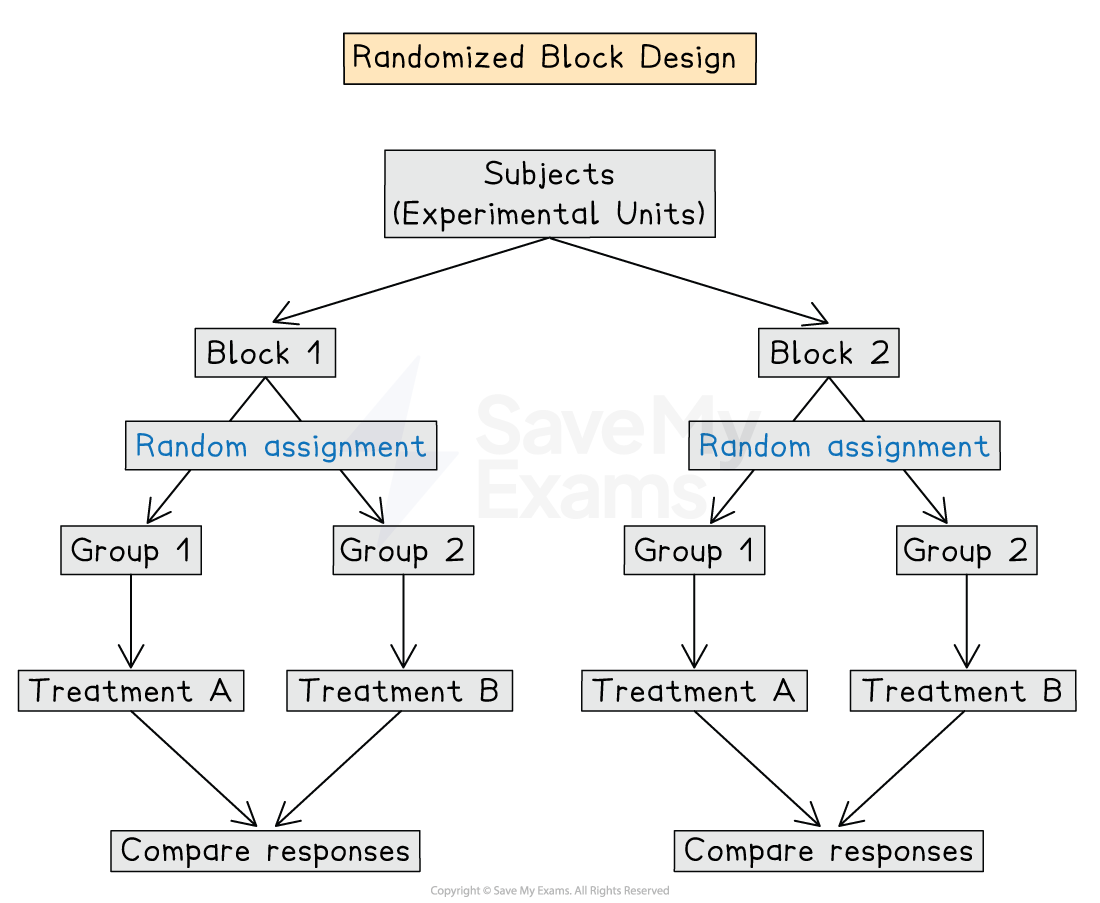
An experiment that has a randomized block design is one in which
experimental units are separated out into blocks
based on an identified blocking variable that could cause an issue
then experimental units are randomly assigned the different treatments within each block
Common methods for randomly assigning treatments can be used in each block
e.g. using random number generators or flipping a fair coin
If an experiment has more than two treatments
each block needs to be randomly assigned all of the treatments
Is a randomized block design better than a completely randomized design?
In general, a randomized block design is better than a completely randomized design
making it easier to distinguish the effectiveness of the treatment
from any differences caused by the blocking variable
However, completely randomized designs should be used
if blocking variables are unknown
or if the sample size is very large
because larger samples tend to introduce more blocking variables
which means more blocking is required
which ends up reducing the sample size within each block
Matched pairs design
What is a matched pairs design?
A matched pairs design is a special type of randomized block design
The blocks usually have only two experimental units each (a pair)
which are matched either naturally or by the researcher based on some common factor
e.g. matching pairs of individuals who have similar heights
The blocking variable here is height
The experiment has two treatments
These are randomly assigned within each pair
One of the pair receives the first treatment, the other receives the second
A single unit can be used
Each experimental unit serves as its own pair
The order of treatments is randomized
Examiner Tips and Tricks
Exam questions may use the word pairing instead of blocking.
How do I randomly assign treatments to each pair?
One way is to use a random number generator as follows
Label one of the pair as 1 and the other as 2
Use a random number generator to generate a number between 1 and 2
Give the first treatment to the experimental unit whose number is selected
Given the second treatment to the experimental unit whose number was not selected
Is a matched pair design better than a completely randomized design?
A matched pair design is better than a completely randomized design
as it makes it easier to distinguish the effectiveness of the treatment
by removing any effects due to the blocking variable
Worked Example
A sports researcher wants to compare two new running shoe designs (Design A and Design B) to determine which one produces faster 100-meter sprint times. The researcher has recruited 40 volunteer runners for the study. Twenty of the volunteers are trained sprinters, and the other 20 are trained long-distance runners.
Which of the following describes the most appropriate experimental design for this study and provides the correct justification?
(A) A completely randomized design, because randomly assigning the 40 runners to the two shoe designs will completely eliminate the effects of any confounding variables.
(B) A randomized block design with the running discipline (sprinter vs. long-distance) as the blocking variable, because it separates the variation in sprint times caused by the runners' previous training from the variation caused by the shoe designs.
(C) A randomized block design with the shoe design (Design A vs. Design B) as the blocking variable, because the shoe design is the explanatory variable being evaluated in the study.
(D) A matched-pairs design in which each trained sprinter is paired with a trained long-distance runner, and within each pair, the shoe designs are randomly assigned.
Answer:
The purpose of this design is to separate the variation in the response caused by the blocking variable from the rest of the extraneous variation, allowing for more precise comparisons of the treatments
Because trained sprinters will naturally have much faster 100-meter sprint times than long-distance runners, the running discipline is a massive source of extraneous variation
(A) is incorrect because while a completely randomized design (where treatments are assigned completely at random) balances out extraneous variables on average, it does not eliminate them
In a sample of 40 runners, random assignment could still result in an unbalanced group (e.g., one shoe design gets 15 sprinters while the other gets 5), making it an inferior design to blocking in this specific scenario
(C) features a common conceptual error
You block on an extraneous source of variation, not on the explanatory variable (the factor) being tested
(D) misapplies the definition of a matched-pairs design
In a matched-pairs design, experimental units must be paired by matching them on similar extraneous sources of variation
Pairing a sprinter with a distance runner creates highly heterogeneous pairs, defeating the entire purpose of the design
A valid matched-pairs design here would instead have each individual runner run in both shoe designs in a randomized order
The correct answer is B
Summary of the different types of design
Feature | Completely randomized design (CRD) | Randomized block design (RBD) | Matched pairs design | Stratified random sampling |
|---|---|---|---|---|
Type of Design | Experimental design | Experimental design | Experimental design | Sampling design |
Primary Purpose | To explore an investigative question by assigning treatments completely at random, which reduces the potential for confounding variables. | To separate the variation in the response caused by an extraneous variable (the blocking variable), which allows for more precise comparisons across treatments. | To compare exactly two treatments by matching experimental units on extraneous sources of variation. | To divide a population into groups to ensure a sample is selected properly from all subgroups. |
Role of "Groups" | There is no initial grouping of subjects; subjects are placed directly into treatment groups. | Experimental units are first grouped into homogeneous blocks according to similar values of an extraneous variable. | Experimental units are grouped into pairs of similar units, or a single experimental unit serves as its own pair. | The entire population is divided into non-overlapping, homogeneous groups called strata based on shared attributes. |
Randomization Process | Treatments are assigned to experimental units completely at random. | Treatments are randomly assigned to experimental units within each individual block so that all treatments occur within every block. | Within each pair, one treatment is randomly assigned to one member and the other treatment to the second member, or the order of treatments is randomized for a single unit. | A simple random sample is selected within each stratum and then combined to form one final sample. |
Examiner Tips and Tricks
Stratified sampling is a sampling method used to gather data from a population, whereas completely randomized design (CRD), randomized block design (RBD), and matched pairs are experimental designs used to assign treatments to experimental units. Students often confuse stratified sampling with randomized block designs because both involve dividing individuals into homogeneous groups based on shared characteristics. However, stratification is used to randomly select who is included in a study, while blocking is used to randomly assign treatments to subjects who are already in the study.

Unlock more, it's free!
Join the 100,000+ Students that ❤️ Save My Exams
the (exam) results speak for themselves:

Was this revision note helpful?
Build on this topic
