Conservation of Angular Momentum (College Board AP® Physics 1: Algebra-Based): Exam Questions

55 mins20 questions
1
Sme Calculator
1 mark
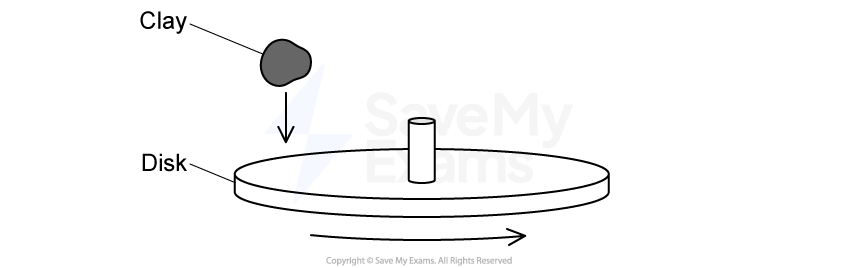
A ball of clay being dropped onto a disc spinning clockwise.

A small ball of clay is dropped from rest onto a large rotating disk, as shown in the figure. Following the collision, the clay sticks to the disk.

How does the total angular momentum and kinetic energy of the wheel-clay system change after the collision?

Angular Momentum

Kinetic Energy

A

Increases

Decreases

B

Increases

Remains Constant

C

Remains Constant

Decreases

D

Remains Constant

Remains Constant

    2
    Sme Calculator
    1 mark
    Diagram showing two masses, m, colliding with the ends of a rod of length L. Each mass moves with velocity v perpendicular to rod.

    Two objects each of mass m and speed v collide with the ends of a thin uniform rod of length L, as shown in the figure. After the collision, the objects remain stuck to the rod.

    Which of the following expressions represents the magnitude of the angular impulse exerted on the objects by the rod?

    • 14mvL

    • 12mvL

    • mvL

    • 2mvL

    3
    Sme Calculator
    1 mark
    Diagram showing a particle of mass m moving towards a vertical rod of length L. Distance from particle m to the top of the rod is 2L/3.

    A rigid rod of length L and mass M is initially at rest on a frictionless surface and not pivoted at any point. A small object of mass m, where m < M, moves perpendicular to the rod, as shown in the figure. The object hits and sticks to the rod at a distance 2L3 from the top end of the rod.

    Which of the following best describes the linear motion and rotational motion of the object-rod system after the collision?

    Linear motion

    Rotational motion

    A

    None

    About the center of mass of the rod

    B

    None

    About the center of mass of the object-rod system

    C

    In the same initial direction as the object

    About the center of mass of the rod

    D

    In the same initial direction as the object

    About the center of mass of the object-rod system

      4
      Sme Calculator
      1 mark
      A rod with length x pivoted at its left end.  A particle collides with the right end of the rod with initial momentum p_i upwards and rebounds with momentum p_f downwards.

      An object moving with linear momentum  pi collides with the end of a thin uniform rod of length x, as shown in the figure. After the collision, the object rebounds with linear momentum  pf, and the rod rotates about a pivot at its other end.

      Which of the following gives the magnitude of the angular momentum of the rod after the collision?

      •  pf  pi

      •  pf + pi

      • (pf  pi)x

      • (pf + pi)x

      5
      Sme Calculator
      1 mark

      A spherical star of mass M and radius R rotates about its axis. It has a rotational inertia of 25MR2. The star explodes, ejecting mass in space radially and symmetrically. The remaining star is left with a mass of 110M and a radius of 150R.

      What is the ratio of the star's final angular velocity to its initial angular velocity?

      • 125 000

      • 1500

      • 500

      • 25 000

      1
      Sme Calculator
      1 mark
      A disc rotating clockwise with linear speed v at the rim and a ball of clay; a black ball of clay moving up towards the rim of the disc at linear speed v/2.

      A system consists of a disk rotating on a frictionless axle and a ball of clay moving toward it, as shown in the figure. At time t = 0, the edge of the disk moves at a linear speed v, and the clay moves at speed 2v. At time t = t0, the clay sticks to the outside edge of the disk.

      Which of the following graphs could represent the angular momentum of the system as a function of time?

      • Graph of angular momentum versus time showing a constant non-zero angular momentum from t = 0 to t = t0 and beyond.
      • Graph of angular momentum versus time showing a constant non-zero angular momentum from t = 0 which decreases to a lower value at t = t0.
      • Graph of angular momentum versus time showing a constant non-zero angular momentum from t = 0 which increases to a higher value at t = t0.
      • Graph of angular momentum versus time showing a constant non-zero angular momentum from t = 0 to t = t0 which decreases linearly to zero after.
      2
      Sme Calculator
      1 mark

      A ball of mass 50 g is thrown at a door of mass 20 kg. The ball strikes the center of the door perpendicularly with a velocity of 20 m/s and rebounds at 15 m/s. The door has a height of 200 cm and a width of 80 cm.

      Taking the rotational inertia of the door about its hinges as 13ML2, which of the following is most nearly the angular speed of the door after the collision?

      • 0.02 rad/s

      • 0.08 rad/s

      • 0.16 rad/s

      • 0.40 rad/s

      3
      Sme Calculator
      1 mark
      Diagram of a swinging ball attached to a pole with a string, moving in a circular path. The radius of the circle is labeled r, and velocity is represented by v.

      A tetherball is suspended from the top of a vertical stationary pole by a massless rope, as shown in the figure. The ball is given an initial speed vand the rope starts to wrap around the pole. The rotational inertia of the ball is mr2, where r is the distance between the ball and the pole.

      Which of the following correctly represents the speed of the ball when the rope has become wrapped around the pole such that the distance between the ball and the pole has reduced by half?

      • 14v

      • 12v

      • 2v

      • 4v

      4
      Sme Calculator
      1 mark

      A pottery wheel with a rotational inertia of 8.2 kg·m2 rotates at a constant rate of 22 rpm. The artist drops a lump of clay of mass 1.8 kg on the wheel, where it sticks at a distance of 46.0 cm from the axis of rotation.

      If no net external torque acts on the system, which of the following is most nearly the angular speed of the wheel after the clay is dropped on it?

      • 2.1 rad/s

      • 2.2 rad/s

      • 2.3 rad/s

      • 2.4 rad/s

      5
      Sme Calculator
      1 mark

      According to the accretion model of the Solar System, the planets formed from a slowly rotating nebula that collapsed under gravity.

      Which of the following correctly describes why planets spin faster than the original nebula?

      • As the nebula collapses, the gravitational forces between the particles increase, causing the net torque on the nebula to increase

      • As the nebula collapses, the gravitational forces between the particles increase, increasing the angular momentum of the system

      • As the nebula collapses, the rotational inertia decreases, and the angular momentum remains constant

      • As the nebula collapses, the rotational inertia increases, causing an increase in angular acceleration

      1
      Sme Calculator
      1 mark
      Diagram of a car driving on a circular track with radius r and speed v. Geometrical lines and angles are shown indicating distances from the track's center.

      A circular track of mass M is placed on a massless horizontal ring which is free to rotate about a frictionless vertical axis, as shown in the figure. A battery-driven toy car of mass m is initially at rest on the track. As the car begins to move, it causes the track to rotate in the opposite direction. When the car moves with linear speed v, the angular speed of the ring is ω. The distance from the axis to the ring's outer edge is r and to the ring's inner edge is 35r. The rotational inertia of the track-ring system is I = 12M(r12 + r22), where r1 is the inner radius and r2 is the outer radius.

      Which of the following expressions correctly represents the angular speed of the ring ω?

      • 5mv8Mr

      • 15mv17Mr

      • 20mv17Mr

      • 25mv17Mr

      2
      Sme Calculator
      1 mark
      Diagram showing a circle with radius 'r'. An object with mass 'm' and velocity 'v' is moving towards the circle from the left.

      An object of mass m and speed v collides and sticks to the rim of a wheel of radius r and rotational inertia 12Mr2 which is free to rotate about a frictionless axle at its center, as shown in the figure. Before the collision, the wheel is initially at rest.

      Which of the following expressions correctly represents the linear speed of the object after the collision?

      • mvrm + 12M

      • mvm  12M

      • 2mvM

      • mvm + 12M

      3
      Sme Calculator
      1 mark

      The main body of a satellite in space rotating with initial angular velocity ω0 can be modeled as a cylinder of rotational inertia I0. When a system of solar panels unfolds and extends outward from the main body, the satellite then has rotational inertia If and angular velocity ωf.

      Which of the following is true about the rotational inertia and angular velocity of the satellite?

      • I0 = If and ω0 = ωf

      • I0 < If and ω0 > ωf

      • I0 < If and ω0 = ωf

      • I0 > If and ω0 > ωf

      4
      Sme Calculator
      1 mark
      Diagram of a collision showing a ball striking a vertical rod, causing it to swing to the right. After the collision, the ball moves below the horizontal at angle θ.

      A uniform rod of mass 3 kg and length L = 1.2 m is free to rotate about a frictionless pivot at its upper end. Initially, the lower end of the rod hangs vertically at rest before being struck by an object of mass 1 kg traveling at a speed of 10 m/s perpendicular to the rod. Immediately after the collision, the object moves at an angle θ below the horizontal, and the bar swings upward, coming to rest in a horizontal position, as shown in the figure. The rotational inertia of a rod about one of its ends is 13ML2.

      If kinetic energy is conserved in the collision, which of the following is most nearly the magnitude and direction of the velocity of the object immediately after the collision?

      • 4 m/s at 30° below the horizontal

      • 4 m/s at 60° below the horizontal

      • 8 m/s at 30° below the horizontal

      • 8 m/s at 60° below the horizontal

      5
      Sme Calculator
      1 mark
      Diagram showing two horizontal discs on a vertical rod. Lower disc X rotates clockwise, upper disc Y is stationary.

      Disk X rotates freely about a frictionless axle at its center. An identical disk Y, which is initially at rest, is dropped directly onto disk X and the two disks stick together, as shown in the figure.

      How does the total angular momentum and total kinetic energy of the two-disk system compare to that of the system before disk Y was dropped?

      Total Angular Momentum

      Total Kinetic Energy

      A

      Is one-half its original value

      Is one-half its original value

      B

      Is one-half its original value

      Is one-quarter of its original value

      C

      Remains the same

      Is one-half its original value

      D

      Remains the same

      Is one-quarter of its original value