1a1 mark
Name one binocular depth cue
1b2 marks
Explain how the binocular depth cue you have identified in question (a) helps us to perceive how far away objects are.
Was this exam question helpful?
Exam code: 8182
Name one binocular depth cue
Explain how the binocular depth cue you have identified in question (a) helps us to perceive how far away objects are.
Was this exam question helpful?
Name one monocular depth cue.
Was this exam question helpful?
Alex is playing catch. The person throwing the ball is very close to him.
Explain how retinal disparity helps Alex perceive the depth of the ball thrown directly towards him.
Was this exam question helpful?
Name one binocular depth cue.
Was this exam question helpful?
Figure 1

Briefly outline two of the monocular depth cues shown in Figure 1.
Explain how each cue you have identified helps us to perceive the distance of objects in this image.
Was this exam question helpful?
Figure 1
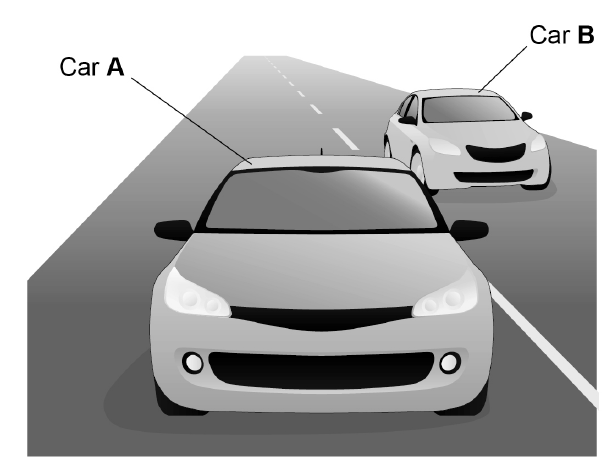
Read the following information.
20 people were shown Figure 1 and asked whether Car A or Car B was further away in this image. 18 people said that Car B was further away. |
Calculate the percentage of people who said Car B was further away.
Show your workings.
Name two monocular depth cues that are present in Figure 1.
Explain how both of the monocular depth cues you have named in Question 6b help people to perceive the distance of the cars in Figure 1.
Was this exam question helpful?
Which one of the following is a description of occlusion?
Distant objects are seen or shown as being higher in the visual field compared to items that are nearer.
The larger objects in the visual field appear to be closer than the smaller objects.
Where an object covers part of another object in the visual field, it appears to be closer.
Where parallel lines appear to meet in the visual field, they are seen to be further away.
Was this exam question helpful?
Read the following information.
Following eye surgery, Ava wears an eye patch to cover her left eye for one week. She notices that wearing the eye patch makes her clumsy and she often bumps into furniture as she moves around her house. |
Outline one binocular depth cue that affects how people judge distance.
Refer to Ava’s experience in your answer.
Was this exam question helpful?
Objects that are closer in your visual field appear larger than those that are further away.
Which one of the following causes this?
Convergence
Height in plane
Linear perspective
Occlusion
Relative size
Was this exam question helpful?
Objects that are closer in your visual field can cover part of another object that is further away.
Which one of the following causes this?
Convergence
Height in plane
Linear perspective
Occlusion
Relative size
Was this exam question helpful?
Which two of the following are binocular depth cues?
A | Convergence |
B | Height in plane |
C | Linear perspective |
D | Relative size |
E | Retinal disparity |
Was this exam question helpful?
Name two monocular depth cues.
Was this exam question helpful?