Commonly Confused Command Words (Edexcel IGCSE Biology): Revision Note
Exam code: 4BI1
Describe vs explain
Students often confuse the command words describe and explain
For example, students may explain a pattern in data when the question asks them to describe it, and so miss the marks for description
Describe means say what happens
This often means:
the pattern, or trend, that can be seen in a set of data
the sequence of events in a biological process
When you describe data, use the numbers you are given
A describe answer does not require reasons
Explain means say why something happens
This is asking for the link between cause and effect
Your answer should include words such as "because" or "so"
Worked Example
A student measured their heart rate before, during and after a period of exercise.

Describe the changes in the student's heart rate during and after exercise.
[2]
Zero-mark answer:
Their heart rate increases in order to pump more blood around the body
This supplies the muscles with more oxygen and glucose for respiration
Full-mark answer:
During exercise, the heart rate increases from 72 beats/min to about 160 beats/min and then levels off [1 mark]
After exercise, the heart rate decreases back to 72 beats/min [1 mark]
Examiner Tips and Tricks
The zero-mark answer explains why the heart rate increases, but it does not describe how the heart rate changes, and so scores nothing; it has not met the requirements of the question.
The full-mark answer makes two mark-worthy points describing the change and using the data given.
Worked Example
Food handlers are told to wash their hands before preparing food.
Explain why washing hands before preparing food reduces the spread of disease.
[2]
Zero-mark answer:
You would wash your hands with soap and warm water for 20 seconds
You would then dry them before you touch any food
Full-mark answer:
Hands can carry pathogens / infectious microorganisms [1 mark]
Washing removes / kills the pathogens, so they are not passed on to the food and eaten [1 mark]
Examiner Tips and Tricks
The zero-mark answer describes how to wash your hands, but the question asks why it matters. Describing the method, however accurately, does not earn marks.
The full-mark answer gains two marks for two separate biological ideas. First, it identifies the problem: pathogens can be present on the hands. Second, it explains how washing solves it: removing the pathogens breaks the route by which they would be transferred to the food and eaten.
Discuss, comment on & evaluate
Discuss, comment on and evaluate are used for longer, higher-mark questions that ask you to use data and your own knowledge
They are easily confused because they all ask you to bring several points together
In the Edexcel specification:
comment on requires the synthesis of a number of variables from data/information to form a judgement
discuss asks you to identify the issue, explore all aspects of it and investigate it by reasoning or argument
evaluate asks you to review information and come to a supported judgement, including strengths and weaknesses
To earn the marks in these questions:
make as many separate points as there are marks
use the data given, including images, and add your own knowledge to explain it
for evaluate, give points that support and oppose the conclusion, then reach a judgement
comment on the quality of the data
For example, the sample size or whether other variables were controlled
Worked Example
Scientists studied the number of red blood cells in people living at different altitudes. The table shows their results.
Altitude in m | Mean number of red blood cells in 1 litre of blood × 1012 | Number of people in sample |
|---|---|---|
0 | 4.8 | 18 640 |
1600 | 5.1 | 2870 |
2400 | 5.3 | 2215 |
Discuss the relationship between altitude and the number of red blood cells.
Use the data in the table and your own knowledge in your answer.
[4]
One-mark answer:
As altitude increases, the number of red blood cells increases [1 mark]
Full-mark answer:
The mean number of red blood cells increases from 4.8 × 10¹² to 5.3 × 10¹² in 1 litre of blood as altitude increases from 0 m to 2400 m [1 mark]
There is less oxygen available at higher altitude [1 mark]
More red blood cells means that more oxygen can be transported to cells for aerobic respiration [1 mark]
The samples at altitude are much smaller than the sample at sea level, so the results at altitude are less reliable [1 mark]
Examiner Tips and Tricks
The one-mark answer describes the trend, but it quotes no data, gives no biology to explain the trend and says nothing about the quality of the data.
The full-mark answer makes four separate points for four marks. It uses the data, explains the trend with biology and comments on the sample sizes.
Suggest & predict questions
Edexcel defines these command words as:
Suggest
Use your knowledge to propose a solution to a problem in a novel context
Predict
Give an expected result
They assess your ability to apply biological knowledge to new scenarios, rather than relying purely on your memory of the facts
Suggest
Suggest questions will normally present you with an unfamiliar context and ask you to use your specification knowledge to put forward a possible solution
There is often more than one possible answer that can score
When answering suggest questions it is essential that your answer relates to the specific scenario presented, rather than just being a generic statement
Worked Example
The photograph below shows a snowshoe hare, a small mammal native to North America.
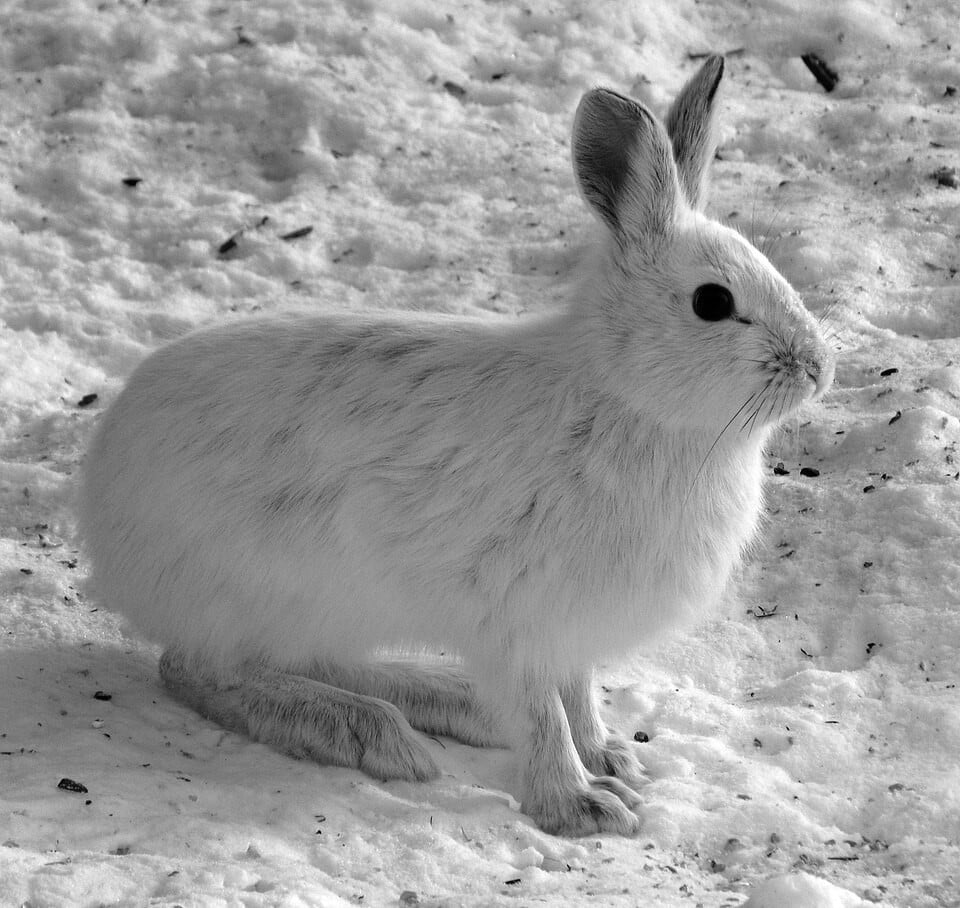
Snowshoe hare (Lepus americanus), D. Gordon E. Robertson, converted to black and white, CC BY-SA 3.0, via Wikimedia Commons (opens in a new tab)
Suggest how two adaptive features, visible in the photograph, aid snowshoe hare survival in their environment.
[2]
Zero-mark answer:
It is adapted to the cold
It has a good sense of smell to avoid predators
Full-mark answer:
It has white fur to camouflage it from predators [1 mark]
It has large feet so it doesn't sink in the snow [1 mark]
Examiner Tips and Tricks
The zero-mark answer gives a generic point ("adapted to the cold") that does not identify any feature of the hare. Its second point may be true, but a sense of smell cannot be seen in the photograph, and the question asks for visible features.
The full-mark answer applies knowledge to the specific scenario. The student has not been taught about snowshoe hares, but they use what they know about adaptive features to identify two features and say how each aids survival. They refer to the specific photograph of the hare and its environment throughout.
Note that there are many more correct answers available than the two given here.
Predict
Predict questions ask you to state what is expected to happen in a specific situation by combining your biological knowledge with the information provided
Predict questions may involve:
looking for trends in data in order to state specific possible values
applying knowledge to identify how an ecosystem, organism, cell or molecule will be affected by an environmental change
calculating ratios in a genetic cross
Worked Example
A student counted the bubbles of carbon dioxide released by yeast at different temperatures. Their results are shown in the table below.
Temperature (°C) | Bubbles per minute |
|---|---|
20 | 11 |
30 | 20 |
40 | 32 |
Predict the number of bubbles per minute at 35 °C.
[1]
Zero-mark answer:
More bubbles, because the yeast respires faster when it is warmer
Full-mark answer:
26 bubbles per minute [1 mark]
Any value from 21 to 31 would be accepted.
Examiner Tips and Tricks
The zero-mark answer gives a reason, but the question asks for a number of bubbles per minute, and no value has been predicted.
The full-mark answer uses the pattern in the table. 35 °C lies between 30 °C and 40 °C, so the number of bubbles lies between 20 and 32, and a value near the midpoint, 26, fits the pattern best.

Unlock more, it's free!
Join the 100,000+ Students that ❤️ Save My Exams
the (exam) results speak for themselves:

Was this revision note helpful?