11 mark
Element X is an unreactive non-metal element. Where could this element be found on the Periodic table?
At the far left hand side
At the far right hand side
At the top of Group VI
At the bottom of Group VII
Was this exam question helpful?
Exam code: 5070
Element X is an unreactive non-metal element. Where could this element be found on the Periodic table?
At the far left hand side
At the far right hand side
At the top of Group VI
At the bottom of Group VII
Was this exam question helpful?
Argon is a noble gas in Group VIII.
Which is the correct formula for argon gas?
Ar
Ar2
Ar3
Ar-
Was this exam question helpful?
Krypton is a noble gas.
How many atoms are joined together in one particle of krypton gas?
1
2
4
8
Was this exam question helpful?
Welding is carried out under argon to keep air away from the hot metal.
Which statement explains why the argon itself does not react with the hot metal?
Its outer shell of electrons is empty.
Its outer shell of electrons is complete.
Its atoms are joined together in pairs.
Its atoms gain electrons from the metal.
Was this exam question helpful?
The formulae of four gases are shown.
Cl2 He N2 O2
Which formula is that of a noble gas?
Cl2
He
N2
O2
Was this exam question helpful?
Which row describes the properties of a typical noble gas?
| outer electrons | atom or molecule | boiling point |
A | full | atom | very low |
B | 6 | molecule | low |
C | 8 | atom | very high |
D | 6 | molecule | high |
Was this exam question helpful?
Which diagram shows a mixture of noble gases?
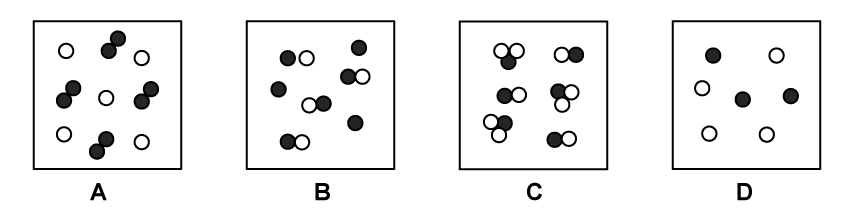
Was this exam question helpful?
A student is asked to explain why argon is unreactive.
The student writes:
argon has a stable octet
The mark is not awarded.
What is missing from the student's answer?
that argon is a gas at room temperature
that argon has eight protons
that the eight electrons are in the outer shell
that argon has eight neutrons
Was this exam question helpful?
Chemists have succeeded in making a small number of compounds of xenon, such as XeF4.
The noble gases are still described as unreactive.
Which statement explains why this description is still used?
Xenon is not a noble gas.
XeF4 is a mixture rather than a compound.
A xenon atom does not have a complete outer shell.
A complete outer shell leaves very little tendency to gain, lose or share electrons, so reactions are very difficult.
Was this exam question helpful?
Sodium forms the chloride NaCl and magnesium forms the chloride MgCl2.
Neon forms no chloride at all.
Which statement explains why?
A neon atom has a complete outer shell, so it has no electrons to lose and no space to gain any.
Neon has more protons than chlorine.
Neon has more electrons than chlorine.
Neon is a gas and chlorine is a gas.
Was this exam question helpful?
Which statement about the Group VIII noble gases is correct?
They all have eight electrons in their outer shell.
Their outer shell holds as many electrons as it is able to hold.
They all have two electrons in their outer shell.
They all have eight electrons in total.
Was this exam question helpful?
The noble gases exist as single atoms rather than as molecules.
Which statement explains why?
Their atoms already hold the maximum number of outer electrons, so sharing would gain them nothing.
They are gases, and gases are made of single atoms.
Their atoms are too small to share electrons with each other.
Their atoms repel one another.
Was this exam question helpful?
The relative atomic mass of argon is 40.
A student states that the relative molecular mass of argon gas is 80.
What is the error in the student's statement?
The relative atomic mass of argon is 20, not 40.
The student should have divided by 2 rather than multiplied.
Argon exists as single atoms, so it has no relative molecular mass.
There is no error in the statement.
Was this exam question helpful?
Argon is unreactive.
Which statement gives the reason for this?
Argon has 22 neutrons and 18 protons.
Argon's outer shell is further from the nucleus than neon's outer shell.
Argon has 18 electrons in total.
Argon's outer shell is complete.
Was this exam question helpful?
Sodium forms Na+ ions and chlorine forms Cl- ions.
Argon forms neither Ar+ nor Ar- ions.
Which statement explains why?
Argon has no outer shell electrons to lose.
Argon's outer shell is already complete, so losing or gaining an electron would break that arrangement.
Argon atoms are neutral and cannot become charged.
Argon is in Group VIII, and Group VIII elements have no charge.
Was this exam question helpful?