Calculating Orbital Speeds (Cambridge (CIE) O Level Physics): Revision Note
Exam code: 5054

Orbital Speed
When planets move around the Sun, or a moon moves around a planet, they orbit in circular motion
This means that in one orbit, a planet travels a distance equal to the circumference of a circle (the shape of the orbit)
This is equal to 2πr where r is the radius of a circle
The relationship between speed, distance and time is:
the average orbital speed of an object can be defined by the equation:
Where:
v = orbital speed in metres per second (m/s)
r = average radius of the orbit in metres (m)
T = orbital period in seconds (s)
This orbital period (or time period) is defined as:
The time taken for an object to complete one orbit
The orbital radius r is always taken from the centre of the object being orbited to the object orbiting
Orbital Motion
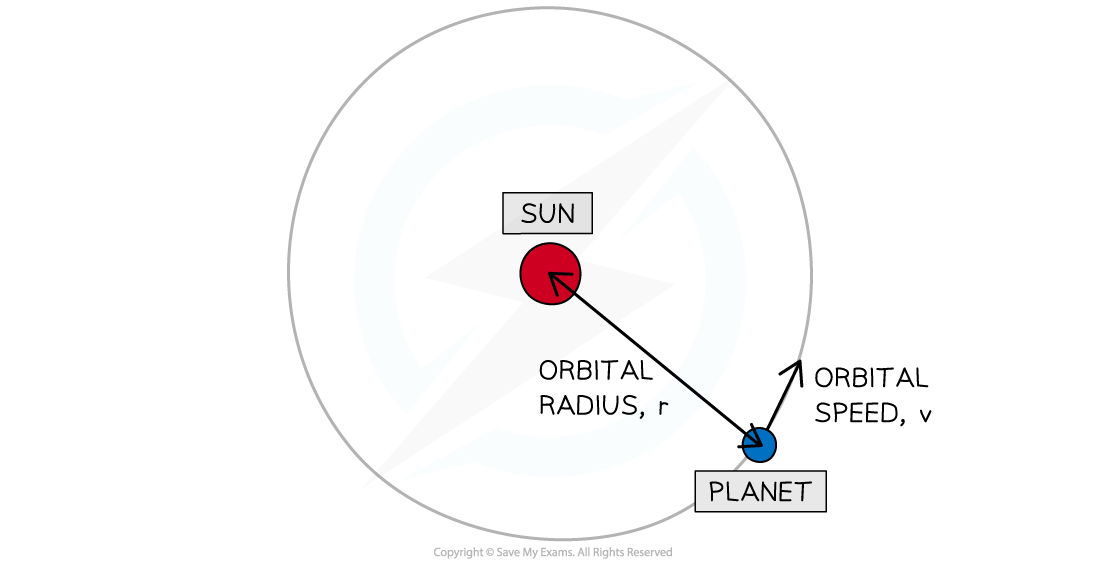
Orbital radius and orbital speed of a planet moving around a Sun
Worked Example
The Hubble Space Telescope (HST) moves in a circular orbit around the Earth. Its distance above the Earth’s surface is 560 km and the radius of the Earth is 6400 km. The HST completes one orbit in 96 minutes.

Calculate the orbital speed of the HST in m/s.
Answer:
Step 1: List the known quantities
Radius of the Earth, R = 6400 km
Distance of the telescope above the Earth's surface, h = 560 km
Time period, T = 96 minutes
Step 2: Write the relevant equation
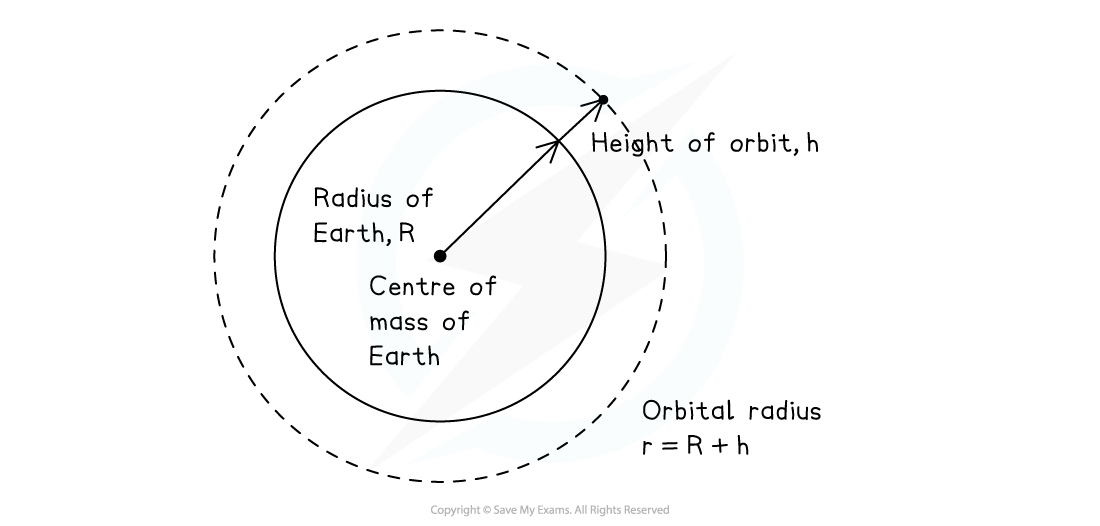
Step 3: Calculate the orbital radius, r
The orbital radius is the distance from the centre of the Earth to the telescope
Step 4: Convert any units
The time period needs to be in seconds
The radius needs to be in metres
Step 5: Substitute values into the orbital speed equation
Examiner Tips and Tricks
Remember to check that the orbital radius r given is the distance from the centre of the Sun (if a planet is orbiting a Sun) or the planet (if a moon is orbiting a planet) and not just from the surface. If the distance is a height above the surface you must add the radius of the body, to get the height above the centre of mass of the body.
This is because orbits are caused by the mass, which can be assumed to act at the centre, rather than the surface.
Don't forget to check your units and convert any if required!

Unlock more, it's free!
Join the 100,000+ Students that ❤️ Save My Exams
the (exam) results speak for themselves:

Was this revision note helpful?
Build on this topic