The Ions in Acids & Alkalis (Cambridge (CIE) O Level Chemistry): Revision Note
Exam code: 5070

Neutralisation Reactions
When acids are added to water, they form positively charged hydrogen ions (H+)
The presence of H+ ions is what makes a solution acidic
When alkalis are added to water, they form negative hydroxide ions (OH–)
The presence of the OH– ions is what makes the aqueous solution an alkali
The pH scale is a numerical scale which is used to show how acidic or alkaline a solution is, in other words it is a measure of the concentration of hydrogen ions in the solution
A neutralisation reaction occurs when an acid reacts with an alkali
When these substances react together in a neutralisation reaction, the H+ ions react with the OH– ions to produce water
For example, when hydrochloric acid is neutralised, sodium chloride and water are produced:
HCl + NaOH → H2O + NaCl

The net ionic equation of acid-alkali neutralisations, and what leads to a neutral solution, since water has a pH of 7, is:
H+ + OH– ⟶ H2O
Examiner Tips and Tricks
Not all reactions of acids are neutralisations. For example, when a metal reacts with an acid, although a salt is produced there is no water formed so it does not fit the definition of neutralisation.
Hydrogen Ion Concentration & pH
The pH scale
The pH scale is a numerical scale which is used to show how acidic or alkaline a solution is
It goes from 0 - 14 (very concentrated acids can have values below 0)
All acids have pH values of below 7, all alkalis have pH values of above 7
The lower the pH then the more acidic the solution is
The higher the pH then the more alkaline the solution is
A solution with a pH of 7, such as water, is described as being neutral

The pH scale showing acidity, neutrality and alkalinity
We have already seen that acids are substances that contain hydrogen ions in solution
The higher the concentration of hydrogen ions, the lower the pH
The higher the concentration of hydroxide ions in a solution the higher the pH
So pH is a measure of the concentration of H+ ions in solution, but they have an inverse relationship
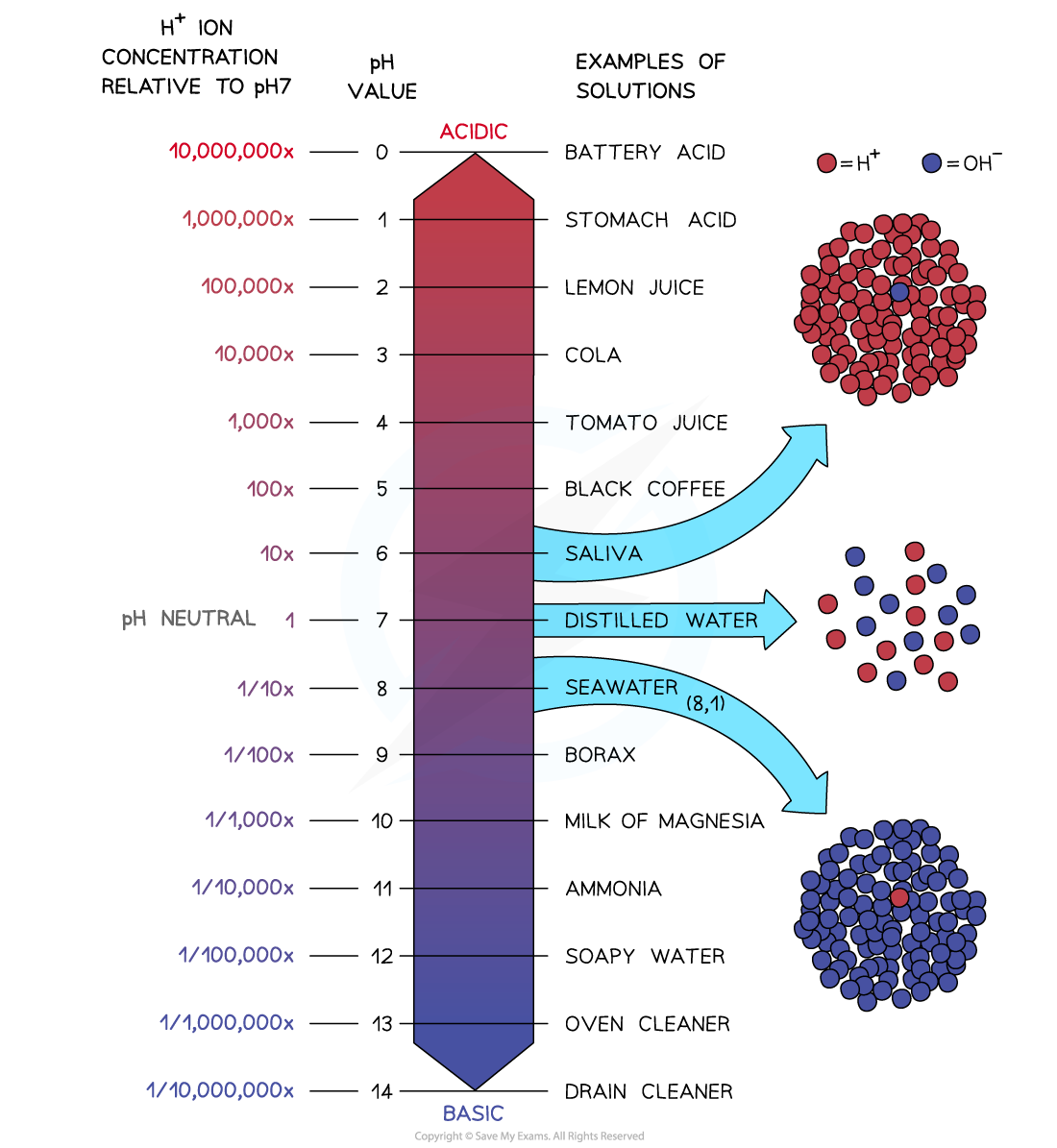
The pH scale is logarithmic, meaning that each change of 1 on the scale represents a change in concentration by a factor of 10
Therefore an acid with a pH of 3 has ten times the concentration of H+ ions than an acid of pH 4
An acid with a pH of 2 has 10 x 10 = 100 times the concentration of H+ ions than an acid with a pH of 4
Examiner Tips and Tricks
pH reflects the concentration of hydrogen ions in solution. The more hydrogen ions, the lower the pH and vice versa. This is not the same as acid strength, which depends on how fully the acid dissociates.
Universal indicator
Universal indicator is a mixture of different indicators which is used to measure the pH
A drop is added to the solution and the colour is matched with a colour chart which indicates the pH which matches specific colours

The pH scale with the Universal Indicator colours which can be used to determine the pH of a solution

Unlock more, it's free!
Join the 100,000+ Students that ❤️ Save My Exams
the (exam) results speak for themselves:

Was this revision note helpful?
Build on this topic