Chromatography (Cambridge (CIE) O Level Chemistry): Multiple Choice Questions

Exam code: 5070

4 hours43 questions
1
1 mark

A student carries out an investigation on different plant extracts using paper chromatography. The experimental set-up he uses is shown below.

q1-easy-mcq-12-2-separation-purification-cie-igcse-chemistry

Where should he place the samples of plant extract?

  • On the pencil line

  • Below the pencil line in the solvent

  • Exactly 1 cm above the pencil line

  • Exactly 1 cm below the pencil line

2
1 mark

Paper chromatography was used to determine if a banned preservative, X, is present in four samples obtained from four different packaged foods labelled A, B, C and D.

The results of the analysis of the foodstuffs are shown in the diagram below.

q2-easy-mcq-12-2-separation-purification-cie-igcse-chemistry

Which foodstuff contains X?

    3
    1 mark

    In paper chromatography, the base line is drawn in pencil rather than in ink.

    Why is pencil used?

    • Ink would dissolve in the solvent and separate into spots of its own.

    • Pencil marks hold the samples in place on the base line.

    • Ink would react with the substances in the mixture.

    • Ink would make the chromatography paper less absorbent.

    4
    1 mark

    A student measures the distance travelled by a spot and the distance travelled by the solvent front on a chromatogram.

    The student calculates an Rf value of 1.4.

    What mistake has the student made?

    • The distance travelled by the solvent was divided by the distance travelled by the spot.

    • The distance was measured to the top of the spot instead of to its centre.

    • The base line was drawn too close to the bottom of the paper.

    • The paper was left in the solvent for too long.

    5
    1 mark

    Which mixture can be separated and identified using paper chromatography?

    • sand from a mixture of sand and water

    • the coloured dyes in black ink

    • salt from salt solution

    • ethanol from a mixture of ethanol and water

    1
    1 mark

    A student uses paper chromatography to find an Rf value for Fe3+(aq). The result is shown.

    q39-cie-o-level-chemistry-specimen-2023-paper-1

    To make the spot containing Fe3+(aq) more visible, the paper is sprayed with aqueous sodium hydroxide so that a precipitate of iron(III) hydroxide forms.

    Under the conditions of the experiment, the Rf value of Fe3+(aq) is given by …..1….. and the colour of the precipitate is …..2….. .

    Which row correctly completes gaps 1 and 2?


    gap 1

    gap 2

    A

    x/y

    green

    B

    x/y

    red-brown

    C

    y/x

    green

    D

    y/x

    red-brown

      2
      1 mark

      The Rf​ values of three different pigments are shown in the table.

      pigment

      Rf​ value

      P

      0.43

      Q

      0.57

      R

      0.75

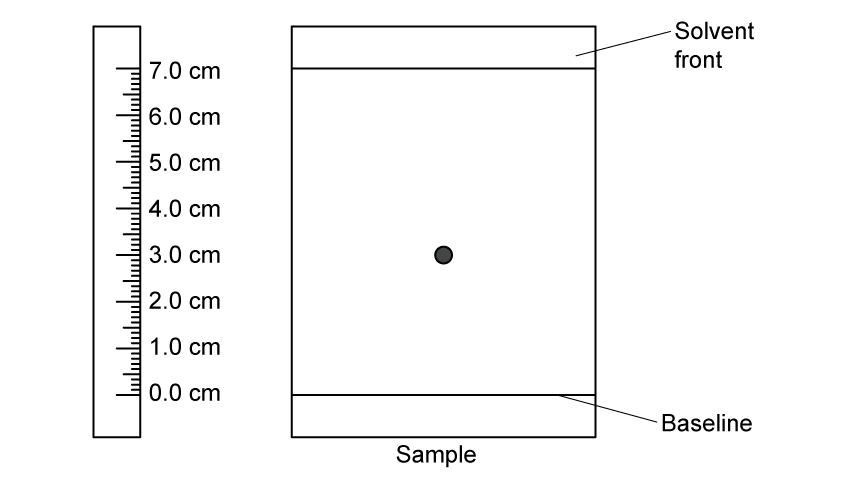
      A student carries out chromatography on an unknown sample. The resulting chromatogram is shown below

      Chromatogram. Baseline at 0.0 cm. Solvent front at 7.0 cm. One sample spot at 3.0 cm above baseline. Ruler shown 0.0–7.0 cm.

      What is the identity of the unknown pigment?

      • pigment P

      • pigment Q

      • pigment R

      • none of these pigments

      3
      1 mark

      A mixture is known to contain four coloured dyes.

      A student separates the mixture using paper chromatography. The finished chromatogram shows only three spots.

      Why are there only three spots?

      • Two of the dyes have the same Rf value in this solvent.

      • One of the dyes is colourless, so a locating agent is needed.

      • The dyes were placed too close together on the base line.

      • The solvent used cannot dissolve the dyes.

      4
      1 mark

      Solution X is a colourless salt of a Group I element.

      Solution Y is a coloured salt of a transition element.

      Both solutions are spotted onto the same piece of chromatography paper and run in a suitable solvent. The spot from Y is found higher up the paper than the spot from X.

      Which statement is correct?

      • Y has the larger Rf value and X needs a locating agent.

      • Y has the larger Rf value and Y needs a locating agent.

      • X has the larger Rf value and X needs a locating agent.

      • X has the larger Rf value and Y needs a locating agent.

      5
      1 mark

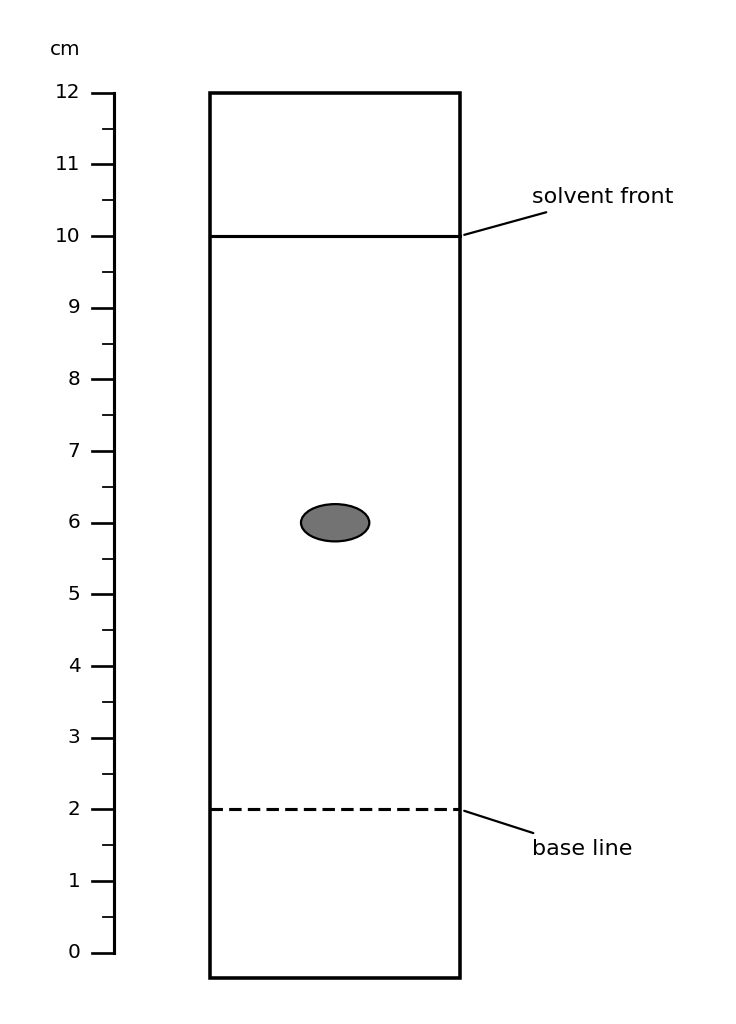
      The diagram shows a finished chromatogram next to a centimetre ruler.

      A vertical strip of chromatography paper beside a centimetre ruler marked from 0 to 12. A dashed horizontal line labelled base line crosses the paper level with the 2 cm mark. A solid horizontal line labelled solvent front crosses the paper level with the 10 cm mark. One shaded oval spot sits on the paper level with the 6 cm mark.

      What is the Rf value of the spot?

      • 0.20

      • 0.50

      • 0.60

      • 0.80

      1
      1 mark

      Four different dyes labelled P, Q, R and S produced the chromatograms as shown below.

      q2-hard-mcq-12-2-separation-purification-cie-igcse-chemistry

      Which dye has an Rf value of 0.7?

      • S only

      • R only

      • Both P and Q

      • None

      2
      1 mark

      A student has been given a sample of an amino acid to analyse by chromatography. As part of the investigation the student will have to use a locating agent to make the colourless amino acid spots visible. The Rf value is then calculated to identify the amino acid.

      Which row describes the correct steps?


      How to add the locating agent

      How to identify the amino acid

      A

      Add to solvent

      Calculate the Rf

      B

      Spray on the chromatography paper before the experiment

      Compare the Rf value to that of known solvents

      C

      Spray on the surface of the solvent

      Perform the experiment again and compare the Rf values 

      D

      Spray on the chromatogram

      Compare the Rf value to that of known amino acids

        3
        1 mark

        It is important that substances used in the synthesis of medicines are pure as impurities in these products can be detrimental to our health. Samples of pure and impure paracetamol were analysed using chromatography. The resulting chromatogram is shown below.

        q4-hard-mcq-12-2-separation-purification-cie-igcse-chemistry

        The impure sample of paracetamol was contaminated with one of the raw chemicals used during its synthesis.

        What is the Rf value of the chemical?

        • 0.50

        • 0.65

        • 0.75

        • 0.85

        4
        1 mark

        A mixture of sugars can be separated out by paper chromatography. 

        The student sprays the dried chromatogram with a locating agent. 

        Why is this used?

        • To help the sugars dissolve in the solvent 

        • To stop the sugars reacting with each other

        • To form coloured spots with the sugars

        • To aid the separation of the mixture

        5
        1 mark

        A pigment has an Rf value of 0.40 in a particular solvent.

        On a chromatogram run in this solvent, the pigment travels 3.2 cm from the base line.

        How far did the solvent front travel?

        • 0.13 cm

        • 1.3 cm

        • 3.6 cm

        • 8.0 cm