Data Handling: Types & Display of Data (College Board AP® Psychology): Exam Questions

3 mins3 questions
1
1 mark

A researcher collects data on the number of hours students spend studying per week and their exam scores. She wants to display the data in a way that shows whether a relationship exists between the two variables.

Which of the following would be the most appropriate type of graph?

  • A bar chart

  • A histogram

  • A pie chart

  • A scatterplot

2
1 mark

A researcher measures the reaction times (in milliseconds) of 200 participants and wants to display how frequently each range of reaction times occurs. The data are continuous. Which of the following is the most appropriate way to display these data?

  • A bar chart with separated bars for each reaction time value

  • A histogram with touching bars showing frequency of reaction time intervals

  • A scatterplot showing reaction time against participant number

  • A line graph showing reaction time across participants

3
1 mark

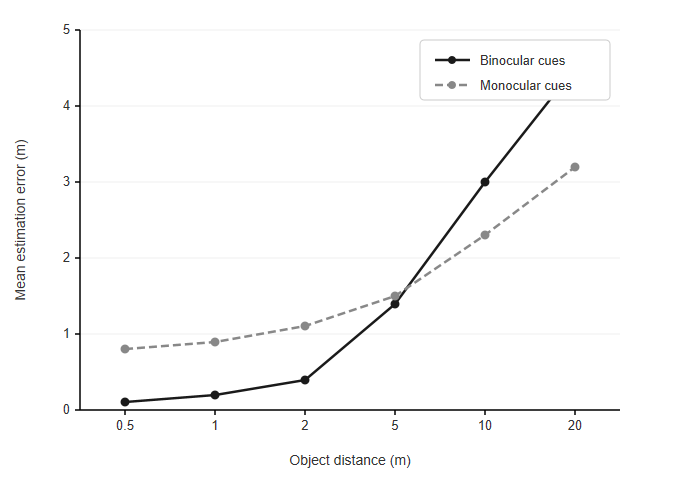
A researcher investigated how accurately people judge the distance of objects using different types of depth cues. Forty participants were tested individually in a controlled room. In one condition, participants used only monocular cues (one eye covered) to estimate the distance of objects placed at six different distances (0.5 m, 1 m, 2 m, 5 m, 10 m, and 20 m). In a second condition, the same participants used binocular cues (both eyes open) to estimate the same distances.

The graph below shows the mean estimation error (in meters) for each condition at each distance. Lower error scores indicate more accurate distance judgments.

Line graph comparing binocular and monocular cues' mean estimation error over object distances from 0.5 to 20 metres, showing errors increase with distance.

Based on the data in the graph, which of the following statements is best supported?

  • Monocular cues produce more accurate distance judgments than binocular cues at all distances tested

  • Binocular cues produce more accurate distance judgments than monocular cues at all distances tested

  • Binocular cues produce more accurate distance judgments than monocular cues at short distances, but monocular cues become relatively more accurate at longer distances

  • The type of depth cue used has no effect on distance judgment accuracy beyond 5 meters