Water & the Transpiration Pull (Cambridge (CIE) AS Biology): Revision Note
Exam code: 9700

Water & the transpiration pull
The movement of water
The mass flow of water in a plant is helped by the polar nature of water
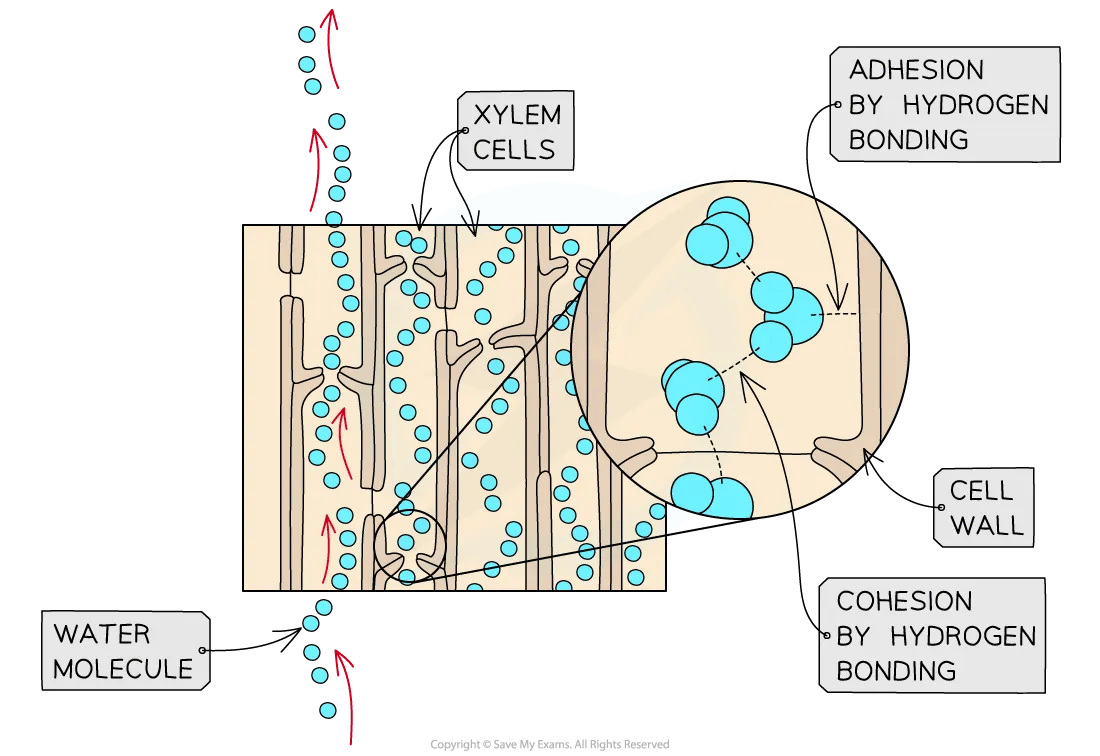
Hydrogen bonds (H-bonds) form between water molecules which results in cohesion between water molecules and adhesion between the cellulose in the cell walls and the water molecules
Water moves from the roots to the leaves because of a difference in water potential between the top and bottom of the plant
This gradient is present due to the constant loss of water from the leaves by transpiration and the constant uptake of water at the roots by osmosis
The evaporation of water into the air spaces in the leaves creates tension in the xylem tissue which is transmitted all the way down the plant because of the cohesive nature of water molecules
The cohesive force results in a continuous column of water with high tensile strength (it is unlikely to break) and the adhesive force stops the water column from pulling away from the walls of the xylem vessels
This mechanism is called the cohesion-tension theory
Xylem vessels have lignified walls to prevent them from collapsing inwards under the tension (negative pressure) in the water column
The transpiration stream
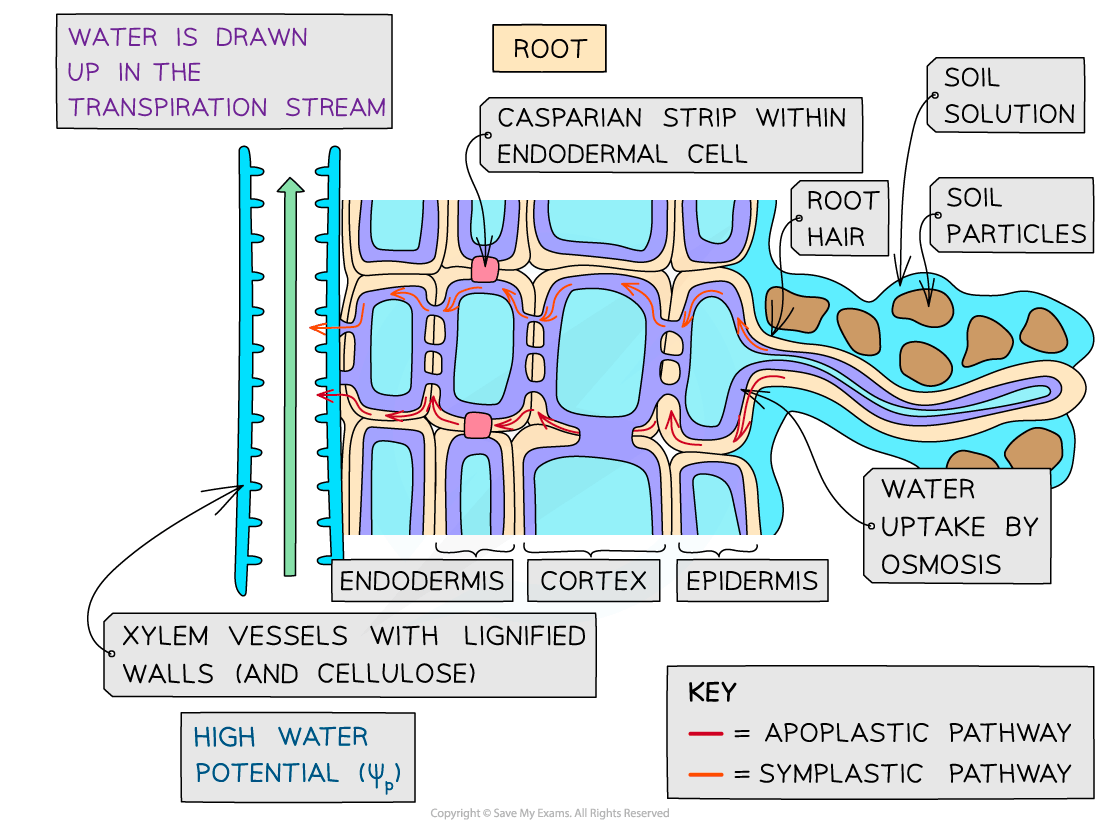
The pathway of the water from the soil through the roots up the xylem tissue to the leaves is the transpiration stream
Water travels across the root either via the apoplast pathway or the symplast pathway
Note that water in the apoplast pathway does not cross cell membranes, so does not move by osmosis

Examiner Tips and Tricks
When answering questions about transpiration it is important to include the following keywords:
Water potential gradient (between leaves and roots),
Diffusion (of water vapour through the stomata)
Transpiration pull (evaporation of water from the walls of mesophyll cells in the leaves pulls other water molecules up from the xylem tissue)
Cohesion (between water molecules)
Adhesion (between water molecules and cellulose within the cell walls)
Cohesion-tension theory (evaporation from the leaves creates tension in the xylem; cohesion between water molecules, due to hydrogen bonding, means the water is pulled up as a continuous column)
Osmosis (water moving via the symplast pathway across the roots and leaves)

Unlock more, it's free!
Join the 100,000+ Students that ❤️ Save My Exams
the (exam) results speak for themselves:

Was this revision note helpful?
Build on this topic