Establishing a Line of Reasoning & Commentary (College Board AP® English Language & Composition): Study Guide
This study guide introduces you to a line of reasoning and developing commentary in a synthesis argument. It explains how writers organize supporting claims, and source evidence and commentary to justify a thesis. It also shows how paragraph sequence reveals an argument’s reasoning, how commentary explains the significance of source evidence and how weaknesses in reasoning can disrupt an otherwise convincing argument.
What is a line of reasoning in AP Lang?
A line of reasoning is the logical progression of supporting claims through which a writer justifies an overarching thesis.
Within each paragraph, evidence and commentary develop one step in that progression. Therefore:
The topic sentence and the paragraph sequence reveal the overall line of reasoning
The commentary develops and explains the reasoning within each paragraph
Together, the paragraphs form the complete line of reasoning
The relationship between claims, evidence and reasoning
Claims justify why one part of the thesis is valid
Evidence addresses what information supports this reason
Reasoning answers why the evidence supports the reason
Two ways writers build a line of reasoning
Inductive reasoning
A writer begins with source evidence, identifies a pattern and then arrives at a broader claim.
The paragraph progresses in this way:
Source evidence
Pattern
Interpretation
Thesis
Deductive reasoning
A writer states the thesis or supporting claim first, and then develops it with source evidence and commentary. The paragraph progresses in this way:
Thesis
Supporting reasons
Source evidence
Commentary
Reasoning leading to a thesis (inductive)
Inductive reasoning may be effective when:
The writer wants to lead the audience into noticing the pattern
The sources reveal a conclusion that may not be immediately obvious
The writer wants to build gradually toward a qualified position
Claim then line of reasoning (deductive)
Deductive reasoning may be effective when:
The position should be clear immediately
Several reasons will be developed
The writer is responding directly to an argumentative task
Examiner Tips and Tricks
Deductive reasoning is overwhelmingly the most common way that students develop their FRQ 1, 2 and 3 for the AP exam.
What is commentary in AP Lang?
Commentary is the writer’s explanation of how and why source evidence supports a reason and contributes to the line of reasoning.
Commentary may explain:
What the source evidence demonstrates
Why the information is significant
How the evidence supports the paragraph’s reason
How the reason advances the thesis
How one source relates to another source
Whether the evidence confirms, extends, qualifies or challenges another idea
Evidence answers “What does the source say or show?”
Commentary answers “What is the significance of that information to my argument?”
How commentary connects evidence to claims
In a synthesis paragraph, commentary usually establishes several connections:
Source evidence connects to a supporting reason
Supporting reason connects to a thesis
Source evidence connects to other source evidence
The body paragraph structure: claim, evidence, commentary
A synthesis body paragraph usually develops one supporting reason in the line of reasoning.
A useful structure is:
Supporting claim
Source evidence
Commentary
Additional source evidence
Commentary
Connection to thesis
This structure is not rigid. A paragraph may use one source or several. The paragraph, however, should remain organized around the writer’s reason rather than around the order in which the sources appear.
How sequence of paragraphs reveals the line of reasoning
The order of body paragraphs shows how the writer wants the audience to understand the argument. Strong essay responses show how the paragraphs work together to justify the thesis.
Notice in the sequence below how the writer’s reasoning moves from need to effective design to responsible implementation:
Students need financial preparation because they will soon face significant decisions
Instruction should develop practical decision-making rather than isolated knowledge
Schools should implement the course without unnecessarily increasing graduation requirements
This sequence is effective because it allows the writer to establish why the course matters, explain what would make it useful and then address whether the proposal is practical.
Common ways to sequence a synthesis paragraph involve writers moving:
From a problem to a proposed response
From immediate effects to long-term consequences
From individual effects to broader effects
From benefits to limitations
From a general principle to a specific application
From the strongest area of agreement to an important qualification
Identifying flaws in a line of reasoning
A synthesis argument has a strong line of reasoning when:
Each paragraph develops a reason that supports the thesis
Source evidence directly supports that reason
Commentary explains the evidence's significance
Relationships among sources are made clear
The conclusion does not go beyond what the evidence can support
The following problems can interrupt that reasoning:
Organizing by sources instead of reasons:
Paragraph 1 — Source A; Paragraph 2 — Source B; Paragraph 3 — Source C
Using evidence that does not support the paragraph’s reason
Summarizing sources instead of explaining them
Treating agreement among sources as proof
Misrepresenting or overstating source evidence
Drawing a conclusion broader than the evidence allows
Assuming a causal relationship without sufficient support
To identify flaws in a line of reasoning, it can be useful to ask yourself the following after drafting each paragraph:
Does the paragraph’s reason support my thesis?
Does the source evidence support my reason?
Does my commentary explain the connection?
Have I represented each source accurately?
Does my conclusion remain within the limits of the evidence?
How to write effective commentary: step-by-step
State the supporting reason:
Identify what the paragraph must prove
Select relevant source evidence:
Choose information that directly supports the reason
Explain what the evidence demonstrates:
Ask: “What does this example reveal?”
Explain why the evidence matters:
Ask: “Why is this evidence important or relevant?”
Connect the evidence to the reason:
Ask: “How does the evidence support the paragraph’s reason?”
Introduce and connect another source:
Ask: “What new idea does the second source contribute and does this source support, extend, qualify or challenge the first source?”
Connect the combined evidence to the thesis:
Ask: “What conclusion can I draw from the sources when I consider them together?”
Worked example: annotated line of reasoning and commentary
Context:
For clarity, the practice sources below state their positions directly. In an actual FRQ 1 source set, sources are often less explicit and may include charts, images, reports, historical documents or informational texts that do not clearly argue for or against the issue. In later tasks, the sources used will reflect this greater level of complexity.
Prompt:
Develop a position on whether high schools should require a personal finance course for graduation
Source | Main idea/argument |
|---|---|
Source A | A consumer-education advocate explains that young adults may soon encounter taxes, credit, rent agreements and banking decisions |
Source B | A curriculum administrator warns that adding another graduation requirement may reduce students' schedule flexibility |
Source C | A teacher describes a simulation-based course in which students budget income and respond to unexpected expenses |
Source D | A behavioral researcher argues that knowing financial concepts does not automatically produce responsible financial habits |
Establish a thesis:
"High schools should require a semester-long personal finance course because students need preparation for decisions they will face soon after graduation; however, the course should emphasize practical simulations and replace an existing requirement rather than increase the total graduation load."
Map the line of reasoning:
Paragraph structure | Supporting reason | Source evidence | Contribution to thesis |
|---|---|---|---|
1 | Students will soon face significant financial decisions | Source A | Establishes the need for the course |
2 | Effective instruction must involve practical decision-making | Sources C and D | Explains how the course should be designed |
3 | The requirement should not unnecessarily restrict student schedules | Source B | Qualifies the proposal and makes it more practical |
Note: the progression here moves from need to effective instruction to implementation.
Final paragraph:
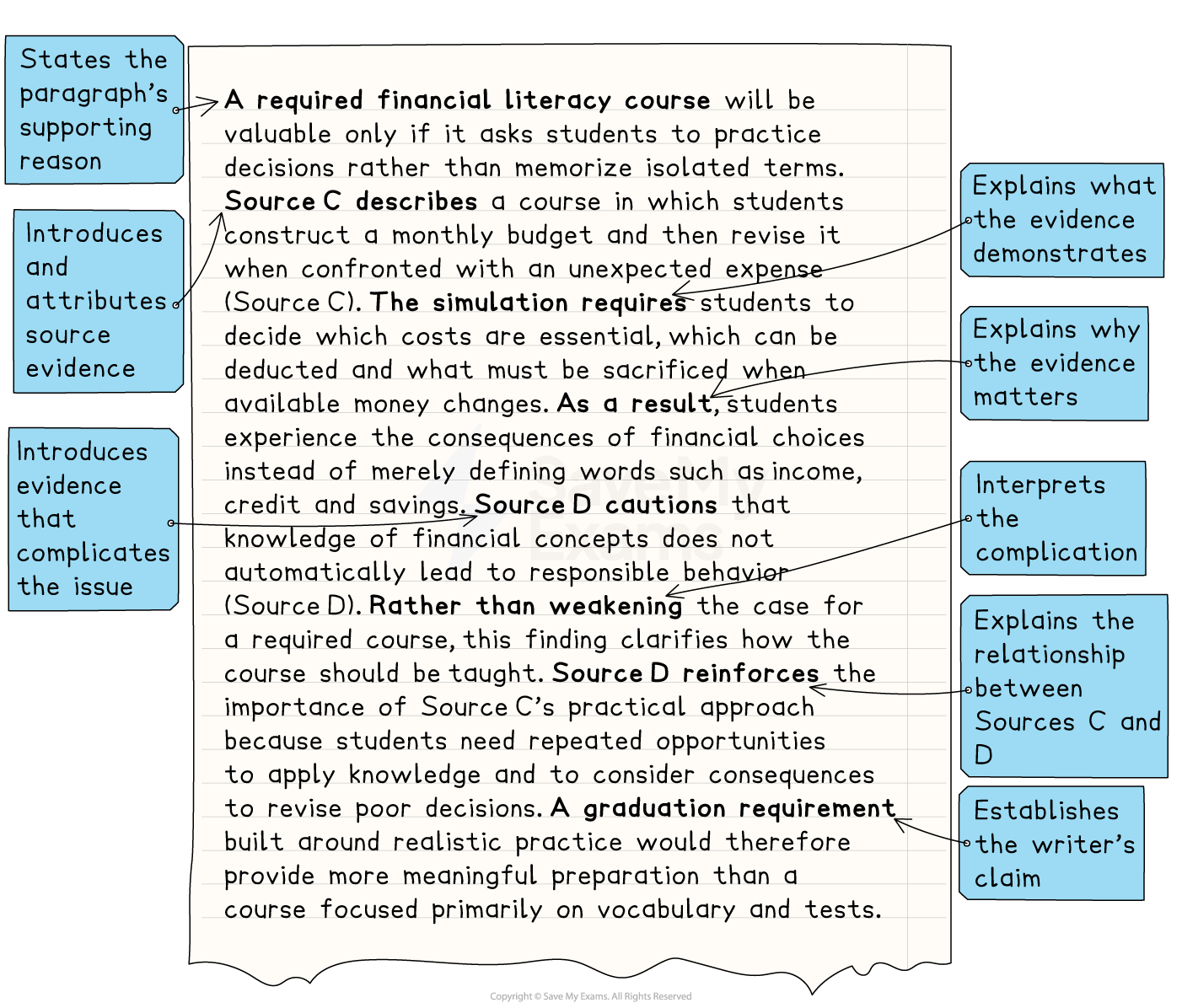
Tips on establishing a line of reasoning
Check the reasoning chain:
After presenting evidence, test both connections in the paragraph by answering the following questions:
This evidence supports my reason because…
This reason supports my thesis because…
If either connection is difficult to explain clearly, the paragraph likely contains a gap in its line of reasoning
You will therefore need to revise the reason or choose stronger evidence
Put sources in conversation:
Effective synthesis does more than place sources side by side. It explains how ideas in sources interact through:
Agreement — one source reinforces or extends another in a meaningful manner
Contention — one source challenges or contradicts another
Qualification — one source introduces a condition, limitation or exception
Common mistakes when establishing a line of reasoning
Organizing paragraphs by source:
Also known as “a source tour,” a source-by-source structure often produces a summary rather than an argument
Instead, organize paragraphs around reasons and use relevant source material to prove those reasons
Using vague commentary:
Weak commentary: “This shows that financial literacy is important.”
Stronger commentary: “Because students must balance competing expenses, the activity demonstrates why financial planning requires judgment rather than memorization.”
Failing to connect evidence to the thesis:
A paragraph may explain its evidence but still fail to show how the supporting reason advances the overarching position
Misrepresenting source evidence:
You should not misrepresent or exaggerate a source’s idea or remove an important qualification to make it fit your argument
Using transitions instead of logic:
Make sure that your transitions are used logically
Words such as therefore, furthermore and however cannot create a meaningful relationship between ideas that do not logically connect
Frequently asked questions
What's the difference between commentary and evidence?
Evidence is information used to support a claim. Commentary is the writer’s explanation of what the evidence demonstrates and how it contributes to the reasoning.
For example:
Evidence:
Source C describes students revising a budget after an unexpected expense
Commentary based on this evidence:
Revising the budget teaches students that financial decisions require adapting priorities when circumstances change
How long should commentary be?
There is no required number of commentary sentences for every piece of evidence.
Commentary should be long enough to explain:
What the evidence demonstrates
Why it is significant
How it supports the paragraph’s reason
How the reason advances the thesis
How it relates to other source material when relevant
A simple example may require one or two sentences. A complex relationship among sources may require more.
What makes a line of reasoning valid?
A valid line of reasoning contains:
A defensible thesis
Distinct reasons that support the thesis
Relevant source evidence
Commentary connecting evidence to reasons
A logical sequence of paragraphs
Conclusions that do not extend beyond the evidence
No major contradiction or extreme language or unsupported assumptions
How is line of reasoning tested in AP Lang FRQs?
In FRQ 1, the synthesis essay, you establish a line of reasoning by developing supporting claims, selecting relevant source evidence and explaining how that evidence justifies your thesis.
Key terms and glossary
Claim: a statement that presents a writer's position and requires proof or defense
Commentary: explanation that shows how evidence supports a reason, how the reason supports the thesis and why the evidence matters
Deductive reasoning: an arrangement that begins with a general claim and then presents reasons and evidence that support it
Evidence: information used to support a claim or reason
Inductive reasoning: an arrangement that begins with evidence or observations and moves toward a broader conclusion
Line of reasoning: the logical progression of reasons, evidence and commentary that explains how the thesis is supported
Overarching thesis: the central claim that guides and unifies an argument
Reason: an explanation of why a claim or thesis is valid
Relevance: the degree to which evidence directly supports the claim or reason being developed
Source evidence: quoted, paraphrased, summarized or visual information drawn from a source
Supporting claim: a claim that develops one part of the thesis and contributes to its defense
Synthesis argument: an argument that integrates ideas and evidence from multiple sources into the writer's own reasoning
Thesis: the main, overarching claim a writer seeks to defend or prove by using reasoning supported by evidence
Topic sentence: a sentence that states the main claim or reason developed in a body paragraph

Unlock more, it's free!
Join the 100,000+ Students that ❤️ Save My Exams
the (exam) results speak for themselves:

Was this revision note helpful?