How to Incorporate Multiple Perspectives (College Board AP® English Language & Composition): Study Guide

This study guide introduces you to incorporating multiple perspectives into a synthesis argument. It explains how to identify a source’s position and perspective, place sources in conversation and use other arguments to support, extend, qualify or challenge your own reasoning. It also shows how to select relevant source material while keeping your own position central.
What does it mean to incorporate multiple perspectives in AP Lang?
To incorporate multiple perspectives means to consider how people with different experiences, responsibilities, interests, values or areas of expertise understand an issue and then integrate relevant parts of their argument into your own.
For FRQ 1, you will be provided with six sources. You should determine:
What each source claims
What perspective shapes that claim
What evidence the source emphasizes
How the source relates to other arguments
How the source can contribute to your position
In an AP Lang source set for FRQ 1, perspective is usually not stated directly. A source may present data, describe a historic example, report research, include an image or explain a problem without clearly announcing support or opposition. Imagine a prompt asking whether communities should convert unused commercial buildings into housing. The source set might include:
A chart showing rent and vacancy rates
A report about renovation costs
An interview with residents concerned about historic preservation
A photograph of an abandoned shopping center
An opinion-editorial about the environmental benefits of reusing buildings
An analysis questioning whether converted buildings meet families’ needs
Some sources may take clear positions. Other sources may provide information that can support more than one argument. Therefore, to infer perspective, ask:
What does this source make seem most important?
Which benefits, risks or groups receive the most attention?
What assumptions guide this source?
What conclusion does the evidence invite the reader to draw?
Could this source support more than one position?
Incorporating multiple perspectives means representing sources clearly, selecting information strategically and explaining how the ideas contribute to your reasoning.
Getting sources into conversation
Sources are in conversation when the writer explains how their ideas interact. Sources may:
Agree about a problem
Support the same position for different reasons
Disagree about a solution
Focus on different consequences
Qualify another’s claims
Answer concerns raised by another source
Reveal what another source has failed to consider
Sources placed beside one another:
Source A supports converting the building
Source B also supports it
Source C raises some concerns
Note how the sources appear together, but their relationship is unclear.
Sources placed in conversation:
While Source A emphasizes the environmental benefits of reusing an existing building, Source B supports conversion because it could increase the housing supply
Source C qualifies both arguments by showing that older commercial buildings may require expensive structural changes before they can safely house families
This example explains where the sources agree, how their reasons differ and how one source introduces a limitation.
How to identify different perspectives in a text
Identify the source’s position:
Ask: what does the source want the audience to believe or do?
Consider the source’s background:
Ask: what experience, responsibility or expertise shapes the source’s approach?
Identify the source’s values and concerns:
Ask: who or what is being called attention to? What outcomes seem most important?
Examine the evidence selected:
Ask: what does the evidence focus on?
Notice what the source fails to consider:
Ask: what concerns receive little or no attention? What might a different perspective notice?
The four ways writers integrate other arguments
Writers commonly integrate sources into arguments to:
Support a position:
A source supports your position when it provides evidence or reasoning that reinforces your claim
Extend an argument:
A source extends your argument when it adds a new consequence, application or idea
Qualify a claim:
A source qualifies a claim when it introduces a condition, limitation or exception
Challenge an opposing view:
A source may challenge another argument by questioning an assumption or offering a different interpretation
Position vs. perspective: what's the difference?
A position is the claim or stance a source takes. A perspective is the lens through which the source approaches the issue. That lens can be shaped through the author’s experience, profession, expertise, values, interests or responsibilities.
Same position but different perspectives
Both support conversion, but they arrive at that position for different reasons:
Source | Position | Perspective |
|---|---|---|
Housing advocate | Supports conversion | Focuses on affordability and housing supply |
Environmental organization | Supports conversion | Focuses on reducing waste and land development |
Similar goals but different positions
Both sources may want responsible development, but they disagree about which projects are practical:
Source | Position | Perspective |
|---|---|---|
Architect | Supports selective conversion | Focuses on design and feasibility |
Budget analyst | Opposes some conversion | Focuses on cost and public spending |
How to integrate other arguments into your own writing
Establish your own claim
Select sources with relevant contributions
Introduce the first perspective
Explain the source’s contribution
Introduce another perspective
Put the sources in conversation
Draw your own conclusion
Worked example: synthesis paragraph with multiple perspectives
Prompt:
Develop a position on whether communities should convert unused commercial buildings into housing
Perspectives and contributions:
Source and type | Perspective | Contribution |
|---|---|---|
A: chart | Housing availability and cost | Suggests that the community may need additional housing |
B: text excerpt | Construction feasibility and expense | Reveals practical obstacles to conversion |
C: interview | Historical preservation and community identity | Introduces a condition involving the protection of valued structures |
D: photograph | Land use and neighborhood decline | Visually illustrates the consequences of leaving property abandoned |
E: report | Environmental sustainability | Adds environmental reasons for reusing existing buildings |
F: article | Family needs and quality of life | Complicates the assumption that any converted space will become suitable housing |
Establish a position:
"Communities should convert suitable commercial buildings into housing when doing so addresses a genuine housing shortage and avoids unnecessary demolition, but local governments must evaluate each project for cost, safety, historic value and residents’ long-term needs."
Develop a supporting claim (to introduce your first supporting paragraph):
"Converting vacant commercial property can address housing and environmental concerns at the same time, but only when the building can provide safe and practical living conditions."
Full paragraph:
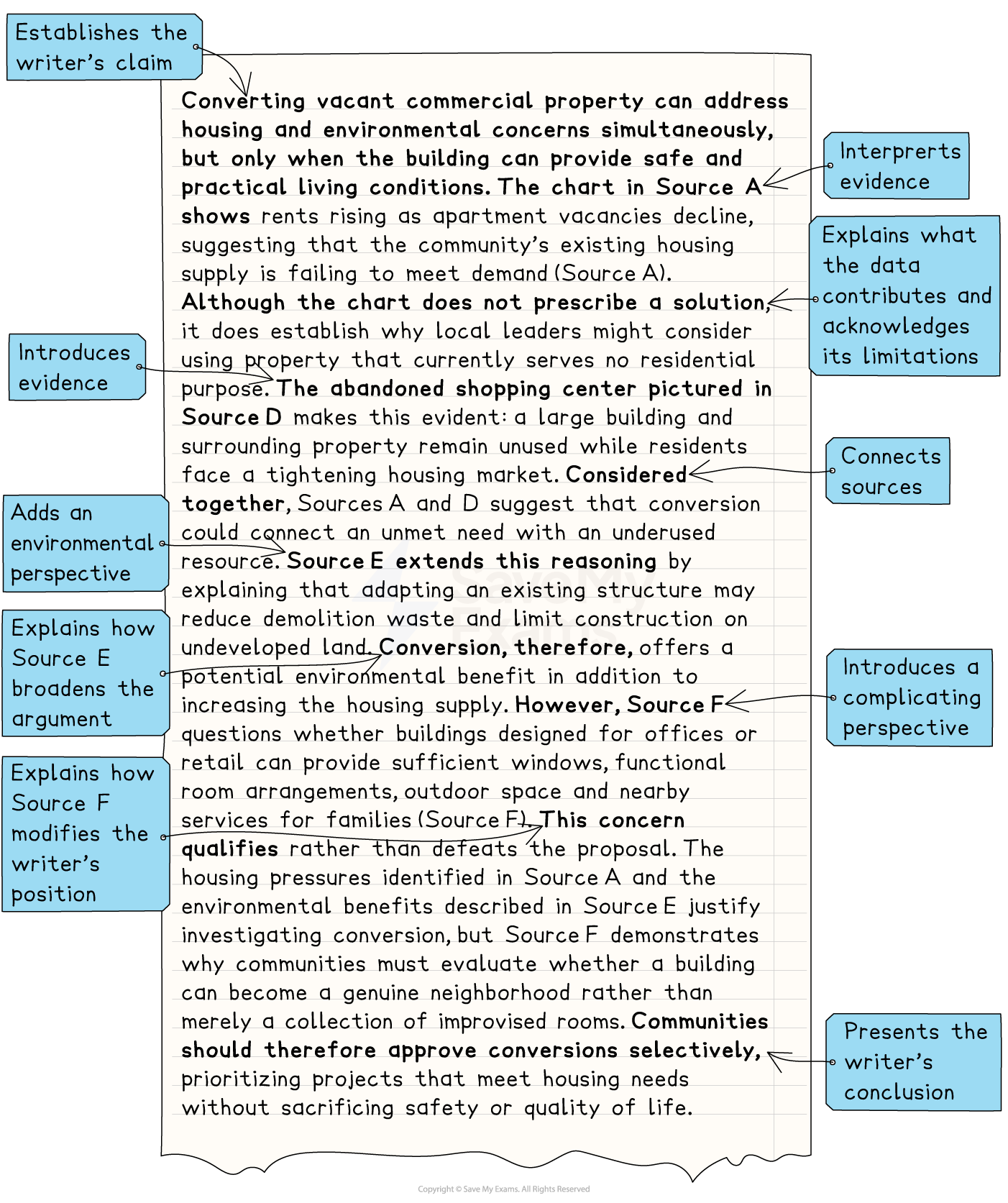
Why the paragraph is effective:
It keeps the writer’s reasoning central
It places sources into agreement, extension, contention and qualification
It acknowledges the limitation of the chart and the photograph
It avoids assigning a simple “for” or “against” position to every source
It distinguishes what a source states from what the writer infers
Tips for incorporating multiple perspectives
Put sources in conversation:
Explain how the sources interact through:
Agreement: one source reinforces or extends another
Contention: one source challenges or contradicts another
Qualification: one source introduces a condition, limitation or exception
Keep your position central:
Before including a source, ask: “What specific function does this perspective perform in my reasoning?”
A source should support, extend, qualify or challenge an idea. After you present it in your paragraph, explain what the source helps you to conclude
Common mistakes when incorporating multiple perspectives
Treating every source as a separate perspective:
Two sources may share the same perspective, while two sources with the same position may approach the issue through very different concerns
Reducing the issue to two sides:
Complex issues usually involve more than “for” and “against.” A source may support a proposal while disagreeing about specific aspects, such as:
Cost
Design
Timing
Implementation
Likely effects or outcomes
Summarizing sources one at a time and stringing them together:
"Source A discusses housing. Source B discusses the environment. Source C discusses costs."
Announcing a relationship without explaining it:
"Sources A and B agree."
Misrepresenting a source:
Always seek to convey the source’s ideas with clarity and accuracy
Frequently asked questions
What's the difference between a viewpoint and a perspective?
A viewpoint is a general opinion or way of seeing an issue. A perspective is the lens shaped by a person’s experience, expertise, values, interests or responsibilities. For AP Lang, it is useful to distinguish that a viewpoint is what a source argues. A perspective is the lens from which the source argues.
How is incorporating perspectives different from synthesis?
Incorporating perspectives is one part of synthesis. Synthesis is the broader process of selecting, combining and explaining source material to develop your own argument. Incorporating perspectives focuses on understanding the different lenses represented by the sources and explaining how their arguments interact.
How many perspectives should I include?
There is no determined number of perspectives you should include. You should include enough perspectives to:
Develop your reasoning
Represent the issue accurately
Address important concerns
Avoid oversimplification
How are multiple perspectives tested in AP Lang FRQs?
Multiple perspectives are most directly involved in the synthesis essay in which you will develop a position by selecting and integrating evidence from provided sources.
Key terms and glossary
Agreement: a relationship in which sources support a shared idea or conclusion
Challenge: to question, dispute or complicate an argument or assumption
Contention: disagreement or tension between source claims, interpretations or solutions
Extend: to add a new implication, application or dimension to an argument
Integration: the process of incorporating source material purposefully into the writer's own argument
Multiple perspectives: different lenses through which people understand an issue, shaped by experience, expertise, interests or values
Perspective: the lens through which a source approaches an issue, shaped by its background, experience, expertise, interests or values
Position: the claim or stance a source takes on an issue
Qualification: a condition, limitation or exception that makes a claim more precise
Source conversation: the interaction among sources as they agree, contend with, extend or qualify one another
Source function: the purpose a source serves within the writer's argument
Strategic selection: choosing source material because it directly advances the reasoning
Support: to reinforce a claim through relevant evidence or reasoning
Synthesis: the process of considering, explaining and integrating ideas from multiple sources into your own argument
Viewpoint: a general opinion or way of understanding an issue

Unlock more, it's free!
Join the 100,000+ Students that ❤️ Save My Exams
the (exam) results speak for themselves:

Was this revision note helpful?