Introduction to the Rhetorical Situation (College Board AP® English Language & Composition): Study Guide
This study guide introduces you to the rhetorical situation, the key elements of the rhetorical situation and the most common frameworks used. It includes a step-by-step guide to analyzing the rhetorical situation, a worked example and common mistakes students make.
What is the rhetorical situation?
The rhetorical situation is the set of circumstances that shapes a text. In AP Lang, you need to understand that writers make choices purposefully. These choices are influenced by the situation in which they are writing and include the following:
What prompted the text
Who the writing is addressing
What the writer wants to achieve
When and where the text was created
What message the writer wants to communicate
These choices or elements each have names. Understanding them helps students to explain why a writer uses particular rhetorical choices.
The elements of the rhetorical situation
Exigence
Exigence is the issue, event, problem or situation that prompts a writer to create a text. It answers the question: why is the writer creating this text now?
Writers may be prompted by:
A public debate
A political event
A social problem
A crisis
A personal experience or
A need to inform, persuade or encourage a response
For example:
Abraham Lincoln’s Gettysburg Address was delivered in 1863 during the American Civil War, at the dedication of a cemetery for soldiers who died at the Battle of Gettysburg. Lincoln honors the soldiers’ sacrifice, but he also urges the living to continue their work.
Let’s examine exigence in the following excerpt:
Example | Exigence |
|---|---|
“The world will little note, nor long remember what we say here, but it can never forget what they did here. It is for us the living, rather, to be dedicated here to the unfinished work which they who fought here have thus far so nobly advanced. It is rather for us to be here dedicated to the great task remaining before us…” | The speech is prompted by the dedication of a cemetery for soldiers who died at Gettysburg |
Examiner Tips and Tricks
Exigence and purpose are sometimes confused. Remember, exigence answers “Why was this text created now?”, while purpose answers “What does the writer or speaker want this text to achieve?”
Audience
Audience is the person or group the writer addresses. An audience may share beliefs, values, needs, concerns, experiences or assumptions. However, an audience is not always completely unified; individual members of the audience may have different views or backgrounds. Writers, therefore, adapt their choices for their audience. They may adjust their tone, evidence, examples or language based on what the audience knows, believes or values.
For example:
Example | Audience |
|---|---|
“The world will little note, nor long remember what we say here, but it can never forget what they did here. It is for us the living, rather, to be dedicated here to the unfinished work which they who fought here have thus far so nobly advanced. It is rather for us to be here dedicated to the great task remaining before us…” | Lincoln addresses the people gathered at the cemetery dedication, as well as the wider American public |
Purpose
Purpose is what the writer hopes to accomplish.
A writer may want to:
Inform
Persuade
Criticize
Defend
Explain
Challenge
Inspire or
Call the audience to action
Frequently, a writer has more than one purpose.
For example:
Example | Purpose |
|---|---|
“The world will little note, nor long remember what we say here, but it can never forget what they did here. It is for us the living, rather, to be dedicated here to the unfinished work which they who fought here have thus far so nobly advanced. It is rather for us to be here dedicated to the great task remaining before us…” | Lincoln honors the dead while encouraging the living to continue the work of preserving the nation |
Writer (or speaker)
The writer or speaker is the person or voice creating the text. The writer’s identity and role can affect how the audience receives the message. Therefore, consider:
The writer’s role or position
The writer’s credibility
The writer’s relationship to the subject
The writer’s relationship to the audience
The writer’s attitude toward the issue
What the writer stands to gain
Context
Context is the broader issue surrounding the text. Context helps explain why a text matters and how an audience might understand it.
Context may include:
Time
Place
Occasion
Historical moment
Cultural expectations
Social conditions or
Political circumstances
For example, a speech about freedom will convey a different meaning if delivered during a war, versus in a school assembly; circumstances therefore shape the meaning of words.
Message
The message is the central idea the writer communicates. It answers the question: what does the writer want the audience to understand, believe or do?
Message is more than the writer’s topic.
For example:
Topic | Message |
|---|---|
School phone policies | Phone restrictions help students to focus |
Rhetorical analysis frameworks: SPACE CAT, MSCAPE and SOAPS-Tone
Rhetorical frameworks help you identify the component parts of the rhetorical situation. It is not necessary to use every framework, but three of the most common are:
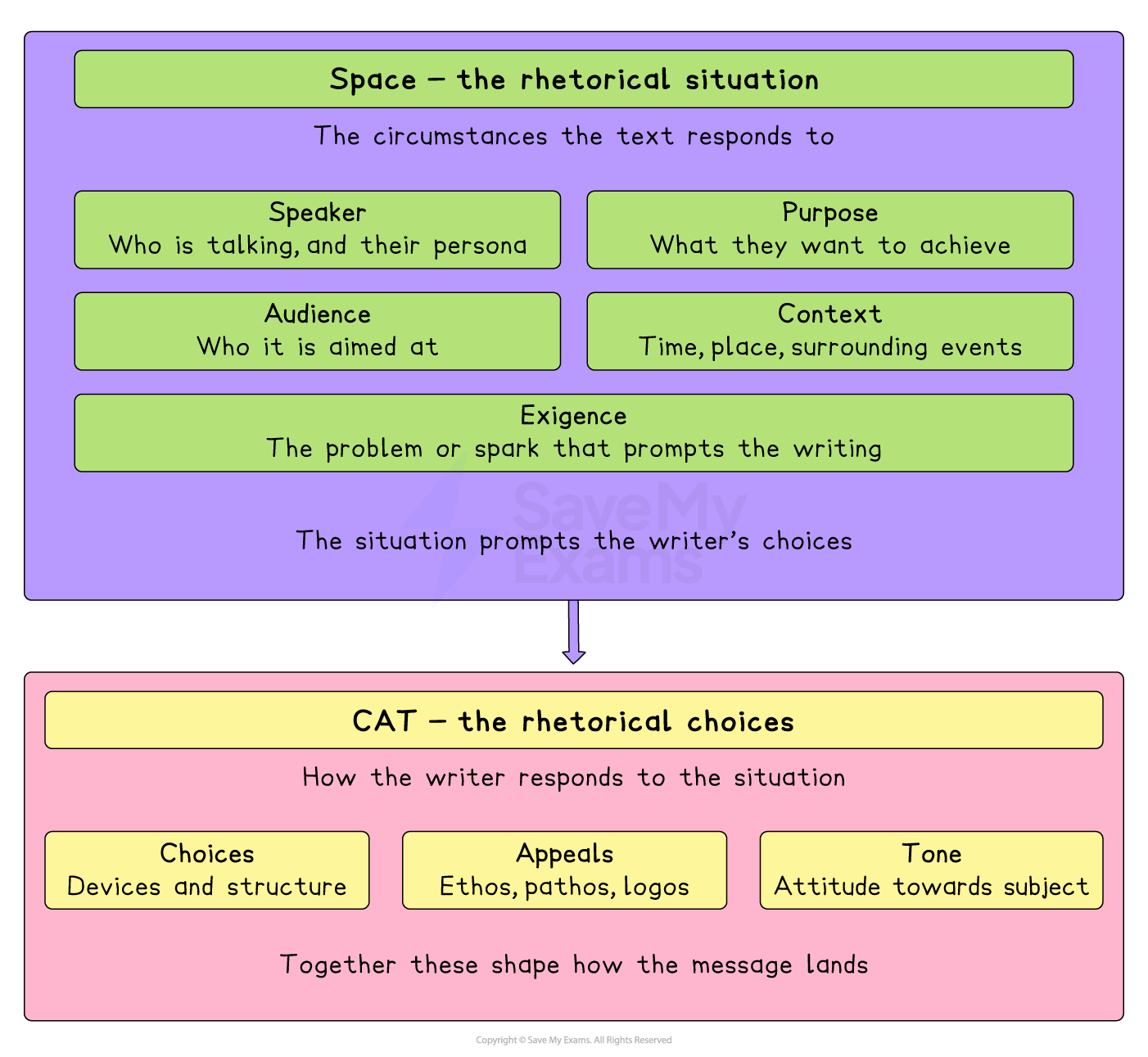
SPACE CAT (Speaker, Purpose, Audience, Context, Exigence + Choices, Appeals, Tone)
SPACE = the rhetorical situation (the circumstances the text responds to):
Speaker: who is talking and their persona
Purpose: what they want to achieve
Audience: who it is aimed at
Context: time, place, surrounding events
Exigence: the problem or spark that prompts the writing
The situation prompts the writer's choices.
CAT = the rhetorical choices (how the writer responds to the situation):
Together these shape how the message lands.
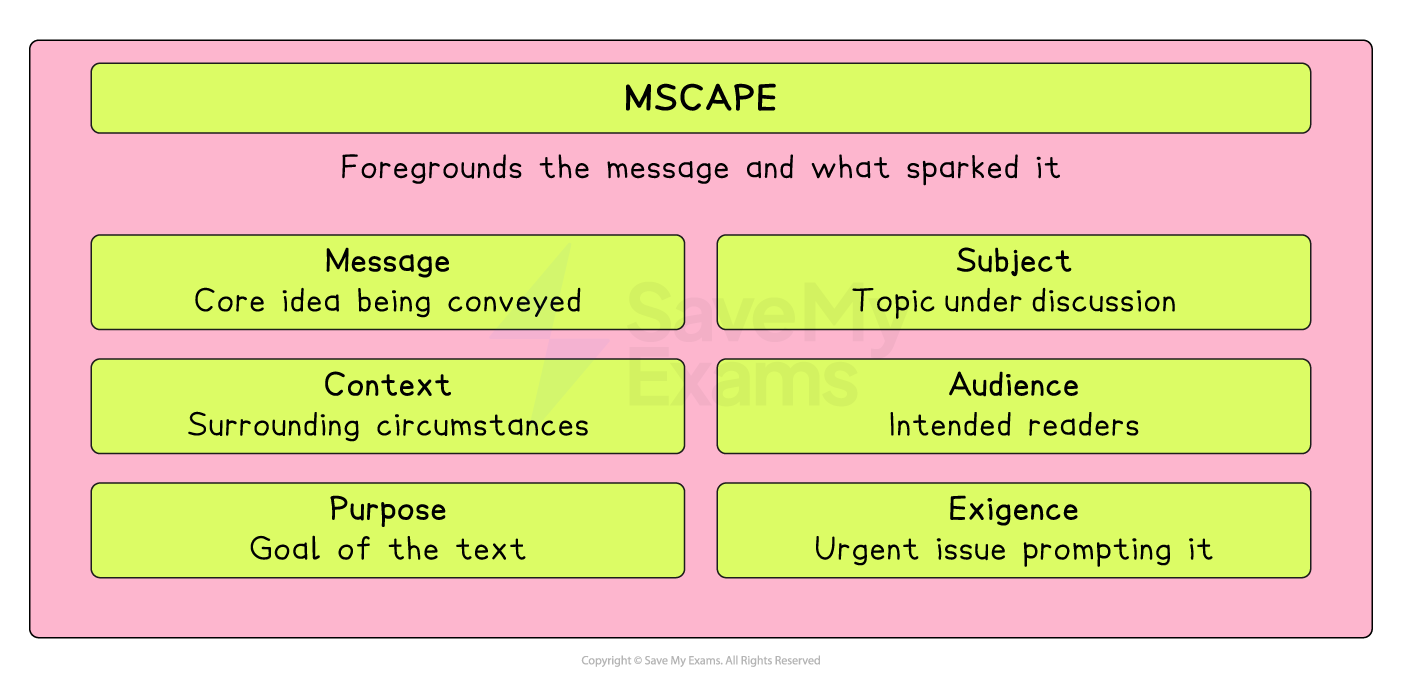
MSCAPE (Message, Subject, Context, Audience, Purpose, Exigence)
Foregrounds the message and what sparked it:
Message: core idea being conveyed
Subject: topic under discussion
Context: surrounding circumstances
Audience: intended readers
Purpose: goal of the text
Exigence: urgent issue prompting it
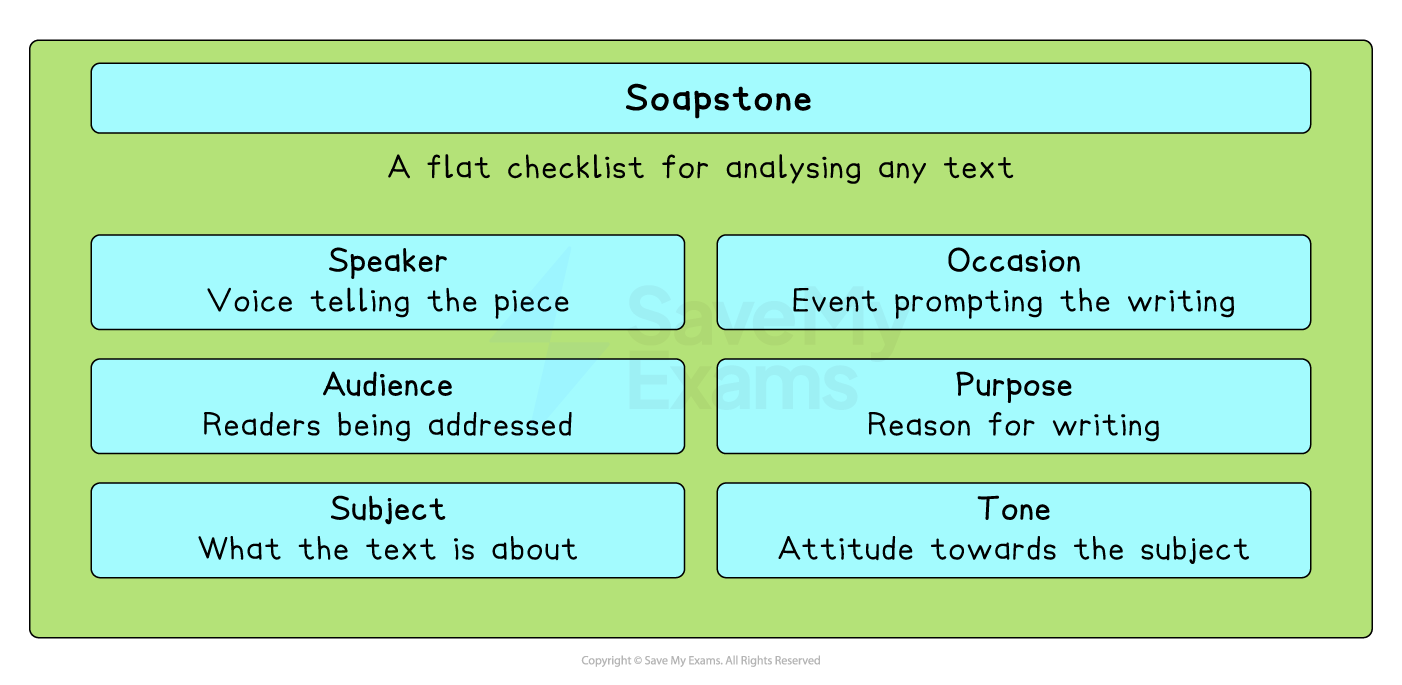
SOAPS-Tone (Speaker, Occasion, Audience, Purpose, Subject, Tone)
A flat checklist for analyzing any text:
Speaker: voice telling the piece
Occasion: event prompting the writing
Audience: readers being addressed
Purpose: reason for writing
Subject: what the text is about
Tone: attitude towards the subject
Which framework should you use?
The best framework is the one that helps identify the rhetorical situation accurately and connect it to the writer’s choices:
SPACE CAT is useful because it connects the rhetorical situation to the writer’s choices
MSCAPE is useful because it separates the subject from the message
SOAPS-Tone is useful for quickly identifying the basic rhetorical situation of a text
It is worth noting that this study guide focuses on the rhetorical situation part of these frameworks. For choices, appeals and tone, please see the study guide Introduction to Rhetorical Choices.
How to analyze the rhetorical situation: step-by-step
When reading a passage, follow these steps, noting that some steps could be answered before others, depending on the passage:
Identify the writer or speaker:
What role, position or perspective does the writer have?
Identify the exigence:
What issue, event or situation prompted the writer to create the text?
Identify the audience:
Who is the writer addressing? What might this audience believe, value or need?
Identify the purpose:
What does the writer want the audience to think, feel, understand or do?
Identify the context:
What time, place, occasion or broader situation surrounds the text?
Identify the message:
What central idea does the writer communicate?
Connect the situation to the choices:
How does the rhetorical situation shape the writer’s tone, evidence, organization or language?
Worked example: annotated rhetorical situation analysis
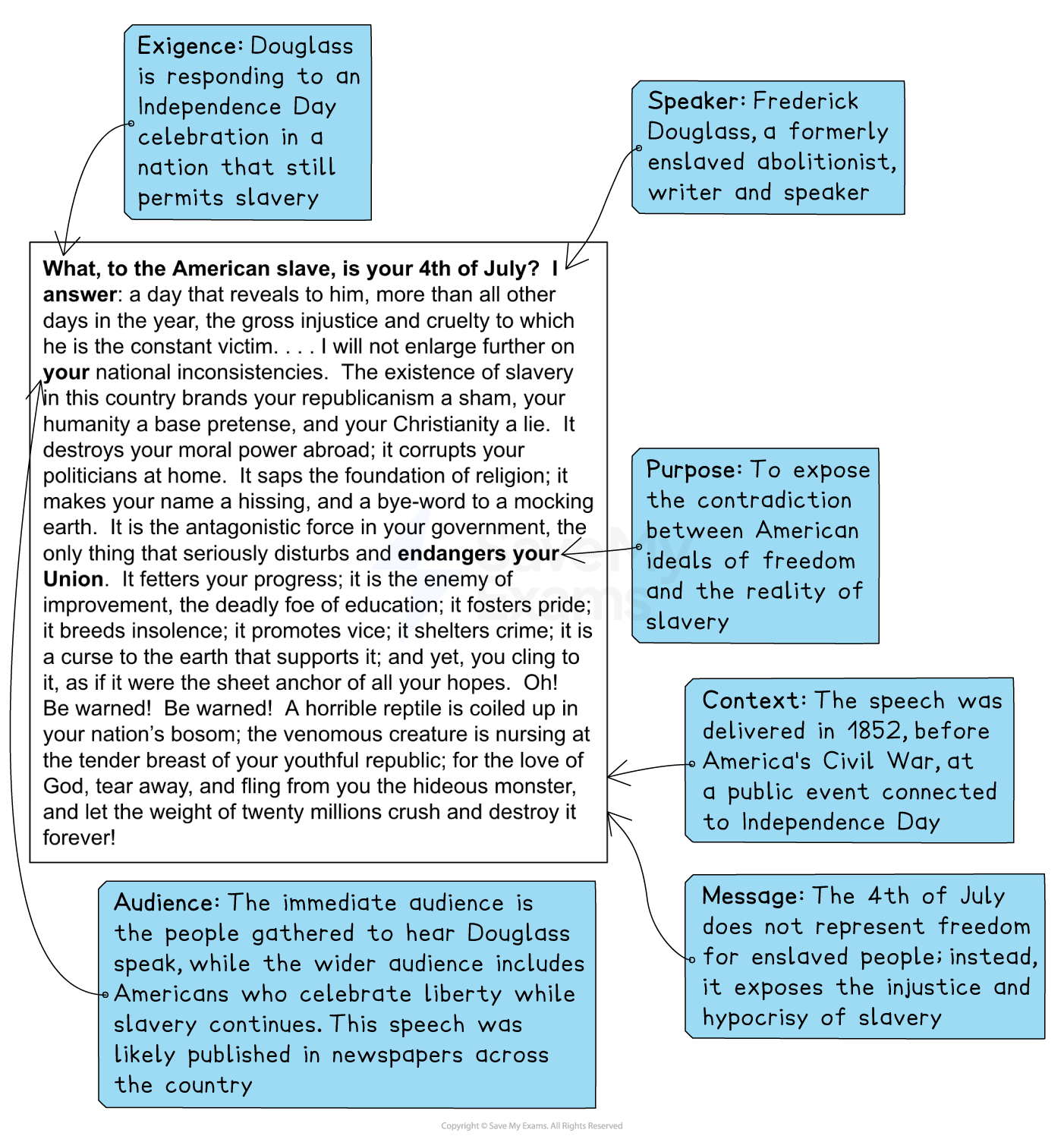
Context:
Frederick Douglass was a formerly enslaved American writer, speaker and abolitionist. In 1852, he was invited to speak at an event connected to Independence Day, the American holiday celebrating freedom from British rule. In his speech, Douglass challenged the audience to consider the contradiction between America’s celebration of liberty and the continued existence of slavery.
Directions:
Read the following excerpt from Douglass’ speech
Identify speaker, exigence, audience, purpose, context and message
Examiner Tips and Tricks
Do not treat the rhetorical situation as a checklist; you should not simply list the audience, purpose and context in your analysis. A strong rhetorical analysis explains how these elements influence the writer’s choices.
Common mistakes in rhetorical situation analysis
Confusing exigence with purpose:
Exigence is why the writer has chosen to write the text at that point in time; purpose is what they have written the text for
Identifying the audience too broadly:
“Everyone” or “the general public” or “the American people” is usually too vague; identify the specific group(s) the writer addresses
Describing the topic instead of the message:
The topic is what the text is about, while the message is what the writer communicates about that topic
Saying that every writer’s purpose is to persuade without understanding:
Writers may also aim to inform, criticize, honor, defend, explain, challenge or call the audience to action
Ignoring the context:
Identifying context is key: the time, place, occasion or broader situation often explains why the writer’s choices matter
Listing appeals without explaining their effect:
Explain how ethos, pathos, logos and kairos help the writer achieve a purpose with a specific audience (for more on appeals, please see Rhetorical Appeals)
Analyzing word choice without connecting it to the rhetorical situation:
Strong analysis explains why a writer’s language or tone fits the audience, purpose or context
Frequently asked questions
What’s the difference between SOAPS-Tone and SPACE CAT?
SOAPS-Tone helps you identify the speaker, occasion, audience, purpose, subject and tone. SPACE CAT includes many of the same components but also emphasizes choices and appeals, making it useful for rhetorical analysis essays.
Is the rhetorical situation the same as the rhetorical triangle?
No. The rhetorical triangle usually focuses on the relationship between the writer, audience and message. The rhetorical situation is broader because it also includes exigence, purpose and context and is therefore more thorough in its use for overall analysis.
Do I need to identify all elements in every essay?
No. You do not need to discuss every element in your essay. You should focus on the elements that are most relevant to the passage and prompt. However, understanding the full rhetorical situation helps you to make stronger claims about the writer’s choices.
How is the rhetorical situation tested in MCQs versus the FRQ 2?
In multiple choice questions, you will likely be asked to identify or explain elements such as audience, purpose, exigence or context. In the FRQ 2, the rhetorical analysis essay, you should use the rhetorical situation to explain how a writer’s choices help to achieve a purpose for a specific audience.
Key terms and glossary
Audience: the person or group a writer addresses or seeks to influence
Context: the time, place, occasion and broader circumstances that surround a text
Exigence: the issue, event, problem or situation that prompts a writer to create a text
Message: the central idea a writer communicates
Purpose: what a writer hopes to accomplish
Rhetorical situation: the circumstances that shape a text, including the exigence, audience, writer, purpose, context and message
Subject: the topic of the text
Tone: the writer's attitude toward the subject, audience or situation
Writer or speaker: the person or voice creating the text

Unlock more, it's free!
Join the 100,000+ Students that ❤️ Save My Exams
the (exam) results speak for themselves:

Was this revision note helpful?