How to Frame an Argument (College Board AP® English Language & Composition): Study Guide

This study guide introduces you to framing an argument in AP Lang. It explains how writers orient an audience, provide necessary context, narrow the focus of an issue and lead readers toward a defensible thesis. Framing helps the audience understand not only what the writer will argue, but also why the issue matters and how the argument should be understood.
What does it mean to frame an argument in AP Lang?
To frame an argument means to prepare the audience to understand the issue, the context, and the writer’s position.
Framing answers questions such as:
What issue is being discussed?
Why does this issue matter?
What situation or debate gives rise to the argument?
What key terms or tensions should the audience understand?
What position will the writer defend?
Framing usually appears near the beginning of an essay, often in the introduction before the thesis. Framing helps the reader move from the broad issue presented to the writer’s specific claim.
Why framing matters: orienting your audience
Framing matters because readers need direction. A thesis may be clear by itself, but without framing, it can feel unsupported.
Note the difference in the lone thesis and the framing of that same thesis:
Lone thesis:
"High schools should create a weekly flex period because students need more support."
Framed thesis:
"Many high schools offer tutoring before or after school, but students with busy schedules, jobs, sports or family responsibilities may not be able to attend these sessions. During the regular school day, students often move quickly from one class to another with little time to ask questions, complete make-up work or meet with teachers. High schools should create a weekly flex period because it would make academic support more accessible without lengthening the school day."
Effective framing helps the audience to understand the following:
The issue
The problem or tension
The reason the argument matters
The direction of the author’s reasoning
Necessary contextualization in AP Lang
Necessary contextualization means providing the background information the reader needs in order to understand the argument. It means establshing what the issue is, why it matters, and what readers need to understand.
Necessary context may include:
The issue being debated
The situation that created the debate
The audience affected by the issue
The values or concerns in tension
The meaning of key terms
The limits of the argument
For example, in an essay about a weekly flex period, students might need to understand that the issue is not simply whether free time is enjoyable. The real question is whether schools should build structured time into the day for tutoring, make-up work, club meetings and independent academic support.
Too little context:
"Schools should have a flex period because students need help."
Too much unfocused context:
"Schools have existed for centuries, and over time have had many different schedules, classes, teachers and responsibilities."
Better contextualization:
"Although many schools provide academic help outside regular hours, that support is not equally available to students who rely on buses, work after school or care for younger siblings. A flex period built into the school day would make support part of the schedule rather than an extra opportunity only some students can use."
How to provide background without summarizing
In AP Lang, framing should lead toward an argument, not simply explain the topic or become a summary. A useful test is to ask: Does this background help the reader understand my claim? If the answer is no, the information probably does not belong in the framing.
Background that summarizes:
"Some schools have flex periods, which some students use for tutoring or clubs. Some teachers like them, and some teachers do not."
Background that frames:
"The debate over flex periods is really a debate over access to support. If help is available only before or after school, then students with transportation, work or family duties may be excluded from the very resources meant to help them succeed."
Strategies for useful background
To provide background without summarizing:
Identify the specific issue
Explain the tension or problem
Include only details the reader needs
Avoid a long history of the topic
Move toward the thesis quickly
Helpful sentence frames
The debate over _________ is really a debate about ________
Although many people assume _______, the more important issue is _______
In this situation, the central tension is between _______ and _______
Before deciding whether _______, readers must consider _______
Where the thesis fits in framing
The thesis is the main claim the writer will defend. Framing leads the audience toward the claim. In a traditional introduction, the movement is often:
Context issue or tension thesis
Example:
"Many students are told to seek help before or after school, but not all students can stay late or arrive early. Transportation schedules, family responsibilities, activities and jobs can make outside-of-school support difficult to access. High schools should create a weekly flex period because it would make academic support more equitable, give students time to manage responsibilities and allow teachers to intervene before small problems become larger ones."
Notice how the first two sentences frame the issue and lead to the final sentence, or the thesis.
In AP Lang, the thesis does not have to be the final sentence of the introduction, and official scoring guidance (the scoring rubric) allows a defensible thesis to appear anywhere in the response. However, placing the thesis near the beginning helps the reader follow the argument more easily.
Step-by-step: how to frame an argument
Read the prompt carefully:
Determine the task, the topic, the context and type of support expected
Identify the issue:
Ask: what is this argument really about?
Identify the tension:
Strong framing often presents a tension between two reasonable concerns
Provide only necessary context:
Include the information readers need to understand the debate
Narrow the focus:
Do not try to address every possible aspect of the issue
Present a defensible thesis:
The thesis should take a position that requires proof or defense
Check that the framing matches the thesis:
After drafting, ask:
Does my framing prepare the reader for my thesis?
Did I include only relevant context?
Did I identify the central issue or tension?
Does the thesis feel like a natural result of the framing?
Worked example: framing an argument
Prompt:
Develop a position on whether high schools should build a weekly flex period into the school schedule for tutoring, makeup work, club meetings and independent academic support
Understand the prompt:
Element | Answer |
|---|---|
Task | Develop a position |
Topic | Whether high schools should create a weekly flex period |
Context | Schools are considering structured time for academic support and student responsibilities |
Type of support | Reasoning and evidence drawn from knowledge, experience, observation or provided sources, depending on the assignment |
Identify the central issue:
The issue is whether schools should make academic support part of the regular schedule rather than an optional resource outside school hours
Identify the tension:
Students’ need for accessible support
Schools’ limited instructional time
The risk that unstructured time could be wasted
Build and check the framing:
Provide necessary context:
Students may be offered time before or after school, but those times are not equally available to students with transportation, work, activities or family responsibilities
Narrow the focus:
The argument focuses specifically on a weekly flex period, not every possible way schools could support students
Present a defensible thesis:
High schools should build a weekly flex period into the schedule because it would make academic support more accessible, give students structured time to manage responsibilities, and allow teachers to address problems before they become more serious
Check the match:
The framing prepares the reader for the thesis by focusing on access, time, structure and the need for support during the school day
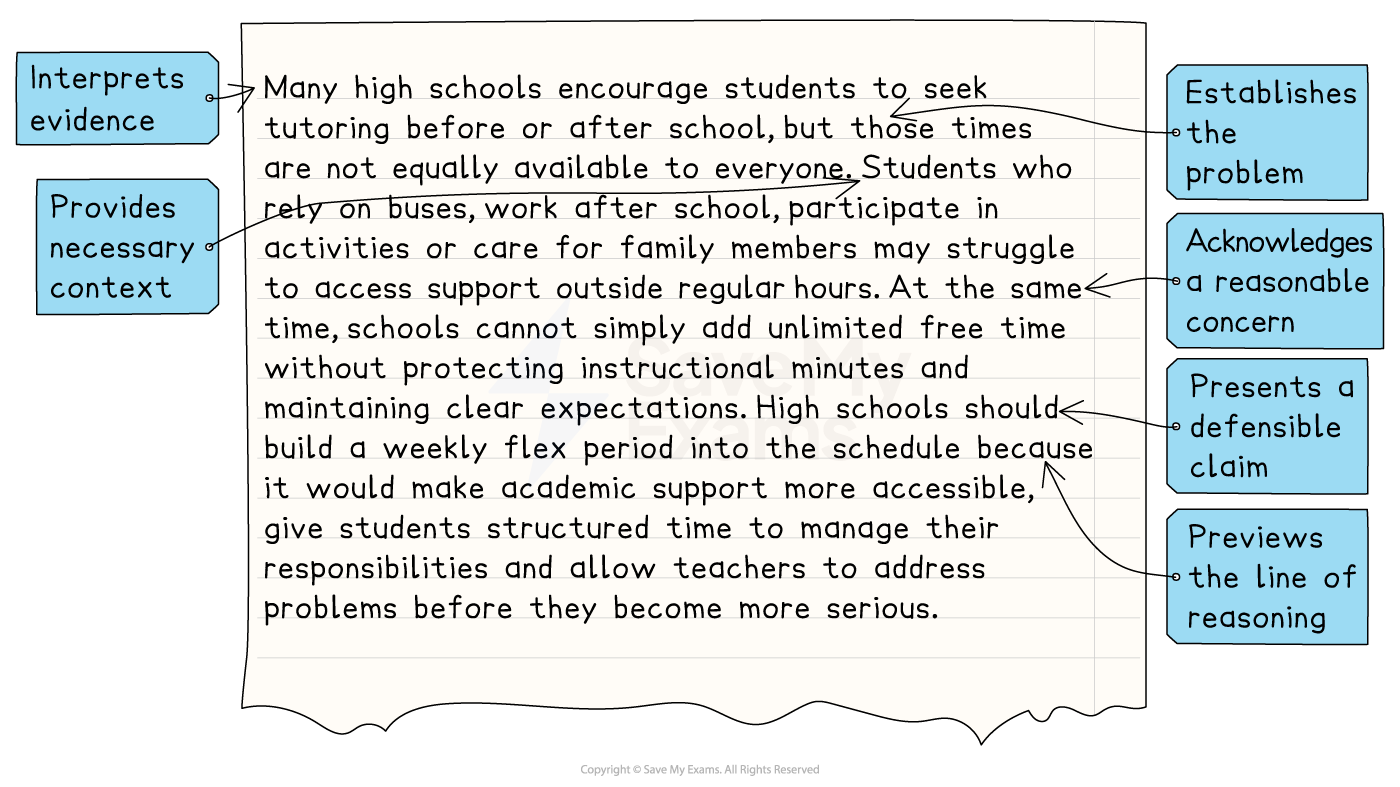
Framed paragraph:
Why the framing is effective:
The paragraph identifies the issue, provides necessary background, acknowledges a complication, narrows the focus and moves smoothly into a defensible thesis.
Tips on framing the argument
Frame the issue, not the universe:
Avoid openings that begin too broadly:
A weak opening might say "Education has always been important to society"
A stronger opening might say: "When academic help is available only outside regular school hours, the students who need support the most may be the least able to access it"
Move from context to claim:
Effective framing should lead naturally to the thesis:
Ask yourself: what does my reader need to understand before my claim makes sense?
Next, provide the information briefly and move to the argument
Common mistakes when framing an argument
Beginning with a vague universal statement
Writing a hook that does not connect to the thesis
Providing background but no argument
Summarizing the issue for too long
Ignoring the task
Having too broad a thesis
Frequently asked questions
What's the difference between framing and a hook?
A hook is one possible opening move used to engage the reader. Framing is broader. It includes the context, issue, tension and focus that prepare the reader to understand the thesis. A hook may be part of the framing, but a hook alone is not enough.
For example, a question, statistic, anecdote or scenario may catch attention, but you still need to connect that opening to the issue and thesis.
How long should the framing section be?
In timed AP writing, framing is usually brief, often two to four sentences before the thesis. The goal is to provide enough context for the thesis to make sense. Frame only what the reader needs in order to understand the claim.
Where in an AP Lang essay should I frame the argument?
Framing usually appears in the introduction before the thesis. However, you may also add brief framing at the start of a body paragraph when a new reason or source requires context.
How is argument framing scored on the FRQs?
Argument framing is not scored as a separate category. It can still help the essay by making the thesis clearer, setting up a line of reasoning and showing awareness of the topic or situation. Proper framing establishes your credibility as a writer and a thinker.
Key terms and glossary
Audience: the person or group a writer addresses or seeks to influence
Background information: information that helps the audience understand the issue
Claim: a statement that presents a writer's position and requires proof or defense
Context: the time, place, occasion and broader circumstances that surround a text
Contextualization: necessary background that helps the audience understand the issue and claim
Defensible thesis: a main claim that responds to the prompt and can be supported with reasoning and evidence
Exigence: the issue, event, problem or situation that prompts a writer to create a text
Framing: the process of orienting the audience to the issue, context, stakes and position of an argument
Hook: an opening strategy that engages the reader's attention and leads toward the argument
Line of reasoning: the logical progression of reasons, evidence and commentary that explains how the thesis is supported
Purpose: what a writer hopes to accomplish
Rhetorical situation: the circumstances that shape a text, including the exigence, audience, writer, purpose, context and message
Stakes: the reason an issue matters or the consequences connected to it
Thesis: the main, overarching claim a writer seeks to defend or prove by using reasoning supported by evidence

Unlock more, it's free!
Join the 100,000+ Students that ❤️ Save My Exams
the (exam) results speak for themselves:

Was this revision note helpful?