Introduction to Rhetorical Choices (College Board AP® English Language & Composition): Study Guide
This study guide introduces you to rhetorical choices in AP Lang. It explains how writers make choices based on an audience’s beliefs, values and needs. It also covers the CAT of SPACE CAT, common rhetorical choices, rhetorical appeals, tone, a step-by-step guide to identifying choices, a worked example and common mistakes students make.
What are rhetorical choices in AP Lang?
Rhetorical choices are the decisions a writer makes to influence an audience and achieve a purpose. These choices are closely connected to the rhetorical situation. Before making choices, a writer considers the situation surrounding the text, including:
Who the audience is
What the audience believes, values or needs
What the writer wants to achieve
What issue or occasion has prompted the text
What context surrounds the argument
Writers then make choices that fit that situation. These choices may involve:
Words
Details
Examples
Evidence
Tone
Structure
Sentence patterns
Rhetorical appeals
For example, a writer responding to an urgent problem may use forceful language, repetition or emotional examples because the purpose is to motivate immediate action.
The CAT of SPACE CAT: choices, appeals, tone
SPACE CAT is a framework you can use to analyze rhetoric. The first part, SPACE, helps students identify the rhetorical situation:
Speaker
Purpose
Audience
Context
Exigence
The second part, CAT, helps you analyze how the writer responds to that situation:
Choices
Appeals
Tone
How CAT extends the rhetorical situation
The rhetorical situation explains the circumstances surrounding a text. CAT explains how the writer responds to those circumstances.
For example:
An audience may be skeptical (rhetorical situation) — in response, the writer chooses to acknowledge opposing views
An audience may feel afraid (rhetorical situation) — in response, the writer chooses to use a calm tone
The issue is urgent (rhetorical situation) — in response, the writer chooses to present a call to action
Why CAT matters for AP Lang analysis
CAT helps you avoid vague analysis that simply identifies some surface-level aspect. For example, a weak response might say:
“The writer uses emotional language.”
Strong AP Lang analysis is deeper, usually explaining what choice the writer makes, how the choice works and why the choice matters for the audience and purpose. This stronger response might say:
“Since the audience may not recognize the problem’s urgency, the writer uses emotionally charged language to present the issue as immediate and morally serious.”
Rhetorical choices: word choice, syntax and structure
Writers use many rhetorical choices, but three important categories are word choice, syntax and structure.
Word choice
Word choice refers to specific words a writer uses. Word choice can affect:
Tone
Mood
Emphasis
Credibility
Emotional impact
The audience’s attitude toward a subject
For example, calling a policy “necessary” creates a different effect from calling it “harmful.”
Syntax
Syntax is the arrangement of words, phrases and clauses in a sentence.
Writers may use syntax to:
Create emphasis
Build momentum
Slow the pace
Show contrast
Create urgency
Make an idea memorable
For example, a writer may use a short sentence, or a purposeful fragment, after a long sentence to make a point feel final or forceful.
Structure
Structure is the way ideas are organized across a paragraph, passage or whole text.
Writers may structure ideas by:
Beginning with a problem
Moving from cause to effect
Comparing two ideas
Acknowledging a counterargument
Building from personal experience to a broader claim
Ending with a call to action
It is important to identify structure because the order of ideas can guide the audience’s response.
Rhetorical appeals: ethos, pathos, logos and kairos
Writers use rhetorical appeals to influence how an audience thinks, feels or responds. The main rhetorical appeals are as follows:
Ethos: an appeal to credibility or character:
It shows the writer is trustworthy, knowledgeable, fair or moral
Pathos: an appeal to emotion:
The writer evokes feelings such as sympathy, anger, fear, hope or pride
Logos: an appeal to logic:
The writer uses evidence, facts, examples, statistics or clear reasoning
Kairos: an appeal to timing or urgency:
The writer shows why an issue matters at that particular moment
For more on rhetorical appeals, see Rhetorical Appeals.
Examiner Tips and Tricks
In AP Lang, you should avoid simply naming an appeal. Strong analysis explains how the appeal helps the writer achieve a purpose with a specific audience.
Tone in AP Lang
Tone is the writer’s attitude toward the subject or audience. It matters because it shapes how the audience receives the message. For example, a writer addressing a grieving audience may use a solemn, respectful tone, while a writer criticizing injustice may use an indignant tone.
Tone should be connected to purpose. You should ask why the writer creates that attitude and how it affects the audience.
How rhetorical choices serve a writer’s purpose
A rhetorical choice is effective when it helps the writer achieve a purpose.
Purpose | Writer’s choice | Effect |
|---|---|---|
To build trust | Acknowledges an opposing view | Makes the writer seem fair and reasonable |
To create urgency | Uses repetition or short sentences | Makes the issue feel immediate |
To clarify an idea | Uses an analogy | Helps the audience to understand a complex point |
To inspire action | Ends with a call to action | Encourages the audience to respond |
To appeal to shared values | Uses inclusive language such as “we” or “our” | Creates a sense of unity or responsibility |
Examiner Tips and Tricks
You should focus on the relationship between the choice and the purpose. A device or technique is only important if it helps the writer communicate the message or influence the audience.
How to identify rhetorical choices: step-by-step
Identify the rhetorical situation:
Who is the writer addressing and what does the writer want to achieve?
Look for patterns:
Does the writer repeat certain words, ideas or sentence structures?
Identify specific choices:
What does the writer do with word choice, syntax, structure, evidence, appeals or tone?
Ask how the choice works:
Does it build trust, create emotion, clarify a point, emphasize urgency or guide the audience’s thinking?
Connect the choice to the audience:
Why would this choice matter to this particular audience?
Connect the choice to purpose:
How does this choice help the writer achieve the purpose?
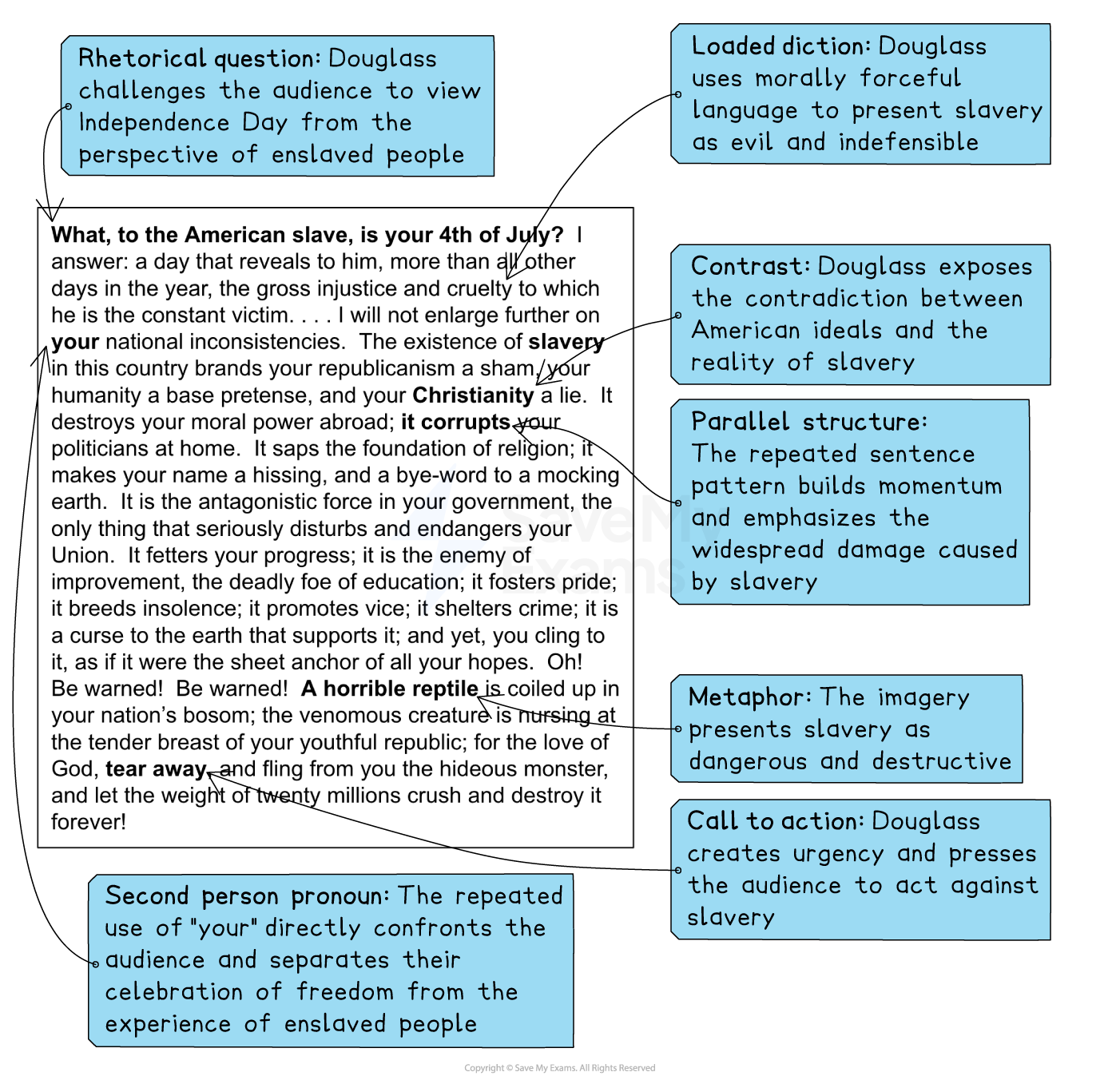
Worked example: annotated analysis of rhetorical choices
Context:
Frederick Douglass was a formerly enslaved American writer, speaker and abolitionist. In 1852, he was invited to speak at an event connected to Independence Day, the American holiday celebrating freedom from British rule. In his speech, Douglass challenged the audience to consider the contradiction between America’s celebration of liberty and the continued existence of slavery.
Directions:
Read the following excerpt from Douglass’ speech
Identify the rhetorical choices (for MSCAPE analysis, see Introduction to The Rhetorical Situation)
Common mistakes when analyzing rhetorical choices
Naming a device without explaining its effect:
Students should explain how the choice shapes the audience’s understanding or response
Using vague verbs such as “shows” or “uses” without analysis:
Strong analysis explains how the choice persuades, emphasizes, contrasts, clarifies or builds trust
Ignoring the audience:
A choice should connect to what the audience believes, values, needs or fears
Ignoring the writer’s purpose:
You should explain how the choice helps the writer achieve a goal
Treating appeals as separate from choices:
Appeals are created through choices such as evidence, word choice, examples, tone or structure
Assuming tone is the same as mood:
Tone is the writer’s attitude, while mood is the feeling created for the audience
Writing a list instead of analysis:
A strong response explains the relationship between the rhetorical situation, the writer’s choices and the intended effect
Frequently asked questions
What’s the difference between rhetorical choices and rhetorical appeals?
Rhetorical choices are the decisions a writer makes, such as using specific words, examples, syntax, structure or tone. Rhetorical appeals are the persuasive effects those choices create, such as ethos, logos, pathos or kairos.
How do I move from naming choices to analyzing them?
You should ask what the choice does for the audience and purpose. Instead of writing, “The writer uses repetition,” you should explain what the repetition emphasizes and why that emphasis matters.
Why is tone treated separately from other rhetorical choices?
Tone is often treated separately because it shapes the audience’s overall impression of the writer and message. However, the tone is still created through choices such as word choice, syntax, details and structure.
How are rhetorical choices tested in AP Lang FRQs?
In the rhetorical analysis essay, you explain how a writer’s choices help achieve a purpose for a particular audience. In synthesis and argument essays, you make your own rhetorical choices when developing claims, selecting evidence and addressing the audience.
Key terms and glossary
Appeal: a method of influencing an audience's judgment, emotions, values or reasoning
Audience: the person or group a writer addresses or seeks to influence
Call to action: a statement that urges an audience to think, feel or act in a particular way
Ethos: an appeal based on credibility, character and trust
Kairos: an appeal based on timing and circumstance — presenting an argument at the most opportune moment
Logos: an appeal based on logic, evidence and reasoning
Pathos: an appeal to an audience's emotions, values or senses
Purpose: what a writer hopes to accomplish
Rhetorical choice: a decision a writer makes to influence an audience and achieve a purpose
Structure: the organization of ideas in a paragraph, passage or whole text
Syntax: the arrangement of words, phrases and clauses in a sentence
Tone: the writer's attitude toward the subject, audience or situation
Word choice: the specific words a writer selects to communicate meaning, tone and perspective

Unlock more, it's free!
Join the 100,000+ Students that ❤️ Save My Exams
the (exam) results speak for themselves:

Was this revision note helpful?