The Auditory Sensory System (College Board AP® Psychology): Study Guide

Structures and functions of the auditory sensory system
Sound is produced by the vibration of air molecules in waves
Two key physical properties determine how we perceive sound:
Physical property | Perceived as | Example |
|---|---|---|
Amplitude (height of the wave) | Loudness — measured in decibels (dB) | A whisper has low amplitude; a rock concert has high amplitude |
Frequency (cycles per second, Hz) | Pitch — high Hz = high pitch; low Hz = low pitch | A bird's chirp has high frequency; a bass guitar has low frequency |
Sound waves travel from the environment to the brain via a sequence of structures:
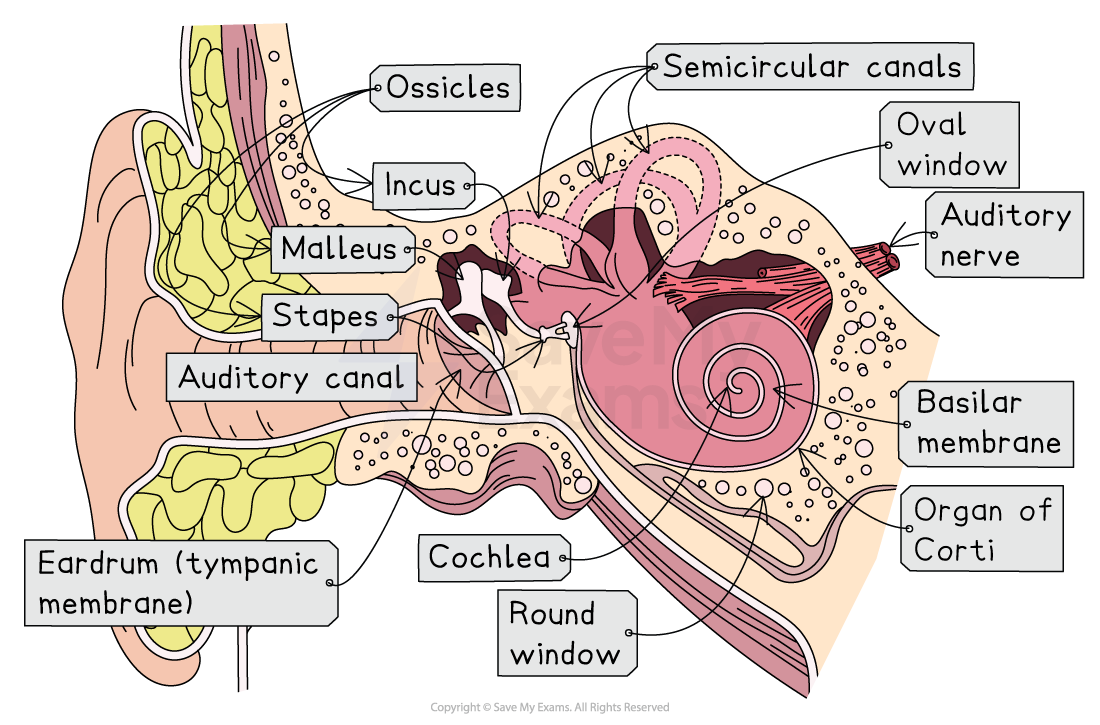
Sound waves enter the outer ear canal and travel to the tympanic membrane (eardrum), which vibrates in response
Vibrations pass through three tiny bones in the middle ear
the malleus (hammer)
incus (anvil), and
stapes (stirrup)
These tiny bones are collectively called the ossicles, which amplify the vibrations
E.g., the ossicles amplify sound by a factor of approximately 20, allowing very faint sounds to be detected
The stapes transmits vibrations to the oval window
This is the membrane-covered entry point to the fluid-filled inner ear
The cochlea is a spiral-shaped, fluid-filled structure in the inner ear containing the basilar membrane and hair cells
This is where transduction occurs; fluid movement caused by incoming sound waves bends the hair cells, converting mechanical movement into neural signals
Neural signals travel via the auditory nerve to the temporal lobe for processing
E.g., loud noise over time physically damages hair cells — because hair cells do not regenerate, this damage is permanent, which is why prolonged exposure to loud music causes lasting hearing loss
Theories of pitch perception
Three theories work together to explain how we perceive pitch across different frequency ranges:
Place theory
Frequency theory
Volley theory
Place theory asserts that different frequencies activate hair cells at different locations along the basilar membrane
The brain determines pitch based on where the membrane is vibrating most
E.g., high-pitched sounds (like a whistle) activate hair cells near the base of the cochlea; low-pitched sounds activate hair cells near the apex
This theory best explains high-pitched sounds
Frequency theory suggests that the basilar membrane vibrates at the same rate as the sound wave
The auditory nerve fires at the same rate, sending pitch information to the brain
E.g., a 500 Hz sound causes the auditory nerve to fire 500 times per second
This theory best explains low-pitched sounds (up to ~1,000 Hz)
Volley theory extends frequency theory for mid-range frequencies (~1,000–4,000 Hz)
Groups of neurons take turns firing in rapid succession, allowing the overall firing pattern to match the sound wave frequency even when no single neuron could fire fast enough alone
E.g., to match a 3,000 Hz sound, three groups of neurons each fire 1,000 times per second in alternating volleys
Best explains mid-range sounds
No single theory fully accounts for all pitch perception, rather the three theories work together across different frequency ranges
Sound localization
Sound localization is the brain's ability to determine the direction from which a sound originates
The brain compares the timing and loudness of a sound arriving at each ear to calculate its direction
E.g., a sound coming from your right reaches your right ear a fraction of a second before your left ear — the brain detects this tiny time difference to identify the direction
Binaural (two-ear) hearing is essential for localization
People with hearing loss in one ear find it very difficult to locate where sounds are coming from
Hearing difficulties and deafness
Type | Cause | Example | Reversibility |
|---|---|---|---|
Conduction deafness | Damage to the mechanical structures that conduct sound to the cochlea (eardrum, ossicles, ear canal) | A perforated eardrum from an ear infection | Often treatable with hearing aids or surgery |
Sensorineural deafness (nerve deafness) | Damage to the hair cells in the cochlea or the auditory nerve; hair cells do not regenerate | Permanent hearing loss from years of working in a loud factory without ear protection | Typically permanent; profound cases may be addressed with a cochlear implant |
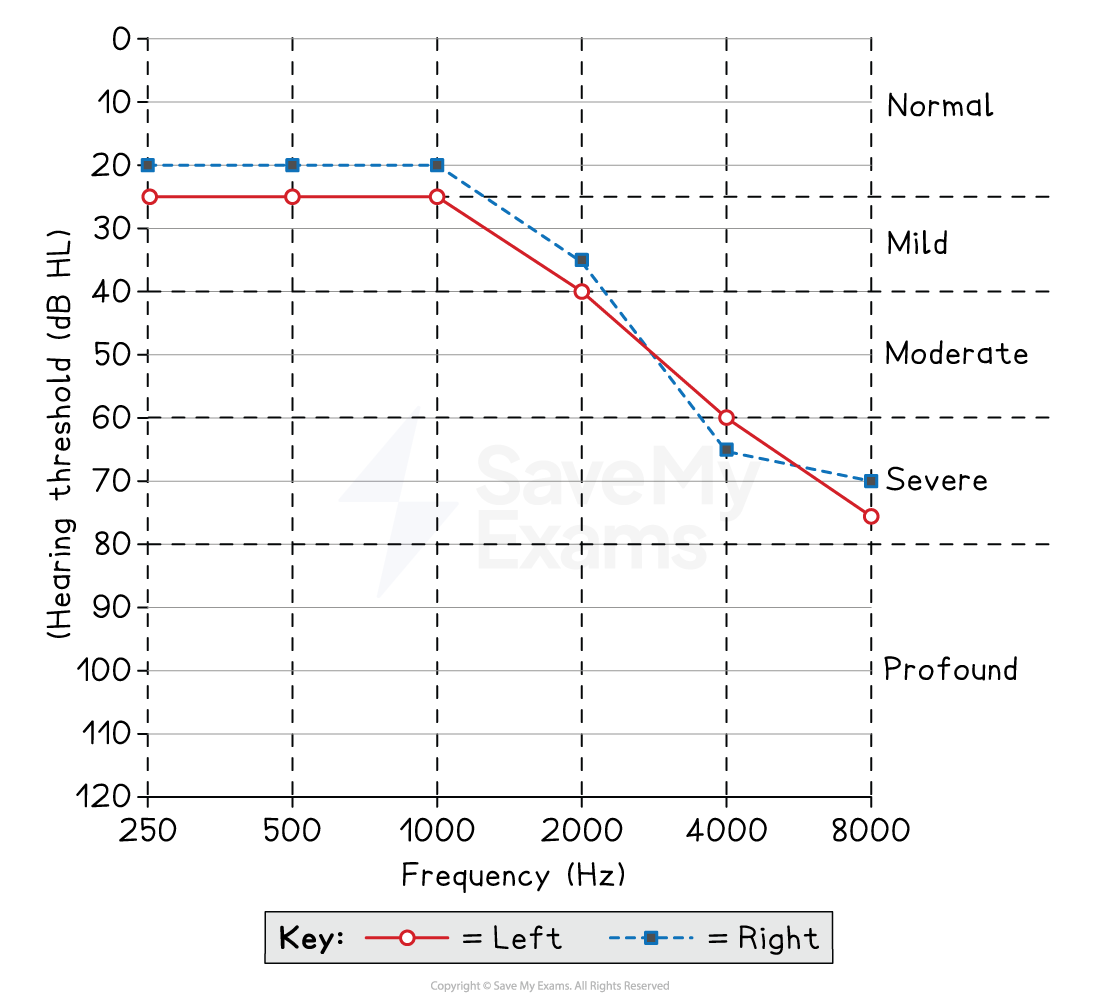
Age-related hearing loss (presbycusis) is common and typically begins with progressive loss of sensitivity to high-frequency sounds first
Examiner Tips and Tricks
For Skill 1.A, pitch theory questions may describe a sound and ask which theory explains its perception
Always check whether the sound is described as high, low, or mid-range before selecting your answer
For Skill 1.A, hearing loss questions may describe a person's symptoms and ask you to identify the type of deafness
Locate where the damage occurs, e.g. before the cochlea (conduction) or at/after the cochlea (sensorineural)
Amplitude and frequency are physical properties of sound waves, whereas loudness and pitch are how we perceive them
The exam may test whether you can correctly match the physical property to the perceptual experience (Skill 1.A)
For Skill 3.C, audiograms are graphs that plot hearing threshold (in dB) against frequency (in Hz)
A person with age-related hearing loss would show elevated thresholds at high frequencies. Be able to identify which frequencies show the greatest threshold elevation and link this to the type and likely cause of hearing loss

Unlock more, it's free!
Join the 100,000+ Students that ❤️ Save My Exams
the (exam) results speak for themselves:

Was this revision note helpful?