The Process of Neural Transmission (College Board AP® Psychology): Study Guide

Neural transmission
Neural transmission is the process by which information is communicated within and between neurons
It is the biological basis of every thought, feeling, and behavior
Neural transmission involves two stages:
Electrical transmission — the signal travels along the length of a single neuron as an electrical impulse
Chemical transmission — the signal crosses the gap between neurons (the synapse) via chemical messengers called neurotransmitters
This process occurs in an orderly, systematic way and involves six key concepts:
resting potential
threshold
depolarization
the all-or-none principle
the refractory period
reuptake
Stage 1: Electrical transmission — the action potential
Resting potential
When a neuron is not firing, it is in a resting state - this electrical charge is known as the resting potential
The neuron is described as polarized in this state as it is negatively charged on the inside, positively charged on the outside
Threshold
For a neuron to fire, it must receive enough incoming stimulation to reach a critical level of charge known as the threshold
If the combined input from other neurons is sufficient to push the charge to approximately −55 millivolts, the threshold is reached and the neuron fires
If the threshold is not reached, the neuron does not fire
Depolarization
Once the threshold is reached, positive ions rush into the cell, rapidly changing the membrane potential from negative to positive
This change in charge travels down the length of the axon as an action potential — the electrical impulse that carries information along the neuron
Depolarization spreads progressively down the axon toward the terminal buttons
The all-or-none principle
A neuron either fires completely or does not fire at all; there is no in-between
The strength of the action potential is always the same regardless of the strength of the stimulus
E.g. a louder noise does not produce a stronger action potential in a single neuron, but it may cause more neurons to fire more frequently
This principle means neural communication is reliable and consistent
The refractory period
Immediately after firing, the neuron cannot fire again for a brief period while it resets to its resting potential
During the absolute refractory period, no amount of stimulation can trigger another action potential
During the relative refractory period that follows, the neuron can fire again but requires stronger-than-normal stimulation to do so
The refractory period limits the rate at which a neuron can fire and ensures signals travel in one direction only
Stage 2: Chemical transmission — across the synapse
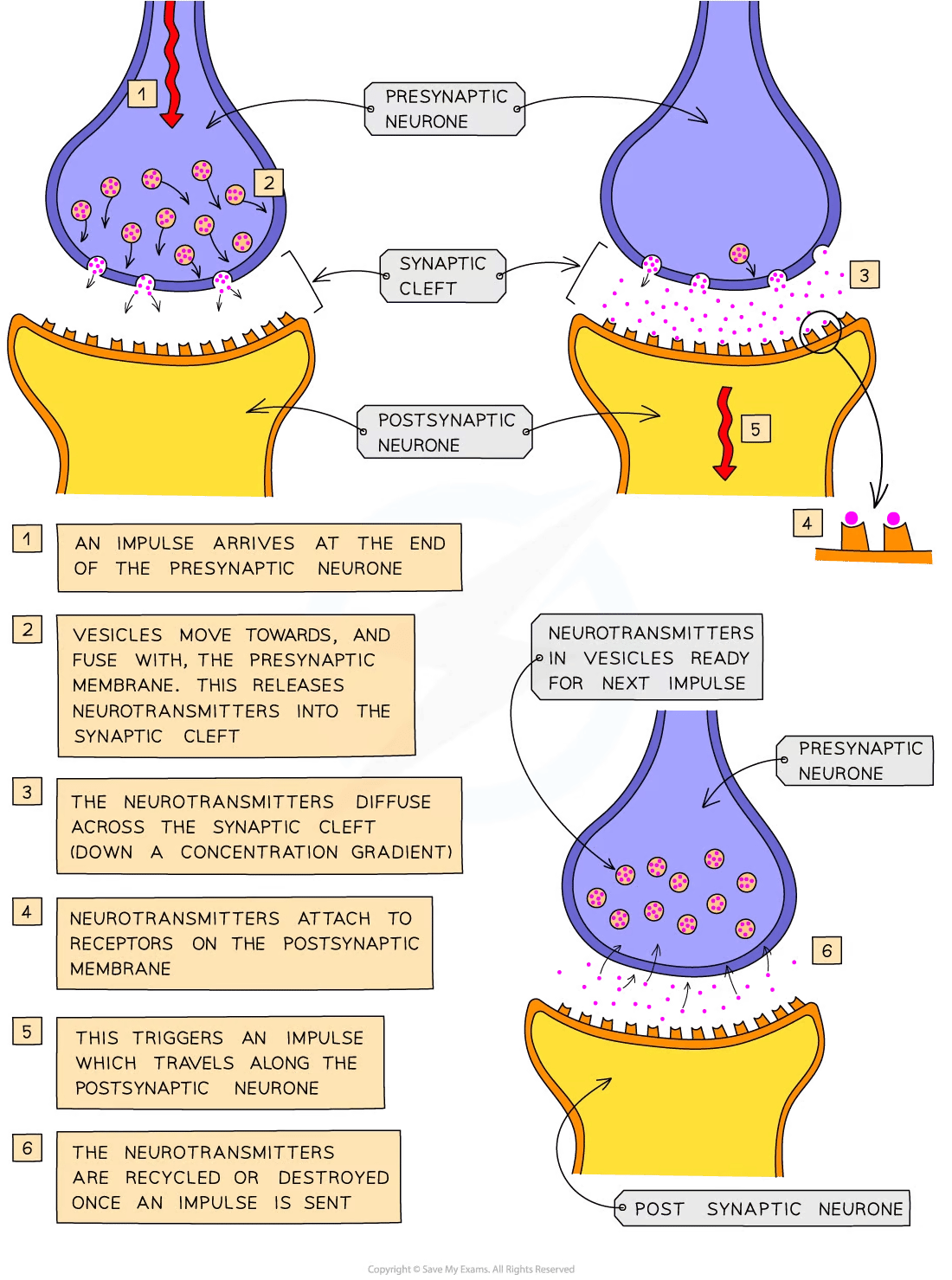
When the action potential reaches the terminal buttons at the end of the axon, it triggers the release of neurotransmitters from small storage sacs called vesicles
Neurotransmitters are released into the synaptic cleft
This is the gap between the terminal buttons of the presynaptic neuron and the dendrites of the postsynaptic neuron
Neurotransmitters diffuse across the synaptic cleft and bind to receptor sites on the postsynaptic membrane
Receptor sites are specific to particular neurotransmitters, like a lock-and-key mechanism
Binding at the postsynaptic receptor either:
Excites the postsynaptic neuron
This makes an action potential more likely by pushing the charge toward threshold
Inhibits the postsynaptic neuron
This makes an action potential less likely by pushing the charge away from threshold
Whether the postsynaptic neuron fires depends on the sum of all excitatory and inhibitory signals it receives at any given moment
This is known as summation
After neurotransmitters have been released and have bound to receptor sites, they are cleared from the synaptic cleft
Most neurotransmitters are reabsorbed back into the presynaptic neuron through a process called reuptake, where they can be recycled and used again
Some are broken down by enzymes in the synaptic cleft
Reuptake is essential for terminating the signal and preventing continuous, uncontrolled firing of the postsynaptic neuron
When neural transmission goes wrong
Disruptions to the process of neural transmission can have significant consequences for behavior and mental processes
Multiple sclerosis (MS) is a disorder in which the immune system attacks and deteriorates the myelin sheath surrounding axons
Without adequate myelination, the electrical signal slows down or fails to travel efficiently along the axon
This disrupts motor control, coordination, and sensation depending on which neurons are affected
Myasthenia gravis is a disorder in which the immune system attacks the receptor sites at the neuromuscular junction, blocking the neurotransmitter acetylcholine from binding
Because acetylcholine is responsible for triggering muscle contractions, this disruption leads to muscle weakness and fatigue
This illustrates how disrupted chemical transmission at the synapse directly affects behavior and physical functioning
Examiner Tips and Tricks
The six key concepts (resting potential, threshold, depolarization, the all-or-none principle, the refractory period, and reuptake) are all individually assessable on the AP exam (Skill 1.A)
Make sure you can define each one precisely and explain its role in the sequence of neural firing
You may be given a scenario describing a disorder or drug effect and asked to identify which stage of neural transmission has been disrupted (Skill 1.A)
E.g. a drug that blocks reuptake keeps neurotransmitters in the synapse longer, prolonging their effect
Myasthenia gravis blocks receptor binding, preventing the postsynaptic neuron from receiving the signal
For Skill 3.A, you may be shown a diagram of a synapse or an action potential and asked to identify a specific concept
Practice matching each term to where it occurs in the sequence
Neurotransmitters affecting behavior
Each neurotransmitter has specific functions related to behavior and mental processes
How a neurotransmitter functions depends on its location in the nervous system
Neurotransmitters communicate either:
excitatory messages (making an action potential more likely)
inhibitory messages (making an action potential less likely)
The same neurotransmitter can have different effects depending on:
where in the nervous system it is acting
which receptor it binds to
Below are eight key neurotransmitters affecting behavior:
Neurotransmitter | Key functions | Problems associated with excess or deficit |
|---|---|---|
Dopamine | Motor movement, alertness, anticipation of reward | Deficit linked to Parkinson's disease; excess linked to schizophrenia |
Serotonin | Mood regulation, sleep, pain sensitivity, hunger | Deficit linked to clinical depression |
Norepinephrine | Alertness and arousal | Deficit linked to depression |
Glutamate | Excitatory neurotransmitter; involved in memory | Associated with migraines and seizures when dysregulated |
GABA | Primary inhibitory neurotransmitter | Dysregulation linked to seizures and sleep problems |
Endorphins | Pain control; produces feelings of wellbeing | Involved in addictions |
Substance P | Pain perception | Deficit may be associated with lack of pain perception |
Acetylcholine | Motor movement; memory function | Deficit linked to Alzheimer's disease; also involved in myasthenia gravis, which causes muscle weakness |
Key distinctions
Glutamate is the brain's primary excitatory neurotransmitter
It makes action potentials more likely
GABA (gamma-aminobutyric acid) is the brain's primary inhibitory neurotransmitter
It makes action potentials less likely
It is essentially glutamate's counterpart
Endorphins are the body's natural painkillers
They are released during physical exercise, injury, or excitement and reduce the perception of pain
Acetylcholine was the first neurotransmitter ever identified
It plays a dual role in both the central nervous system (memory) and the peripheral nervous system (muscle contraction)
Examiner Tips and Tricks
Only the eight named neurotransmitters above will be assessed on the AP exam — make sure you can describe the key function of each and the behavioral consequences of an excess or deficit (Skill 1.A).

Unlock more, it's free!
Join the 100,000+ Students that ❤️ Save My Exams
the (exam) results speak for themselves:

Was this revision note helpful?