Retrieval & Forgetting (College Board AP® Psychology): Study Guide

Retrieval processes
Retrieval is the process of accessing and bringing stored information out of memory so it can be used
There are two main types of retrieval:
Recall: retrieving information without external cues. The information must be reproduced from memory alone
E.g. answering a free-response exam question, recalling someone's name without being prompted
Recognition: identifying previously encountered information when it is presented. This relies on retrieval cues
E.g. answering a multiple-choice question, identifying a face in a crowd
Recognition is generally easier than recall because the stimulus itself acts as a retrieval cue
Retrieval cues are stimuli that help trigger the retrieval of a memory
The more retrieval cues available, the more likely successful recall becomes
Factors that enhance retrieval
Retrieval is more successful when the conditions at retrieval match the conditions at encoding:
Context-dependent memory: retrieval is enhanced when a person is in the same physical environment as when the information was encoded
E.g. students who studied underwater and were tested underwater recalled more than students who studied underwater but were tested on land .The underwater context served as a retrieval cue
State-dependent memory: retrieval is enhanced when a person is in the same internal physical state (e.g., under the influence of a substance) as when the information was encoded
E.g. information memorized while under the influence of alcohol is more easily recalled in the same state. However, this does not mean the memories are accurate
Mood-congruent memory: people are more likely to recall memories that match their current emotional mood
E.g. when feeling happy, positive memories are more readily recalled. When feeling sad, negative memories come to mind more easily
Retrieval practice and metacognition
Testing effect (retrieval practice effect): the finding that actively retrieving information from memory during study, rather than simply re-reading, significantly improves long-term retention
E.g. taking practice tests, using flashcards, and attempting to recall material from memory are more effective revision strategies than passive re-reading
Metacognition is the awareness and understanding of one's own thinking and memory processes, including the ability to monitor how well you know something and adjust your study strategies accordingly.
E.g. realizing that you can recognize a term on a multiple-choice question but cannot recall its definition without prompts is a metacognitive insight that should lead you to use more active retrieval practice
Examiner Tips and Tricks
For Skill 1.A, retrieval questions may describe a scenario and ask you to identify the type of retrieval or the factor enhancing it
Is the person in the same place they encoded the information (context-dependent)? The same emotional state (mood-congruent)? The same physical state (state-dependent)?
For Skill 3.A, retrieval practice and metacognition questions may describe a study behavior and ask you to identify the concept
Testing effect questions will describe a student using active retrieval and ask why this improves retention compared to re-reading
Forgetting
Forgetting is a normal and inevitable part of memory, which occurs for several reasons
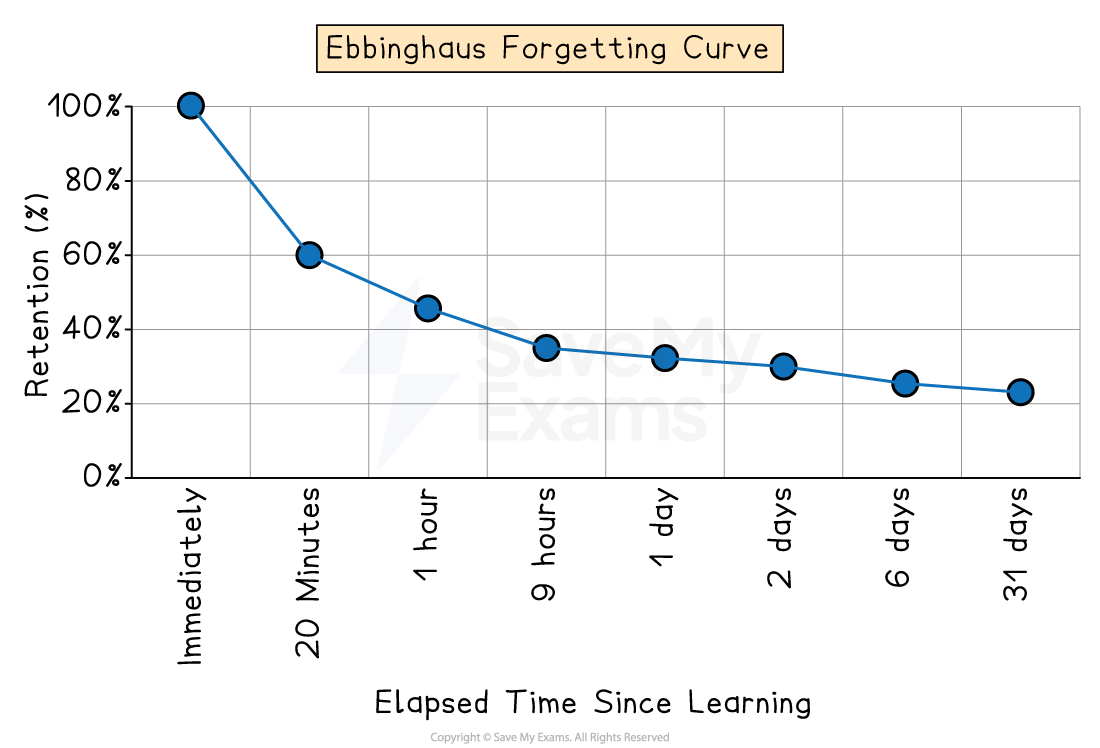
The forgetting curve, described by Hermann Ebbinghaus, shows that forgetting occurs most rapidly immediately after learning and then levels off over time
Most forgetting happens in the first few hours and days after encoding, but after this initial drop, the rate of forgetting slows significantly
E.g. you might forget most of the details of a lecture within 24 hours, but what remains after a week tends to be retained for much longer
The forgetting curve has important implications for study strategies
The spacing effect directly addresses the steep initial forgetting by re-encoding information at intervals before it is fully lost
Causes of forgetting
Encoding failure: information that was never properly encoded in the first place cannot be retrieved, as it was never stored in LTM
E.g. you cannot recall the exact design on the back of a coin you have handled thousands of times because you never encoded that detail
Interference: new or old information competes with and disrupts the retrieval of a target memory. There are two types of interference:
Proactive interference: older information interferes with the recall of newer information
E.g. if you learned French before Spanish, French vocabulary may interfere when you try to recall Spanish words
Retroactive interference: newer information interferes with the recall of older information
E.g. studying sociology the evening after studying psychology may interfere with your recall of the psychology material on the next day's test
Tip-of-the-tongue phenomenon: a state of inadequate retrieval in which a person is certain they know a piece of information but cannot quite retrieve it. They can often recall partial information such as the first letter or number of syllables
E.g. knowing that an actor's name begins with "M" and has three syllables but being unable to fully retrieve it
Repression: a psychodynamic concept proposing that the mind unconsciously pushes distressing or threatening memories out of conscious awareness to protect the ego from psychological distress
Repression is a psychodynamic explanation and is not well supported by experimental evidence. Most memory researchers are skeptical of it as an explanation for forgetting
Examiner Tips and Tricks
For Skill 3.C, the forgetting curve may be presented as a graph
Ensure you can identify the steep initial drop in recall accuracy, the point at which forgetting levels off, and link this to the importance of distributed practice for combating early forgetting
Constructive memory
Memory is not a perfect recording of events - it is a constructive process in which memories are actively built and rebuilt during encoding and retrieval, influenced by schemas, suggestions, and imagination
This means that what we remember is not always an accurate reflection of what actually happened. Memories can be altered, distorted, or even entirely fabricated without the person being aware
Memory consolidation is the process by which newly encoded memories are stabilized into long-term storage
During consolidation, memories are vulnerable to distortion. New information encountered after the original event can alter them before they are fully consolidated
The misinformation effect
The misinformation effect occurs when a person's memory of an event is distorted by misleading information encountered after the event
Research by Elizabeth Loftus demonstrated that asking leading questions after an event can alter participants' memories of what actually happened
For example:
In Loftus' car crash experiment, participants who were asked "How fast were the cars going when they smashed into each other?" reported higher speed estimates and were more likely to falsely recall broken glass
In contrast, participants who were asked "How fast were the cars going when they contacted each other?" reported lower speed estimates and were less likely to report broken glass, even though both groups watched the same footage
Source amnesia (also called source confusion) occurs when a person remembers information but forgets or misattributes where it came from
E.g. a person may remember a fact but incorrectly believe they read it in a reputable newspaper when they actually heard it as a rumor. This can make false information feel credible
Imagination inflation: repeatedly imagining an event that never occurred can increase a person's confidence that the event actually happened
This demonstrates that memories can be created for events that never took place, not just distorted versions of real events
Examiner Tips and Tricks
Ensure that you understand these key points:
Forgetting does not mean the memory has been permanently lost
Many forgotten memories were never properly encoded in the first place (encoding failure), or are temporarily inaccessible due to interference — they may not be gone entirely
Eyewitness memory is not always reliable
Dramatic or emotionally charged events can actually increase susceptibility to the misinformation effect
Proactive and retroactive interference are not the same thing
A useful way to remember the difference between the two is that proactive pushes forward (old disrupts new), whereas retroactive reaches back (new disrupts old)
Examiner Tips and Tricks
For Skill 4.A, constructive memory questions may ask you to make a defensible claim about whether eyewitness testimony is reliable
State your claim clearly, support it with evidence (misinformation effect, source amnesia, imagination inflation), and acknowledge the counterargument before defending your position

Unlock more, it's free!
Join the 100,000+ Students that ❤️ Save My Exams
the (exam) results speak for themselves:

Was this revision note helpful?