Principles of Visual Perception (College Board AP® Psychology): Study Guide

Gestalt principles of perception
Gestalt psychology is an approach to perception proposing that the brain naturally organizes sensory information into whole, meaningful patterns rather than processing individual elements in isolation
E.g. when you look at a face, you do not perceive individual lines and shapes — you immediately perceive a face as a unified whole
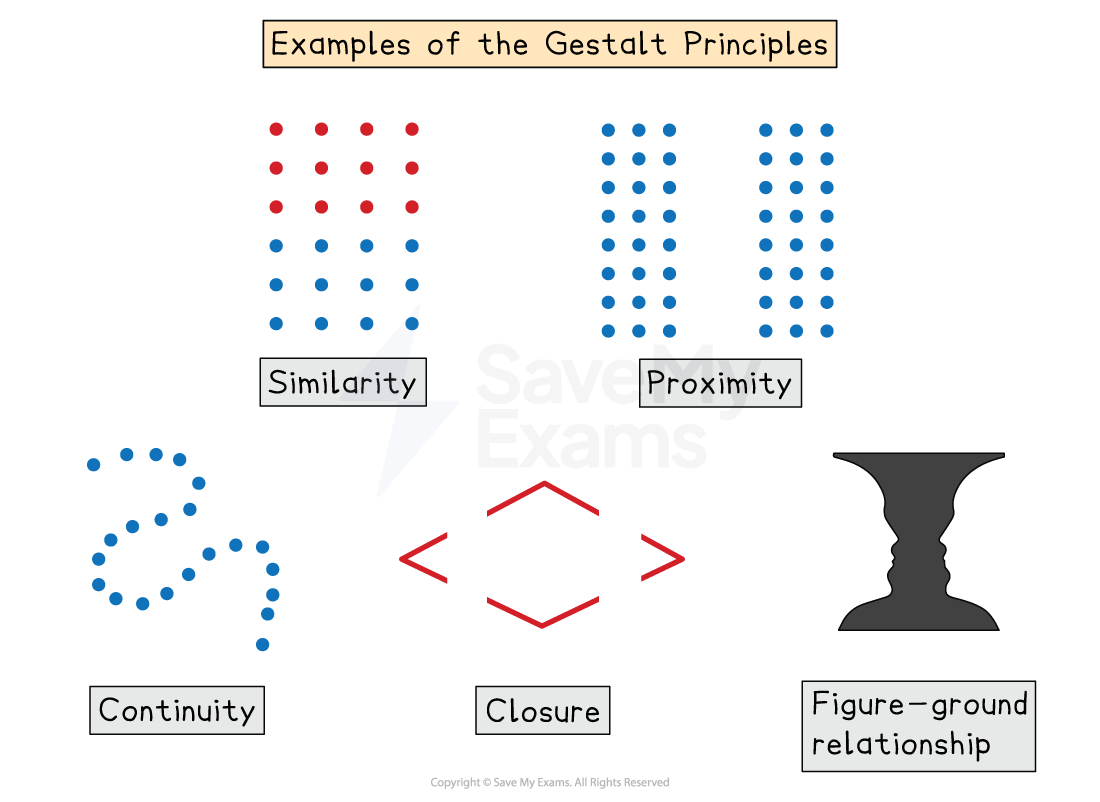
Gestalt psychologists identified a set of principles that describe how the brain groups visual elements together:
Figure-ground relationship: the brain automatically separates a visual scene into a figure (the object that stands out) and a ground (the background behind it)
E.g. in the Rubin's vase illusion, the same image can be perceived as either a white vase (figure) against a black background (ground) or two black faces (figure) against a white background — the brain cannot hold both interpretations simultaneously
Proximity: objects that are close together are perceived as belonging to the same group
E.g. three pairs of vertical lines are perceived as three pairs rather than six individual lines, because the lines within each pair are closer to each other than to lines in other pairs
Similarity: objects that share similar features (shape, color, size) are perceived as belonging to the same group
E.g. a grid of alternating circles and squares is perceived as rows of circles and rows of squares rather than a random collection of shapes
Continuity: the brain prefers to perceive smooth, continuous lines or curves rather than abrupt changes in direction
E.g., two crossing lines are perceived as two continuous lines passing through each other, rather than four lines meeting at a point
Closure: the brain fills in missing information to perceive a complete, recognizable object even when parts of it are absent
E.g., a circle drawn with a small gap is still perceived as a circle rather than an arc, as the brain closes the gap automatically
These principles collectively reflect the Law of Prägnanz
This is the tendency for humans to perceive and interpret ambiguous or complex images in their simplest, most organized form, as this requires the least cognitive effort
Examiner Tips and Tricks
The CED explicitly names only four Gestalt principles: closure, figure and ground, proximity, and similarity
If asked about Gestalt principles in the exam, stick to these there is no need to write about symmetry or continuity as it is not required knowledge (Skill 1.B)
Visual perceptual processes
Visual perception involves the brain actively constructing an interpretation of the world from the two-dimensional images projected onto each retina
Two major categories of depth perception help the brain judge distance and construct a three-dimensional perception of the world:
binocular depth cues
monocular depth cues
Binocular depth cues
Binocular depth cues rely on information from both eyes simultaneously
They depend on having two eyes set slightly apart
Two binocular depth cues include:
retinal disparity
convergence
Retinal disparity
Because our two eyes are positioned slightly apart, each eye receives a slightly different image of the world
E.g. hold a finger close to your face and alternately close each eye — the finger appears to jump position because each eye sees it from a slightly different angle
The brain compares the two images and uses the difference between them to calculate depth and distance
The greater the disparity between the two retinal images, the closer the object is
Convergence
As an object moves closer to the face, the eyes must turn inward toward each other to focus on it
E.g., when you focus on something very close (like the tip of your nose), you can feel your eye muscles working to converge. The more effort required, the closer the object
The brain detects the degree of muscle tension required to converge the eyes and uses this as a cue to distance
Monocular depth cues
Monocular depth cues provide depth information using only one eye
They give the illusion of depth on flat or two-dimensional surfaces and are the cues used by artists to create the impression of three dimensions on a canvas
Five monocular depth cues are as follows:
Depth cue | Description | Example |
|---|---|---|
Relative size | Objects that project a smaller image on the retina are perceived as farther away | Two identical cars — the one appearing smaller is perceived as more distant |
Relative clarity | Objects that appear less sharp and clear are perceived as farther away; haze and blur increase perceived distance | Distant mountains appear hazy and blurred compared to nearby trees |
Texture gradient | As a surface recedes into the distance, its texture appears increasingly dense and fine | A cobblestone path appears coarser up close and smoother in the distance |
Linear perspective | Parallel lines appear to converge as they recede into the distance, meeting at a vanishing point | Railway tracks appearing to meet at the horizon |
Interposition (overlap) | When one object partially blocks another, the blocking object is perceived as closer | A tree partially hidden behind a building is perceived as farther away than the building |
Perceptual constancies
Perceptual constancy is the brain's ability to maintain a stable perception of an object even when the image it projects onto the retina changes due to distance, angle, or lighting conditions
Without perceptual constancy, every time you moved or the lighting changed, familiar objects would appear to be different objects entirely
Type | Description | Example |
|---|---|---|
Size constancy | Objects are perceived as the same size even when their retinal image changes with distance | A friend walking away from you does not appear to be shrinking, even though their retinal image is getting smaller |
Shape constancy | Objects are perceived as the same shape even when viewed from different angles | A door is perceived as rectangular whether it is closed (rectangle) or open at an angle (trapezoid) |
Brightness constancy | Objects are perceived as the same color or brightness even when lighting conditions change | A white piece of paper looks white both in bright sunlight and in a dimly lit room, even though the amount of light it reflects differs greatly |
Apparent movement
Apparent movement is the perception of motion when objects are not actually moving
The brain is highly sensitive to motion and can be tricked into perceiving movement from static or rapidly changing image. Two well known examples demonstrate this:
Stroboscopic effect (phi phenomenon): a rapid sequence of still images presented at a certain speed creates the perception of smooth, continuous movement
E.g. this is the basis of all film and animation, where a series of still frames played quickly enough appears as moving images
Autokinetic effect: if a stationary point of light is viewed in a completely dark room, it will appear to move. The brain has no external reference points to establish that the light is stationary, so slight eye movements are interpreted as object movement
Examiner Tips and Tricks
For Skill 3.A, you may be shown a figure illustrating a Gestalt principle or a depth cue and asked to name the concept it demonstrates
Practice identifying each principle and depth cue from a visual example, not just from a written description
The CED explicitly names only five monocular depth cues: relative size, relative clarity, texture gradient, linear perspective, and interposition
If asked about monocular depth cues in the exam, there is no need to write about any other monocular depth cues in your answers
For Skill 1.B, perceptual constancy questions may describe a scenario where an object's retinal image has changed but the person still perceives it correctly
Be able to identify which type of constancy (size, shape, or brightness) is being demonstrated and explain why the brain maintains the stable perception
For Skill 3.A, apparent movement questions may describe a real-world scenario and ask you to identify the phenomenon
Ensure you know the difference between the stroboscopic effect/phi phenomenon (rapid sequence of images) and the autokinetic effect (stationary light in darkness)

Unlock more, it's free!
Join the 100,000+ Students that ❤️ Save My Exams
the (exam) results speak for themselves:

Was this revision note helpful?