Theories of Motivation (College Board AP® Psychology): Study Guide

Drive reduction theory & instinct theory
Motivation is a need or desire that energizes and directs behavior
Without motivation, action and learning do not occur
Motivations can be:
Primary drives: biological motivations that ensure survival
E.g. hunger, thirst, sleep, reproduction
Secondary drives: learned motivations developed through experience and linked to primary needs
E.g. the motivation to earn money, which can be exchanged for food, shelter, and other primary needs
Psychologists have proposed several theories to explain what motivates behavior
Drive reduction theory
Drive reduction theory proposes that biological needs create internal tension (a drive), motivating behavior to restore balance and reduce tension down to zero
This is based on homeostasis, which is the body’s tendency to maintain stable internal conditions
When homeostasis is disrupted (e.g. blood sugar drops), a drive is created
The drive motivates behavior to restore balance (e.g. seeking food)
Once the need is satisfied, the drive is reduced and homeostasis is restored
Drive reduction theory explains physiological needs and desires most effectively
It explains why we eat, drink, sleep, and seek warmth
It is less effective at explaining behaviors not linked to biological deprivation
E.g. it cannot easily explain why people create art, or pursue intellectual challenges
Instinct theory
Instinct theory proposes that behavior is driven by innate, fixed patterns of action triggered by specific stimuli
Instincts:
are unlearned and species-typical
do not require prior experience to be triggered, e.g. birds migrating at specific times of year
Humans do not appear to demonstrate instinctual behavior in the same way
While humans have biological drives, these are not expressed as fixed, invariant action patterns
Human behavior is more flexible and influenced by learning
Instinct theory is therefore limited in explaining human motivation, and has been replaced by more comprehensive motivational theories
Arousal theory & the Yerkes-Dodson law
Arousal theory
Arousal theory proposes that behavior is motivated by the need to maintain an optimal level of arousal
Unlike drive reduction theory, it recognizes that both low and high arousal are aversive
People seek stimulation when under-aroused and seek to reduce stimulation when over-aroused
E.g. a bored student seeks stimulation by listening to music; an anxious student tries to calm themselves down before an exam
Optimal arousal levels vary between individuals and across tasks:
Some individuals seek high stimulation (thrill-seeking)
Others prefer lower, calmer levels
The Yerkes-Dodson law
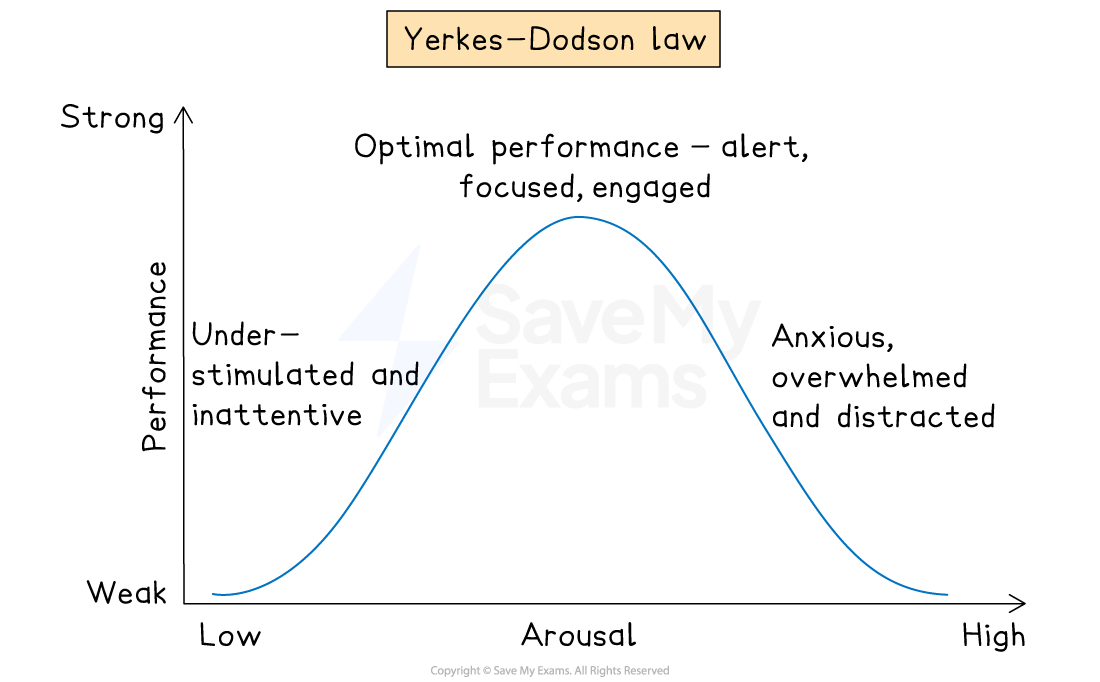
The Yerkes-Dodson Law describes the relationship between arousal and performance:
Performance on most tasks follows an inverted U-shaped curve when plotted against arousal level:
Low arousal = poor performance (under-stimulated, inattentive)
Moderate arousal = optimal performance(alert, focused, engaged)
High arousal = poor performance (anxious, overwhelmed, distracted)
Critically, the optimal arousal level varies with task difficulty:
Simple or well-learned tasks are performed best at higher levels of arousal
E.g. a professional athlete performing a routine movement performs better with some competitive pressure
Complex or novel tasks are performed best at lower levels of arousal
E.g. a student attempting a difficult new concept performs better in a calm, low-pressure environment than under exam stress
Self-determination theory & incentive theory
Self-determination theory (SDT)
SDT proposes that behavior is driven by both intrinsic and extrinsic motivation
Balancing the two affects wellbeing and performance
Intrinsic motivation:
Motivation that comes from within
Behavior is driven by interest, enjoyment, or personal meaning
The activity itself is the reward
E.g. reading for pleasure; playing music because you love it; solving a puzzle for the satisfaction of solving it
Extrinsic motivation:
Motivation that comes from outside
Behavior is driven by the opportunity to gain an external reward or avoid a punishment
The reward is separate from the activity
E.g. studying to get a good grade; working to earn a salary; exercising to lose weight
SDT proposes that intrinsic motivation is linked to greater wellbeing, deeper learning, and persistence than extrinsic motivation
SDT identifies three core psychological needs that support intrinsic motivation:
Autonomy: the belief that one has choice and control over one's actions
Competence: the belief that one has the skills and knowledge needed to succeed
Relatedness: the sense of connection to others and belonging in social relationships
Incentive theory
Incentive theory proposes that behavior is motivated not by internal drives , but by external rewards (incentives) that attract or “pull” behavior
Incentives are stimuli that we are drawn to because we have learned to associate them with rewards
E.g. food cues, such as smell, triggering eating, or the prospect of good grades motivating studying
Incentive theory is closely related to extrinsic motivation in SDT
Both emphasize the role of external rewards in driving behavior
Lewin's motivational conflicts theory
Lewin’s theory proposes that motivation often involves resolving conflicts between competing options
Many situations involve choices with positive and/or negative features, creating psychological tension that must be resolved
The theory identifies four types of motivational conflict:
Conflict Type | Description | Example |
|---|---|---|
Approach-approach | Choosing between two desirable options. Both are positive, but only one can be chosen | Choosing between two universities you have been accepted to. Both are excellent, but you can only attend one |
Approach-avoidance | A single option has both positive and negative features. | Wanting to go to a party (approach: fun, social) but also not wanting to go (avoidance: anxious, tired). The same option has both positive and negative aspects |
Avoidance-avoidance | Choosing between two undesirable options. Both are negative, but one must be chosen | Having to choose between two unpleasant tasks. Neither is wanted, but one must be completed |
Multiple approach-avoidance | Choosing between multiple options that each carry both positive and negative features. This is the most common type of real-world conflict | Choosing between two universities, each with pros and cons. One offers a stronger academic program but poorer location, the other a better social life but weaker reputation |
Sensation-seeking theory
Sensation-seeking theory proposes that individuals differ in their need for novel, varied, and intense experiences
High sensation seekers pursue stimulation, novelty, and risk
Low sensation seekers prefer familiar, predictable environments lower-stimulation environments
The theory identifies four types of sensation seeking:
Type | Description | Example |
|---|---|---|
Experience seeking | Seeking novel experiences through the mind, senses, or unconventional lifestyle | Traveling to unfamiliar places; trying unusual foods; seeking out new music or art |
Thrill and adventure seeking | Seeking physical risk, speed, or danger | Skydiving, bungee jumping, extreme sports |
Disinhibition | Seeking stimulation through social situations, parties, or substance use | Enjoying wild social events; risk-taking in social contexts |
Boredom susceptibility | Low tolerance for repetition and routine. Easily restless when under-stimulated | Struggling to maintain attention in repetitive tasks; frequently seeking change |
Sensation seeking is partly biological
High sensation seekers may have lower baseline levels of arousal and therefore require more stimulation to reach optimal arousal
Sensation seeking varies across the lifespan
It tends to peak in adolescence and early adulthood and decline with age
Examiner Tips and Tricks
Ensure that you understand these key points:
Drive reduction theory does not explain all motivation
It explains biological needs well, but cannot account for behaviors that increase arousal, such as thrill-seeking or curiosity
Multiple theories are needed
The Yerkes–Dodson law does not mean high arousal always impairs performance
High arousal can improve performance on simple or well-learned tasks, but impairs performance on complex or novel tasks.
The task difficulty is essential to the prediction
Intrinsic motivation is not always superior to extrinsic motivation
Extrinsic motivation can initiate and sustain behavior in the short-term. especially when tasks are uninteresting
Problems arise when it reduces existing intrinsic motivation
Approach–avoidance conflict is not a choice between good and bad options
It involves a single option with both positive and negative features
Examiner Tips and Tricks
For Skill 1.A, scenario questions require identification and application of the the specific theory being demonstrated
For drive reduction, identify the biological need, the drive, and the behavior that it reduces
For Yerkes–Dodson, consider arousal level and task difficulty
For Lewin's theory, identify the specific type of conflict
For Skill 2.B, motivation research often uses experimental designs
Be prepared to identify the IV and DV, evaluate control of variables, and consider issues such as random assignment and what the measure of behavior actually reflects
For Skill 2.C, motivation research also uses non-experimental methods
E.g., surveys of sensation-seeking scores correlated with risk-taking behavior, or self-report measures of intrinsic vs extrinsic motivation.
When evaluating these, consider self-report bias, the inability to establish causation from correlations, and difficulties in measuring constructs like intrinsic motivation reliably

Unlock more, it's free!
Join the 100,000+ Students that ❤️ Save My Exams
the (exam) results speak for themselves:

Was this revision note helpful?