Psychodynamic Theories of Personality (College Board AP® Psychology): Study Guide

The psychodynamic theory of personality
Psychodynamic theory is derived from the work of Sigmund Freud and developed by later theorists
Its core assumption is that unconscious processes drive personality
Much of our behavior, thoughts, and emotions operate outside conscious awareness
The psychodynamic approach was foundational in emphasizing the role of internal mental processes in shaping behavior
The structure of the mind: the iceberg analogy
Freud proposed that the mind operates across different levels of awareness, illustrated by the iceberg analogy:
Conscious (tip above water): thoughts and perceptions we are currently aware of
Preconscious (just below the surface): information not in awareness but accessible with effort
Unconscious (submerged mass): the largest and most influential part, containing hidden thoughts, desires, and conflicts
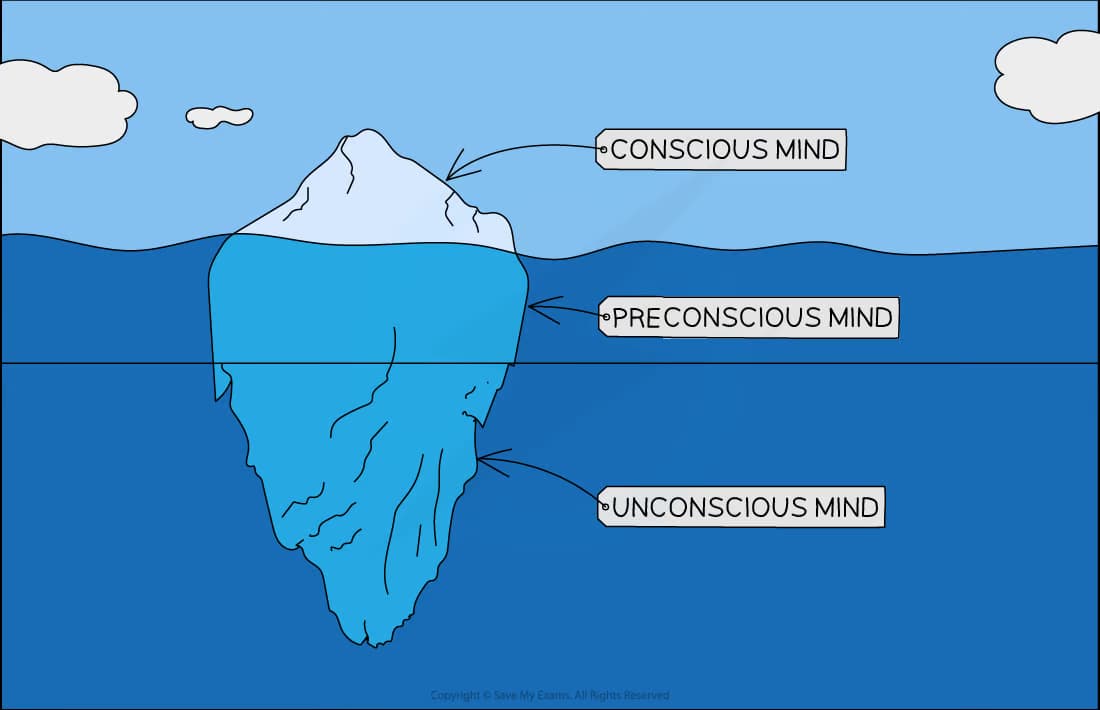
The conscious mind
The conscious mind contains everything we are actively aware of and thinking about
Only a small portion of mental life is conscious at any given moment
E.g. your current thoughts as you read this sentence
The preconscious mind
The preconscious contains information that is not currently in awareness but can retrieved with effort
E.g. your home address or the name of a former teacher
The unconscious mind
The unconscious contains thoughts, memories, desires, and conflicts that are actively kept out of awareness
Freud argued that this is the most powerful level of the mind, influencing behavior without conscious awareness
E.g. early experiences of criticism may lead someone to seek constant approval in adulthood without understanding why
Unconscious material can influence behavior by by entering awareness in disguised forms, e.g.
Dreams: Freud believed dreams represent disguised expressions of unconscious wishes and conflicts
Their surface content (manifest content) conceals the underlying unconscious meaning (latent content)
E.g. dreaming of flying may represent an unconscious wish to break free from constraints
Freudian slips: verbal errors that appear accidental but express true, repressed feelings
E.g. intending to say "I love my partner" but saying "I loathe my partner," reveals what is really felt at an unconscious level
Defense mechanisms: unconscious strategies that are used to manage anxiety
E.g. a person who is angry with their boss comes home and shouts at a family member (displacement)
The role of the unconscious in personality
According to psychodynamic theory:
early childhood experiences, especially conflicts and anxieties, are repressed into the unconscious
these repressed experiences continue to shape adult personality and behavior
E.g. someone may deny negative childhood experiences because they are too distressing to confront
The structure of personality
Freud proposed that personality consists of three interacting systems which are often in conflict
These are the:
id
ego
superego
They are not separate entities but dynamic parts of a single personality, working together (though not always in harmony)
The id
The id is the most primitive part of personality and is present from birth
It operates entirely in the unconscious and is driven by the pleasure principle as it seeks immediate gratification of desires without regard for consequences
It contains basic instincts such as hunger, sex, and aggression, and has no sense of morality, logic, or time
E.g. an infant crying immediately when hungry, demanding instant satisfaction
The ego
The ego develops from the id in early childhood (around age 2) as the child encounters reality
It operates across conscious, preconscious, and unconscious levels and is guided by the reality principle
The ego mediates between the demands of the id, the constraints of reality, and the moral standards of the superego
It constantly balances the demands of each as the id's impulses could lead to serious consequences, yet the superego's rigid moral demands can lead to self-blame and excessive guilt
It is responsible for rational thinking, planning, and decision-making
E.g. wanting an entire cake (id), recognizing that this is wrong/greedy (superego), and choosing a reasonable portion (ego negotiates)
The superego
The superego develops around age 5 as the child internalizes societal and parental values
It operates across conscious and unconscious levels and is driven by the morality principle
The superego enforces moral standards and strives for perfection rather than reality
It has two components:
conscience - punishes the ego with guilt when moral standards are violated
ego ideal - produces pride and self-esteem when moral standards are met
E.g. feeling intense guilt after eating that one slice of cake, even though it was a reasonable compromise
The dynamic relationship between id, ego, and superego
Freud believed that psychological conflict, and ultimately personality, arises from the ongoing tension between these three structures:
the id demands immediate gratification
the superego imposes moral constraints
the ego attempts to mediate between them and reality
When the ego cannot successfully manage this conflict, anxiety results, and defense mechanisms are used to reduce it
Defense mechanisms and assessing personality
Defense mechanisms are unconscious strategies used by the ego to reduce anxiety caused by unacceptable thoughts or conflicts
They operate automatically and involve distorting or denying reality
They can be adaptive in moderation, but overuse prevents resolution of underlying conflicts
E.g. they may provide temporary relief from having to confront uncomfortable truths, but in the long term, over-reliance on defense mechanisms impairs functioning and prevents growth
The eight defense mechanisms
Repression
Definition: blocking threatening thoughts, memories, or desires from entering conscious awareness
E.g. having no memory of a traumatic event
Repression is the most fundamental defense mechanism, as all others build on it
Denial
Definition: refusing to acknowledge or accept an unwanted reality; acting as if a threatening situation does not exist
E.g. ignoring evidence of a serious illness; refusing to accept a threatening reality
Displacement
Definition: redirecting emotions from a threatening target onto a safer, less threatening substitute
E.g. shouting at a family member after conflict at work
Projection
Definition: attributing one's own unacceptable thoughts, feelings, or impulses to another person, rather than acknowledging them internally
E.g. believing someone dislikes you when you dislike them
Reaction formation
Definition: expressing the exact opposite of one's true, unacceptable feeling
E.g. acting overly friendly toward someone you dislike
Regression
Definition: reverting to an earlier, more childlike stage of behavior when under stress. These are usually behaviors that provided comfort or relief at an earlier developmental stage
E.g. comfort eating, nail-biting, throwing tantrums
Rationalization
Definition: creating a logical, socially acceptable explanation for behavior that was actually driven by unacceptable motives; generating justifications after the fact
E.g. blaming a failed exam on unfair questions
Sublimation
Definition: channeling unacceptable impulses into socially acceptable, often productive activities, particularly sexual or aggressive drives
E.g. directing aggression into sport
Freud considered sublimation the most healthy and constructive defense mechanism, as it transforms potentially harmful energy into something of social or personal value
Assessing personality: projective tests
Psychodynamic psychologists use projective tests to access the preconscious and unconscious mind
This is because the unconscious cannot be directly accessed through self-report
Projective tests involve ambiguous stimuli, which individuals interpret
The assumption is that the person will reveal their unconscious thoughts and conflicts onto the ambiguous material, revealing hidden aspects of personality
Projective tests are non-experimental methods, as they do not involve controlled conditions or manipulation of variables
Two key projective tests include:
The Rorschach Inkblot Test
The Thematic Apperception Test (TAT)
The Rorschach Inkblot Test
Participants are shown a series of 10 symmetrical inkblot images and asked to describe what they see in each
Responses are analyzed for content, form, and movement, and scored to obtain an evaluation of personality
E.g. seeing aggressive or violent images repeatedly may indicate underlying hostile impulses
The test is highly subjective in scoring and interpretation, as different scorers may produce different interpretations of the same responses
The Thematic Apperception Test (TAT)
Participants are shown a series of ambiguous pictures of people in various situations and asked to create a story about each:
What is happening? What led to this? What are the characters thinking and feeling? What will happen next?
The stories are analyzed for recurring themes, needs, and conflicts assumed to reflect the participant's own unconscious concerns
E.g. repeatedly constructing stories featuring themes of abandonment may indicate unconscious fears of rejection
Interpretation depends heavily on the clinician's judgment, which makes results difficult to replicate across different assessors
Examiner Tips and Tricks
Ensure that you understand these key points:
The unconscious is not simply forgotten information
It is an active system that keeps threatening material out of awareness.
Repressed material is not lost but continues to influence behavior
Defense mechanisms are not always pathological
They are normal and universal, and can be adaptive in moderation
They become problematic when overused or rigidly applied
The id, ego, and superego are not physical brain structures
They are theoretical constructs used to explain behavior and cannot be directly observed, which is one reason Freud's theory is criticized for being unscientific
Examiner Tips and Tricks
For Skill 1.A, scenario questions may require you to identify and apply specific psychodynamic concepts
Ensure that you are able to name the structures (id, ego, superego) and defense mechanisms, define them, and apply them to any scenario in this topic
For Skill 2.C, projective tests should be evaluated as non-experimental methods
Focus on issues such as subjective scoring, difficulty establishing what is being measured (unclear validity), and the lack of controlled conditions, meaning no causal conclusions can be drawn

Unlock more, it's free!
Join the 100,000+ Students that ❤️ Save My Exams
the (exam) results speak for themselves:

Was this revision note helpful?