A researcher investigated how accurately people judge the distance of objects using different types of depth cues. Forty participants were tested individually in a controlled room. In one condition, participants used only monocular cues (one eye covered) to estimate the distance of objects placed at six different distances (0.5 m, 1 m, 2 m, 5 m, 10 m, and 20 m).
In a second condition, the same participants used binocular cues (both eyes open) to estimate the same distances. All participants completed the monocular condition first and the binocular condition second. The graph below shows the mean estimation error (in meters) for each condition at each distance. Lower error scores indicate more accurate distance judgments.
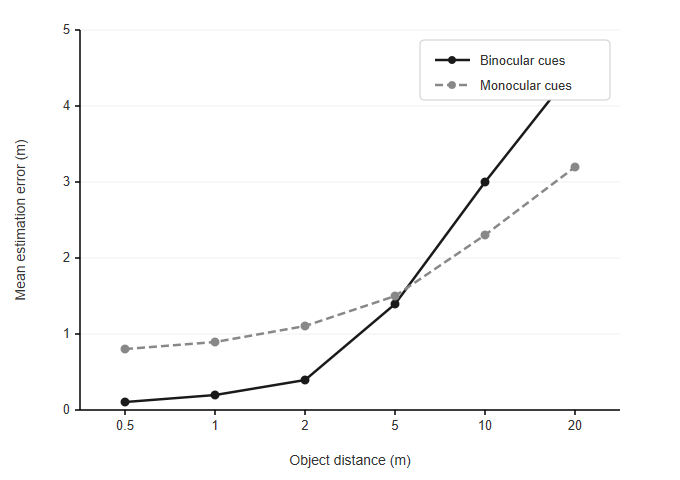
A colleague reviewing the study notes that all participants completed the monocular condition before the binocular condition. She argues that participants may have improved through practice or become fatigued, which could have systematically influenced the results.
Which of the following changes to the research design would most directly address the colleague's concern?
Increasing the number of distance intervals tested
Using a larger and more diverse sample of participants
Randomly assigning participants to either the monocular or binocular condition only
Having half the participants complete the monocular condition first and the other half complete the binocular condition first
Was this exam question helpful?