Henry VIII: Cromwell - the Rise to Power & Revolution in Government (AQA A Level History: Component 1: Breadth study): Revision Note
Exam code: 7042

Summary
Thomas Cromwell rose from humble origins (the son of a Putney blacksmith and cloth worker) to become Henry VIII's chief minister by the mid-1530s, succeeding Wolsey as the dominant figure in government
The Reformation Parliament (1529–1536) sat for an unprecedented 7 years and was used to give Henry's religious revolution statutory authority, transforming what Parliament was used for
Cromwell's key offices included Principal Secretary, Lord Privy Seal and Vicar-General in Spirituals, giving him authority over both government and the Church
His administrative reforms included the the development of a smaller, more professional Privy Council, the creation of the Court of Augmentations and the emergence of the Principal Secretary as the central office of government
The Acts of Union with Wales (1536–1543) extended English legal and administrative structures into Wales
One of the most concrete examples of Cromwell's administrative reach
Historians debate whether Cromwell's changes amounted to a genuine "revolution in government" or whether they were more evolutionary, driven by circumstance rather than deliberate planning
The Rise of Thomas Cromwell: From Wolsey's Servant to Chief Minister
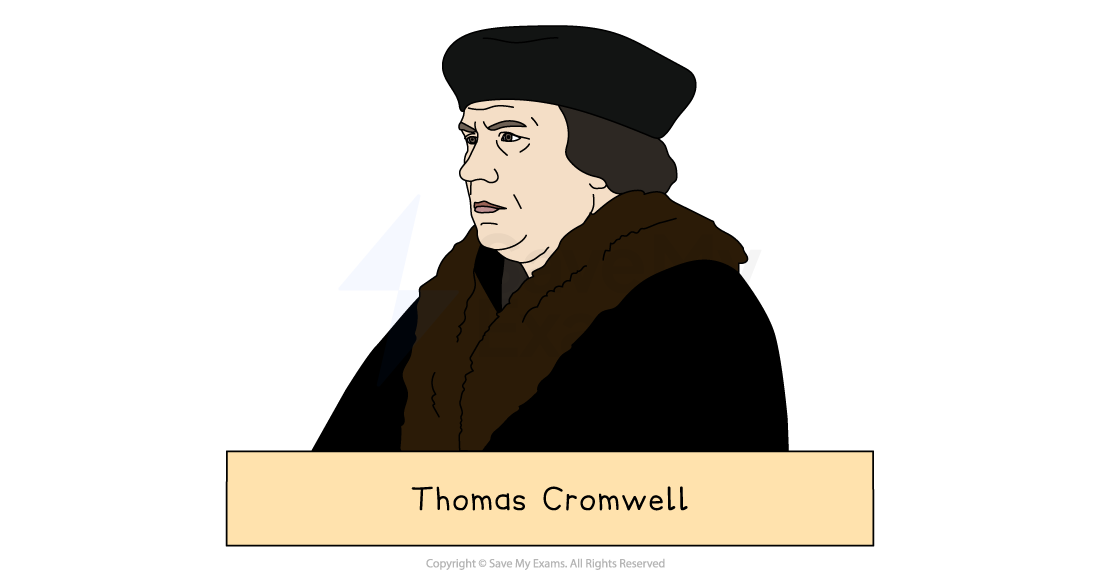
Origins and early career
Thomas Cromwell was born around 1485 in Putney, the son of a blacksmith and cloth merchant
Like Wolsey before him, he was a man of humble origins who rose entirely through ability
Early career:
He spent time as a soldier, merchant and lawyer in Italy and the Low Countries before returning to England
This gave him a broader European perspective than most English administrators of his generation
Under Wolsey:
Cromwell entered Wolsey's service and proved himself an outstanding legal and administrative operator
He helped manage the dissolution of smaller monasteries to fund Cardinal College
When Wolsey fell in 1529, Cromwell performed a remarkable feat of political survival, transferring his loyalty to Henry VIII without losing either his position or his head
This led to his entry into royal service and the path to power
Cromwell's rapid rise through royal service
Cromwell was elected to the Reformation Parliament in 1529
His legal and parliamentary skills quickly attracted Henry's attention
By 1532, he had emerged as Henry's principal adviser on the Great Matter and the Break with Rome
By 1534, he was Principal Secretary
This was the key coordinating office of Tudor government
By 1535, he was Vicar-General in Spirituals
This gave him exceptional authority over the Church
In 1536, he became Lord Privy Seal
This further strengthened his position in government
Why did Cromwell rise?
Cromwell succeeded where Wolsey had failed because he offered Henry something qualitatively different
Henry needed someone who could deliver the Break with Rome, the annulment and the Royal Supremacy, not through diplomatic channels to a hostile Pope, but through Parliament and the law
Cromwell was a master of both
Differences from Wolsey:
He was proactive where Wolsey had been reactive, coming to Henry with legal solutions rather than diplomatic promises
He worked through Parliament rather than around it
This suited the constitutional moment perfectly
"His power was real, but it was less secure than Wolsey's."
John Guy, 'Cromwell and the Reform of Government', in D. MacCulloch (ed.), The Reign of Henry VIII: Politics, Policy and Piety (1995)
Guy's brief but pointed observation captures Cromwell's structural vulnerability, he lacked the European prestige, the Church's wealth and the long personal trust that had sustained Wolsey. His power rested on delivering results for Henry and, when political circumstances changed, he had less protection.
Cromwell & the Reformation Parliament, 1529–1536
The Reformation Parliament was summoned in November 1529 after Wolsey's fall
It sat for an unprecedented 7 years, prorogued on 7 separate occasions, and did not finally dissolve until 1536
It became the instrument through which the Break with Rome was given statutory force
In doing so, it significantly transformed the constitutional relationship between Crown, Church and Parliament
Key legislation
Cromwell drafted or supervised the passage of a series of Acts that systematically dismantled papal authority in England and established the Royal Supremacy
The detail of these Acts belongs to the Break with Rome sub-topic, but their constitutional significance is central to this one
Act in Restraint of Annates (1532) |
|
|---|---|
Act in Restraint of Appeals (1533) |
|
Act of Supremacy (1534) |
|
Treasons Act (1534) |
|
First Succession Act (1534) |
|
Why was the Reformation Parliament constitutionally significant?
Before Cromwell, Parliament had only rarely legislated directly on matters of Church authority and papal jurisdiction on this scale
These were considered entirely beyond its competence
Cromwell's key achievement was to use parliamentary statute to give the Royal Supremacy legal force that no future government could easily undo
Parliament increasingly became the central legislative body of the English state
This was a transformation whose implications would unfold for centuries
Examiner Tips and Tricks
The key point is not just what the legislation did, but what it meant constitutionally. By using Parliament to legislate the Supremacy, Cromwell permanently elevated Parliament's status – it could now act on matters of religion, Church and even succession. This is why Elton called it a revolution.
The Elton Thesis: Was there a 'Revolution in Government'?
The most important historiographical debate in Tudor administrative history centres on Geoffrey Elton's argument that, under Cromwell in the 1530s, English government underwent a fundamental transformation – a "Revolution in Government"
This debate has dominated scholarship since 1953 and is essential for the essay question
Elton's argument
Elton argued that, before Cromwell, English government was based on the royal household
It was personal, dependent on the king's physical presence and will
It was administered by domestic servants
Under Cromwell, this was replaced by permanent bureaucratic departments of state
Institutions that existed independently of the monarch and could function whether the king was present or not
Key examples:
The Privy Council was formalised into a smaller, professional body with fixed membership and recorded proceedings
The Principal Secretary became the key coordinating office of government
New revenue courts (Court of Augmentations (1536), Court of General Surveyors (1540) professionalised financial administration
Parliament was elevated from a tool for taxation into the sovereign legislative body of the state
Elton also argued this was deliberately planned by Cromwell: a conscious act of creative statesmanship rather than an accident of circumstances
"The changes in government under Cromwell were revolutionary, if that term may be applied to any changes which profoundly affect the constitution and government of a state even when no systematic and entire destruction was involved. The essential ingredient of the Tudor revolution was the concept of national sovereignty which Cromwell summarised in the Act of Appeals of 1533 by using the phrase 'this realm of England is an empire'… Cromwell's administrative reforms – like the Privy Council – provided the machinery for the new state he had started to construct."
Geoffrey Elton, England under the Tudors (1974)
Elton's foundational argument is that the Act of Appeals and the Privy Council reforms together created a new kind of state, based on national sovereignty and permanent bureaucratic institutions rather than personal royal household government.
Revisionist challenges to Elton
Elton's thesis was highly influential but has been substantially challenged since the 1970s
The revisionist consensus:
Genuine and significant changes occurred under Cromwell
But they were neither as systematic nor as planned as Elton claimed
They were responses to specific political circumstances (the Break with Rome) rather than the product of a grand administrative vision
David Starkey |
|
|---|---|
Perry Williams |
|
John Guy |
|
"It has been argued over the last 30 years that Cromwell achieved a 'revolution in government' during the 1530s, though this interpretation has been attacked. The 'revolution' thesis maintains that Cromwell consciously reduced the role of the royal household in government and substituted instead 'national' bureaucratic administration within departments of state under the control of a fundamentally reorganised Privy Council. Such an argument is, however, too schematic."
John Guy, Tudor England (1988)
Guy represents the revisionist mainstream – acknowledging real change while rejecting the "revolution" label as too "schematic". His argument that the changes were circumstantial rather than planned is now the dominant view among Tudor historians.
Examiner Tips and Tricks
Know both sides clearly. Elton = planned revolution, household replaced by bureaucracy, Cromwell as creative genius. Revisionists (Guy, Starkey) = evolutionary change driven by circumstances, household remained important, changes less systematic than Elton claimed. The strongest answers use both views to reach a nuanced judgement rather than simply accepting or rejecting the "revolution" label.
Cromwell's Administrative Reforms: The Privy Council
The Privy Council before and after Cromwell
Before: King's Council
Before Cromwell, the King's Council was a large, unwieldy and essentially informal body
Its membership fluctuated, it had no fixed procedures and it met irregularly
After: Privy Council
Under Cromwell, it was transformed into the Privy Council
This was a smaller, more professional executive body that became the central institution of Tudor government
The King's Council (before Cromwell) | The Privy Council (after Cromwell) |
|---|---|
|
|
|
|
|
|
|
|
|
|
Other administrative reforms
The Principal Secretary:
Cromwell transformed his own office into the central coordinating role of government
He managed correspondence, intelligence networks and parliamentary business
Court of Augmentations (1536):
A new permanent institution was created to administer the revenues from dissolved monasteries
It was a model of the new bureaucratic approach
Court of General Surveyors (1540):
This professionalised the management of Crown lands
Acts of Union with Wales (1536–1543):
Brought Wales fully into the English administrative, legal and parliamentary system
This was a significant extension of centralised government
Examiner Tips and Tricks
Boundary reminder: the detail of the Break with Rome legislation (Acts of Annates, Appeals, Supremacy) can be found in the next sub-topic. Here focus on what the Reformation Parliament meant constitutionally, not the detail of each Act.
How Far Did Cromwell Transform Tudor Government and the Role of Parliament?
Use the evidence below to build a balanced argument for the essay question
The strongest answers engage directly with the "revolution vs evolution" debate and assess Cromwell's independence from Henry
Evidence of significant transformation
The Reformation Parliament legislated on Church governance, doctrine and succession, matters previously considered entirely beyond Parliament's competence
The Privy Council was formalised with fixed membership, regular meetings and formal records
it was a permanent executive body rather than an informal household council
The Principal Secretary became the central administrative office of the Tudor state under Cromwell's direction
The Court of Augmentations (1536) was a new permanent bureaucratic institution
This provides evidence of a professionalised approach to financial administration
The Acts of Union with Wales (1536–1543) extended centralised English government into a previously autonomous region
Key historians
G. R. Elton, The Tudor Revolution in Government (1953) |
|
|---|---|
E. Ives, 'Henry VIII: the political perspective', in MacCulloch (ed.), The Reign of Henry VIII (1995) |
|
Evidence of continuity or limited change
The royal household retained political significance throughout
Starkey argues Elton underestimated the continued importance of the Privy Chamber
Many of the new institutions drew on existing practices and precedents
The Court of Augmentations adapted existing models rather than inventing entirely new ones
Cromwell's fall in 1540 led to partial reversion
The conciliar government that followed under Henry's conservatives was notably different from what Cromwell had built
Key historians
M. Everett, The Rise of Thomas Cromwell (2015) |
|
|---|
Examiner Tips and Tricks
The strongest answers engage directly with the "revolution vs evolution" debate rather than just describing what Cromwell did. Ask: were the changes planned or circumstantial? Was Cromwell the driving force or was he working within Henry's framework? Use Elton and the revisionists (Guy, Everett) in direct contrast. Don't just list reforms, explain what made them significant constitutionally.

Unlock more, it's free!
Join the 100,000+ Students that ❤️ Save My Exams
the (exam) results speak for themselves:

Was this revision note helpful?
