Edward VI: Religious Change and the Move Towards Protestantism (AQA A Level History: Component 1: Breadth study): Revision Note
Exam code: 7042

Summary
Religious change under Edward VI broadly moved in two stages:
Somerset's reform (1547–1549) was cautious and deliberately ambiguous
Northumberland's reform (1550–1553) was faster and more explicitly Protestant
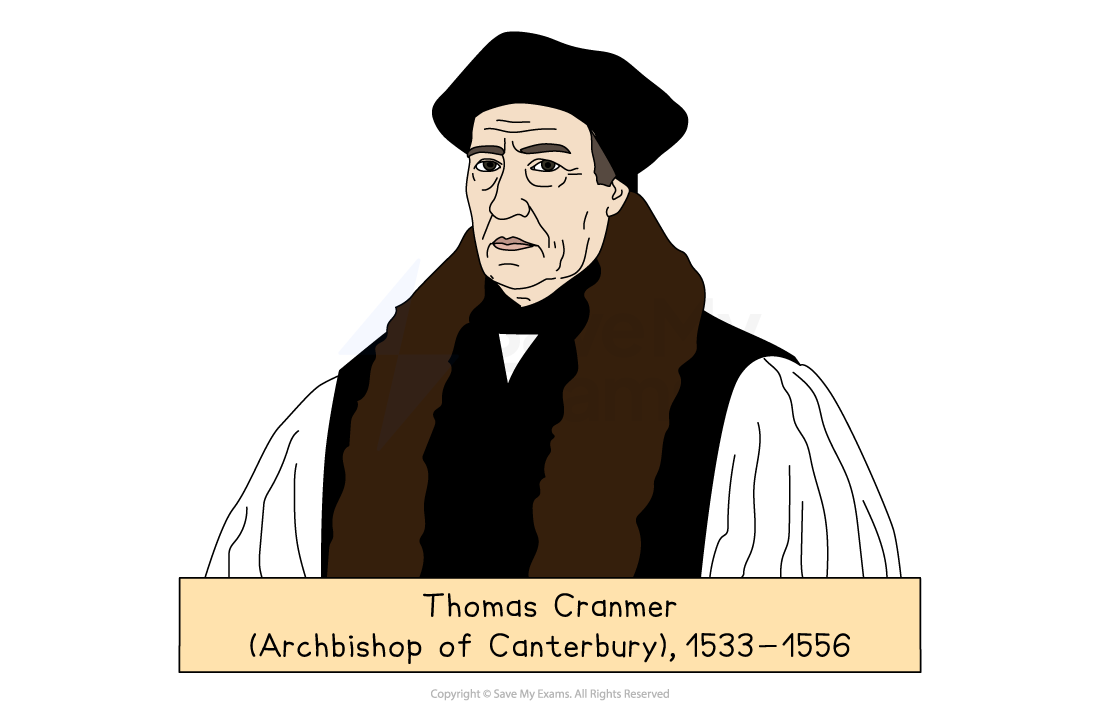
Cranmer was a key individual throughout
He wrote both Prayer Books and shaped the doctrine of the Church of England
The 1549 Prayer Book kept the traditional form of worship but put it into English
It was vague on the Eucharist to avoid conflict
The 1552 Prayer Book was openly Protestant
It removed all traces of the Catholic Mass
The 42 Articles (1553) set out a Protestant statement of doctrine
Edward died before they could be formally enacted by Parliament
Historians disagree on how Protestant England actually was by 1553:
Trevelyan argues Protestantism was taking root among the educated classes
Davies and Duffy argue that popular Catholicism persisted at parish level for a generation
The Religious Situation in 1547: What Edward VI Inherited
Henry VIII's Reformation was driven primarily by political and dynastic concerns rather than a desire for doctrinal change
He broke with Rome but kept Catholic worship largely intact
By 1547, most people in England still attended a recognisably Catholic form of service
The reform faction on the Regency Council wanted to push the Church in a Protestant direction
The conservative faction resisted further change
Archbishop Cranmer was the most important religious figure in England at this time
He had survived Henry VIII by placing loyalty to the Crown above all else
Under Edward, he had the freedom to act
What did the two sides disagree on?
The Key Dispute | Catholic View | Protestant View |
|---|---|---|
The Eucharist |
|
|
The Mass |
|
|
Clergy |
|
|
Images and ceremony |
|
|
Somerset & Religious Reform: The First Prayer Book, 1549
Somerset's approach was cautious and deliberate
He wanted to create space for Protestant reform without triggering a Catholic backlash
Early measures, 1547
1547 Treason Act
Repealed the Six Articles Act and the heresy laws
Protestant debate and preaching could now take place openly
Protestant exiles began returning from the Netherlands and Germany
They settled in towns along the east coast and brought radical ideas with them
Chantries Act (1547): abolished chantries (small religious foundations endowed to pay priests to pray for the souls of the dead)
The primary motive was financial, the money was needed for the war against Scotland
But it also removed a Catholic practice from everyday life
Praying for the souls of the dead was a Catholic doctrine
Hundreds of communities lost the charitable and educational functions chantries provided
The Act of Uniformity (1549) and First Prayer Book
Parliament passed the Act of Uniformity in January 1549
It imposed a single standard of worship across England
Services were now conducted in English
Both bread and wine were offered to the whole congregation during communion
This was a Protestant break with Catholic tradition, which reserved the wine for the priesthood
Cranmer's 1549 Prayer Book was a key document
It was deliberately ambiguous on the Eucharist
It did not clearly deny transubstantiation, but gave the impression the priest was simply commemorating an event
Cranmer's aim was to hold both sides together
He wrote it was best "not so much to have respect how to please and satisfy either of these parties, as how to please God and profit them both"
Assessment
Somerset dismantled the obstacles to Protestant reform without committing to an openly Protestant church
The deliberate vagueness satisfied nobody
Reformers pushed for more
Conservatives resisted what there was
The 1549 Prayer Book was a key trigger of the Western Rising
Cornish rebels called it "but a Christmas game" and demanded Latin Mass back
Examiner Tips and Tricks
Somerset's religious policy is often judged alongside his other failures. However, the vagueness of the 1549 Prayer Book was not an accident: it was a deliberate strategy.
Northumberland & Religious Reform: The Second Prayer Book, 1552
Under Northumberland, the atmosphere at court became strongly Protestant
He actively brought leading Protestant theologians from Europe to England
Martin Bucer (Strasbourg) became Professor of Divinity at Cambridge
Peter Martyr (Florence) became Professor of Divinity at Oxford
Both had Calvinist leanings and directly influenced Cranmer's thinking on the Eucharist
The Second Act of Uniformity (1552)
This made attendance at Church of England services compulsory for both clergy and laity
Offenders could be fined or imprisoned
This was enforcement, not just encouragement
The Second Prayer Book (1552)
The 1552 Prayer Book removed most traditional features of the Catholic Mass and replaced them with a clearly Protestant service
1549 Prayer Book | 1552 Prayer Book | |
|---|---|---|
Eucharist |
|
|
Services |
|
|
Priests |
|
|
Altars |
|
|
Other changes under Northumberland
Iconoclasm intensified
Statues, stained glass and religious images were removed from churches
Commissioners began removing gold and silver plate from parish churches
Holy days were reduced to 25
Many traditional feast days were abolished
Metrical psalms were published for use in services, reflecting Calvinist expectations of worship
Hugh Latimer's Sermon of the Plough (preached at St Paul's in 1548) was widely circulated
It combined Protestant ideas with calls for social justice
Examiner Tips and Tricks
The comparison between the 1549 and 1552 Prayer Books frequently comes up in the exam. Make sure you are clear that the key doctrinal difference is over the Eucharist and why the 1549 wording was deliberately vague. However, for ordinary people, changes to language, ritual and church decoration were often more immediately noticeable.
The 42 Articles, 1553
The 42 Articles were drawn up by Cranmer in 1553
They set out the first fully Protestant statement of doctrine for the Church of England
Key doctrines of the 42 Articles
The articles were influenced by both Luther and Calvin
Doctrines
Transubstantiation was rejected
The Eucharist was a commemorative ceremony, not a miracle
Purgatory was rejected
There was no place between heaven and hell where souls would be purified
Papal authority was rejected
The Pope had no authority over the Church of England
Justification by faith alone was affirmed
Salvation came through faith, not through good works or sacraments
Why do the 42 Articles matter?
They represented the most complete Protestant statement of doctrine produced in England up to that point
They were directly influenced by Calvinist ideas coming from Geneva and Strasbourg
Edward VI died in July 1553 before Parliament could give the articles legal force
They were never officially enacted
They were later revised by Cranmer's successor under Elizabeth I as the 39 Articles (1563)
They remain the basis of Anglican doctrine today
Where had the Edwardian Reformation reached by 1553?
Doctrinally:
The Church of England was Protestant by 1553
The 42 Articles made that clear
In practice:
Many churches had been stripped of altars, images and plate
In law:
Attendance at Protestant services was compulsory
The Latin Mass was outlawed
At parish level:
Much harder to measure
Many communities complied outwardly with the new laws while continuing Catholic practices in private
Whether ordinary people had genuinely changed their beliefs by 1553 is the central question historians disagree on
Examiner Tips and Tricks
The 42 Articles are often overlooked. However, they are important to include in your answers, as they show how far the Edwardian Reformation had gone by 1553. The fact that Edward died before they could be enacted is significant: it raises the question of how durable the Reformation really was.
How Protestant was England by 1553?
Use the evidence below to build your own argument
The question is not about what the government did, but how far ordinary people changed their beliefs
Evidence that England was becoming Protestant
London and the south-east showed genuine Protestant enthusiasm
Trade links with Protestant areas of Europe had brought reformist ideas into port towns
Protestant preaching and printing had been growing since the 1530s
The educated and propertied classes were becoming increasingly Protestant
Many gentry had an economic stake in the Reformation through the purchase of monastic land
Humanism had shaped the thinking of the educated elite
Protestant ideas about scripture, education and the individual had taken root particularly at Cambridge and in the court
The printing press spread Protestant ideas widely
Metrical psalms, vernacular Bibles and Protestant pamphlets were all in circulation
By 1553, a generation of young people had grown up knowing only English-language worship
Key historian
G. M. Trevelyan, English Social History (1946) |
|
|---|
Evidence that England remained largely Catholic
The Western Rising (1549) showed genuine popular attachment to the old religion
Cornish rebels explicitly demanded the Latin mass
When Mary I reversed the Reformation in 1553, there was widespread acceptance
In many parishes, mass was still said more or less openly in defiance of the law
Most ordinary people were less concerned with theological debates than with the survival of familiar religious practices
What mattered to them was whether their local church was open and familiar
The north and west remained strongly conservative
Protestant enthusiasm was concentrated in London and the south-east
The uneducated majority had little access to the printed Protestant culture that was shaping the elite
Key historians
C. S. L. Davies, Peace, Print and Protestantism (1977) |
|
|---|---|
E. Duffy, The Stripping of the Altars (1997) |
|
Examiner Tips and Tricks
Note how the historians above sit: Trevelyan argues England was becoming Protestant, while Davies and Duffy both argue popular Catholicism persisted. Two against one reflects the historiography: the revisionist view has dominated since the 1980s. Trevelyan represents an older tradition that has largely been challenged. Use all three, but be aware that the weight of recent historical opinion favours the view that genuine Protestant conversion was slower and more limited than the official changes suggest.

Unlock more, it's free!
Join the 100,000+ Students that ❤️ Save My Exams
the (exam) results speak for themselves:

Was this revision note helpful?
