Henry VIII: The Fall of Cromwell & Factions at Court, 1539-1547 (AQA A Level History: Component 1: Breadth study): Revision Note
Exam code: 7042

Summary
Cromwell's power suddenly collapsed in 1540, followed by a decade of factional struggle between conservative and reforming groups at Henry's court
Cromwell was executed in 1540:
He was brought down by the Anne of Cleves marriage "disaster", the Howard faction's scheming, and ultimately by Henry's personal decision to destroy him
After Cromwell, court politics was dominated by rivalry between the conservative faction (led by the Duke of Norfolk and Bishop Gardiner) and the reforming faction (led by the Earl of Hertford)
The Six Articles (1539) and the King's Book (1543) represented a conservative backlash in religion, reasserting Catholic doctrine and limiting some of the Protestant direction associated with Cromwell's reforms
The conservatives ultimately lost:
Norfolk was arrested in 1546, and the reformers around Hertford were well positioned to control the government of the young Edward VI
Historians debate whether Henry VIII was an effective ruler who controlled his ministers, or whether factional instability in his final years reveals the fundamental weakness of his style of kingship
The Fall of Cromwell, 1540: Why was he Executed?
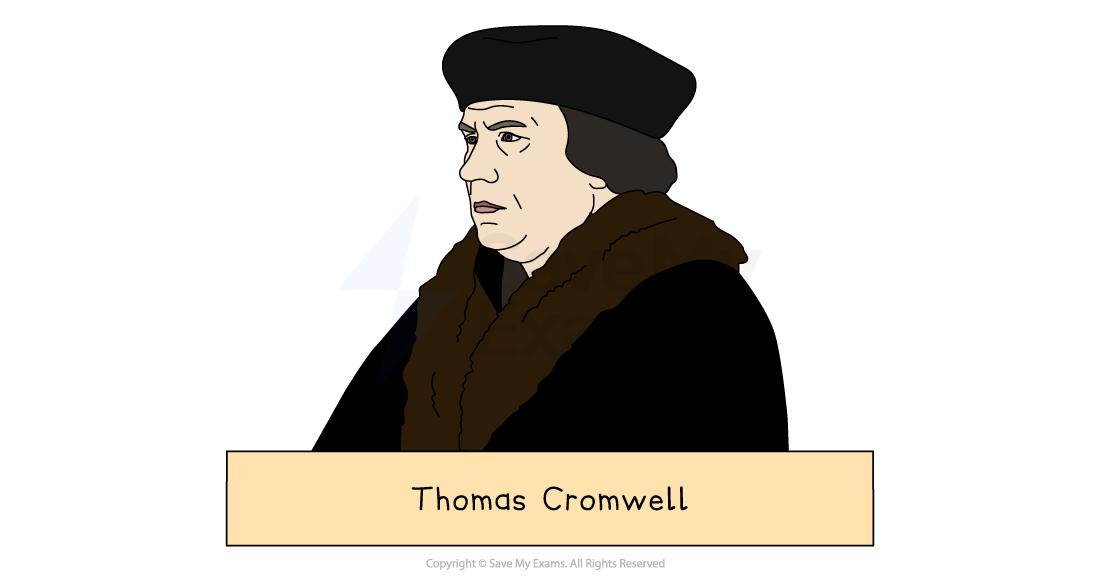
Cromwell's position by 1540
By early 1540, Cromwell appeared to be at the peak of his power
He had just been created Earl of Essex and Lord Great Chamberlain
He had survived the Pilgrimage of Grace, the dissolution and the fall of Anne Boleyn
He had no obvious rival in government
Yet, within months, he was in the Tower, attainted and executed
His fall was rapid, total and irreversible
The Anne of Cleves "disaster"
Cromwell had arranged Henry's fourth marriage to Anne of Cleves in 1540 as a Protestant diplomatic alliance
Henry found her physically unattractive on their first meeting
Henry reportedly said she looked like a horse ("a great Flemish mare")
The marriage was annulled after just six months
Henry never forgave Cromwell for the humiliation
It left Cromwell politically exposed and unable to rely on Henry's personal goodwill
The Howard faction
The conservative Catholic faction, led by Thomas Howard, Duke of Norfolk, had been waiting for an opportunity to destroy Cromwell
Norfolk introduced Henry to his niece, Catherine Howard, who quickly caught Henry's attention
The Howards now had direct personal access to the king and used it ruthlessly
Cromwell was accused of heresy and treason
The heresy charge was ironic:
Cromwell was a moderate Protestant in practice
He was alleged to have said he would fight even against Henry's wishes to defend Protestant reform
The execution
Cromwell was suddenly arrested at a Privy Council meeting on 10 June 1540
This shocked many contemporaries who believed he was still secure in Henry's favour
Cromwell was attainted by Parliament in June 1540, condemned without trial
He wrote a desperate letter to Henry begging for mercy
Henry ignored it
Cromwell was executed on Tower Hill, 28 July 1540
Henry later expressed regret, reportedly saying he had been misled into destroying the best servant he had ever had
This suggests that the Howards and Gardiner may have manipulated Henry, rather than simply acting on his wishes
Examiner Tips and Tricks
Cromwell's fall illustrates a key theme: ministerial power was always conditional on royal favour. Wolsey and Cromwell both rose to extraordinary heights and were destroyed when Henry withdrew his support. The pattern matters more than the individual cases.leves marriage was the immediate trigger, but the underlying cause was the Howard faction's patient scheming. The strongest answers distinguish between trigger and underlying cause.
Faction at Court after Cromwell: Conservatives vs Reformers
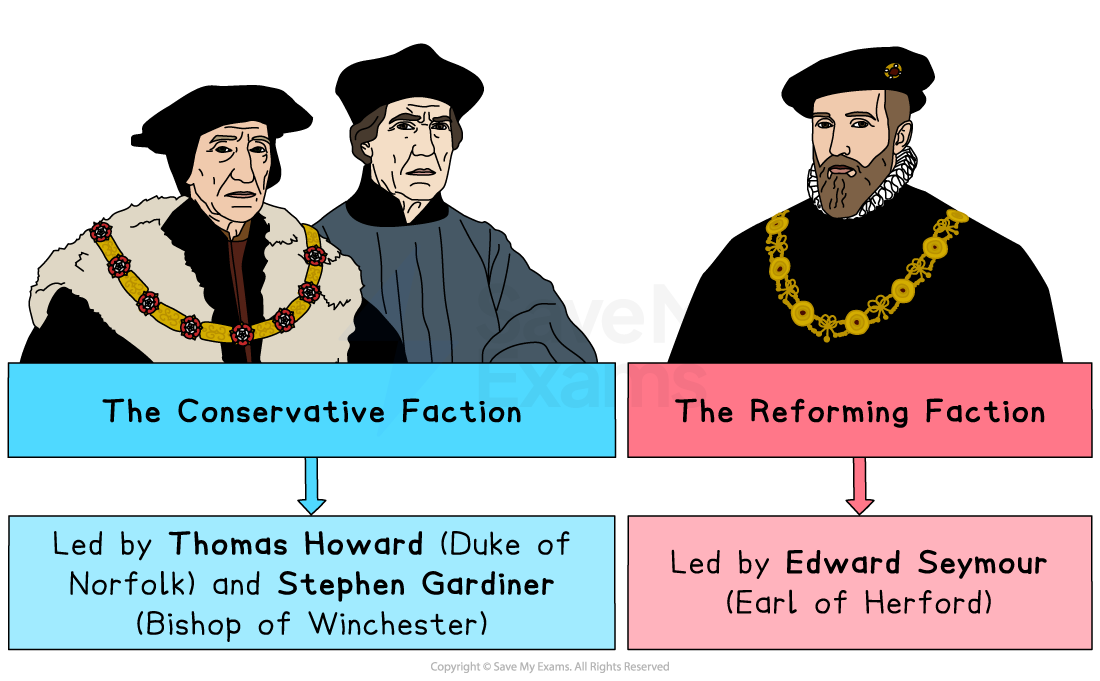
After Cromwell's fall, no single minister replaced him as chief minister
Instead, Henry governed through two competing factions whose rivalry defined the politics of the 1540s
The conservative faction |
|
|---|---|
The reforming faction |
|
Examiner Tips and Tricks
The factional struggle of 1540 to 1547 matters beyond Henry's reign. The reformers' victory directly explains the Protestant direction of Edward VI's government. If you are asked about continuity and change across the Tudor period, this is a key link.
Henry retained personal authority throughout. He personally protected Cranmer when the conservatives tried to destroy him, and he personally decided which faction dominated at any given moment. Faction was real, but Henry was never simply a puppet of either side.
The Conservative Reaction: Religion & Politics, 1539–1547
After the rapid Protestant-leaning changes of 1536 to 1538, Henry pulled back towards Catholic orthodoxy
This conservative reaction was driven by three overlapping forces:
Henry's own theological conservatism: he had never intended to change doctrine, only Church governance
The need for Catholic allies in Europe as the threat of a Franco-Habsburg alliance loomed
The Howard faction's growing influence at court following Anne of Cleves and Catherine Howard
The Six Articles, 1539
This was pushed through Parliament by the Duke of Norfolk in 1539
It reasserted six core Catholic doctrines:
Transubstantiation: the bread and wine at Mass literally become the body and blood of Christ
Clerical celibacy: priests could not marry
Private masses, auricular confession and communion in one kind were all reaffirmed
It imposed severe penalties: denial of transubstantiation was punishable by death
It was known by Protestants as "the whip with six strings"
The impact was immediate:
Protestant bishops Latimer and Shaxton resigned their positions
Archbishop Cranmer discreetly sent his wife to live in Germany, as the articles required clerical celibacy
Protestant reformers at court were temporarily silenced
Examiner Tips and Tricks
The Six Articles are often misread as evidence that the Reformation had been reversed. It had not. They changed doctrine, not the Royal Supremacy. Henry remained Supreme Head of the Church of England. The Break with Rome was permanent; the doctrinal direction was not.
The King's Book, 1543
This was a revised doctrinal statement replacing the more Protestant Bishop's Book of 1537
It was more Catholic in tone, reaffirming traditional practices and doctrine
It showed Henry consciously pulling back from the Protestant direction of the late 1530s
Why the conservative reaction proved temporary
Catherine Howard's fall in February 1542 destroyed the Howards' direct influence over Henry
She was arrested for alleged adultery and executed
Norfolk's family lost the personal access to Henry they had relied upon
Henry's marriage to Catherine Parr (1543) brought reformers back into his close circle
Catherine Parr was educated, Protestant in sympathy and genuinely intellectually influential
The Howards overreached in 1546 when they tried to have Cranmer arrested on heresy charges
Henry personally intervened to protect Cranmer, handing him his own ring as a token of royal favour
This episode revealed the limits of factional power: Henry could shut down any attack when he chose to
Norfolk was arrested in December 1546; his son the Earl of Surrey was executed in January 1547
Henry died on 28 January 1547, with Norfolk still in the Tower
The reformers around Hertford and Cranmer inherited power with little immediate opposition
Examiner Tips and Tricks
When writing about the conservative reaction, always link it back to faction. The Six Articles were not simply Henry's personal religious preference: they were the political product of the Howards' dominance at court in 1539. When Howard influence collapsed in 1542, the conservative reaction lost its political engine.
How Effectively was England Governed under Henry VIII?
This question draws on evidence from across the whole of Henry VIII's reign
Use the specific evidence below to build and support your own argument
Evidence that Henry VIII governed effectively
Henry demonstrated consistent personal control over his ministers
Wolsey and Cromwell were both promoted and destroyed entirely at Henry's will
This suggests Henry was the puppeteer, not the puppet: he chose when to act and when to delegate
The Break with Rome and the Reformation Parliament represented a genuine constitutional achievement
Parliament was used to give sweeping changes a legal legitimacy that proved very hard to reverse
The Royal Supremacy permanently transformed the relationship between Crown, Church and Parliament
The dissolution of the monasteries was efficiently executed and brought enormous wealth to the Crown
It required complex administrative machinery and was completed within five years
England remained stable and largely free from major domestic revolt for most of the reign
The Pilgrimage of Grace (1536) was the most serious challenge but was suppressed without major military engagement
The Privy Council emerged as a more professional body, laying the foundations for later Tudor government
Key historians
M. Everett, The Rise of Thomas Cromwell (2015) |
|
|---|
Evidence that Henry VIII's governance had serious weaknesses
The factional instability of the 1540s revealed the dangers of Henry's personal style of kingship
Without a dominant minister after Cromwell's fall, rival factions competed destructively for royal favour
Policy became inconsistent and erratic, shifting between Protestant and Catholic positions
Henry wasted the financial gains of the dissolution on expensive and largely fruitless foreign wars
More than half of all monastic lands were sold off between 1543 and 1547 to fund campaigns in France
The Crown lost the long-term income these lands would have generated
The succession was repeatedly destabilised by Henry's personal decisions
Three of his six wives were discarded or executed
Mary and Elizabeth were both declared illegitimate at different points, then reinstated
The succession crisis this created was never fully resolved in Henry's lifetime
The executions of More, Fisher and Cromwell damaged England's international reputation
They also illustrated how Henry's government operated through fear rather than consent
Henry left a 9-year-old son as his heir, making a contested minority government almost inevitable
Key historians
J. Guy, History Review (1995) |
|
|---|
Examiner Tips and Tricks
This is the overarching evaluative question for the whole of Henry VIII's government. Draw on evidence from across all the revision notes: Wolsey's rise and fall, Cromwell's reforms, the Break with Rome, the dissolution and the factional struggles of the 1540s. A narrow answer focusing only on one period will not score highly.
The best answers reach a clear judgement rather than simply listing points on both sides. A strong line of argument might be: Henry governed effectively in terms of achieving his personal aims, but his style of kingship created structural instability that became apparent in the factional chaos of his final years and the minority government that followed.

Unlock more, it's free!
Join the 100,000+ Students that ❤️ Save My Exams
the (exam) results speak for themselves:

Was this revision note helpful?
