Edward VI: Government, Somerset & Northumberland (AQA A Level History: Component 1: Breadth study): Revision Note
Exam code: 7042

Summary
Edward VI became king aged nine in 1547
Minority rule meant no regent could easily command the full authority of the Crown
Somerset took power as Lord Protector
He was a capable soldier but a poor politician, and he alienated both the gentry and the poor
The Western Rising and Kett's Rebellion (1549) brought the country to a point of crisis
Somerset was overthrown by his own Council in October 1549
Northumberland restored stability by governing through the Privy Council
He accelerated Protestant reform and began tackling the debased coinage
The Devise for Succession (1553) collapsed within nine days
Mary Tudor took the throne under the terms of Henry VIII's will
Historians disagree on how effectively England was governed
Hoak praises Northumberland as one of Europe's ablest governors
The traditional view condemns both regents and labels the period a mid-Tudor crisis
Edward VI: A Child King & Problems with Minority Rule
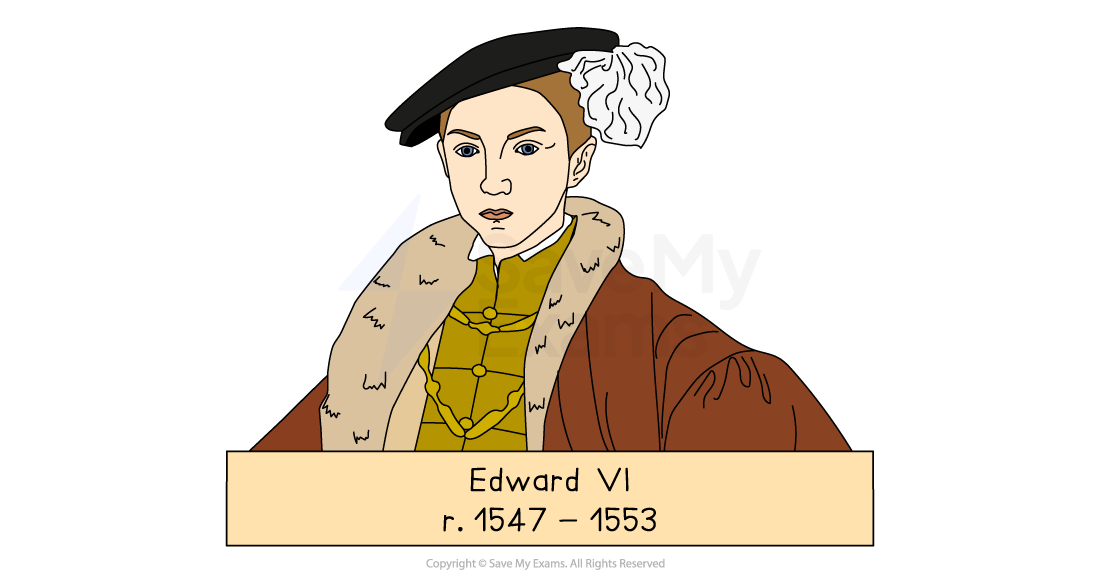
Henry VIII was succeeded by his nine-year-old son; this single fact shaped every decision made between 1547 and 1553
The structural problems of minority rule
A minority government is one where the king is too young to rule
Power passes to a regent who governs in his name
England was governed this way for Edward's entire reign
A regent’s authority was temporary and dependent on maintaining support
It lasted only until the king came of age or died
Every rival knew this
The Regency Council was a coalition of competing interests
Henry VIII intended 16 councillors to govern jointly
Somerset quickly manoeuvred his way to personal dominance instead
Obedience to the Crown depended partly on the personal authority of the monarch
The regent therefore had to construct authority through policy and patronage
England had experienced minority rule before (Henry VI and Edward V)
But never alongside such a dangerous combination of inherited financial, military and religious problems
What Henry VIII left behind
Somerset inherited a near-bankrupt treasury
Over £2 million had been spent on the Scottish and French wars
England could not afford to continue the wars, but withdrawal would mean losing face
The coinage had been repeatedly debased
Henry reduced the silver content of coins
The result was rising prices and falling real wages throughout the 1540s
Religious policy was unresolved
The Break with Rome was complete but there was no Protestant settlement
Reformers and conservatives both pressed their claims on whoever held power
The Privy Council was factional
The struggle between reformers and conservatives had intensified in the last years of Henry's reign
Somerset temporarily suppressed it; he did not resolve it
Social unrest was already building
Enclosure, rising rents and harvest failures through the 1540s had created widespread rural discontent before Edward ever came to the throne
Edward VI | Why does it matter? |
|---|---|
|
|
|
|
|
|
|
|
|
|
Examiner Tips and Tricks
Questions about minority rule reward structural arguments, not just descriptions of Somerset's failures. Show why any regent in 1547 faced difficult conditions. The combined pressure of war debt, debasement, religious uncertainty and a factional council would have tested even the most able government.
The Duke of Somerset as Lord Protector: Character, Aims & Policies
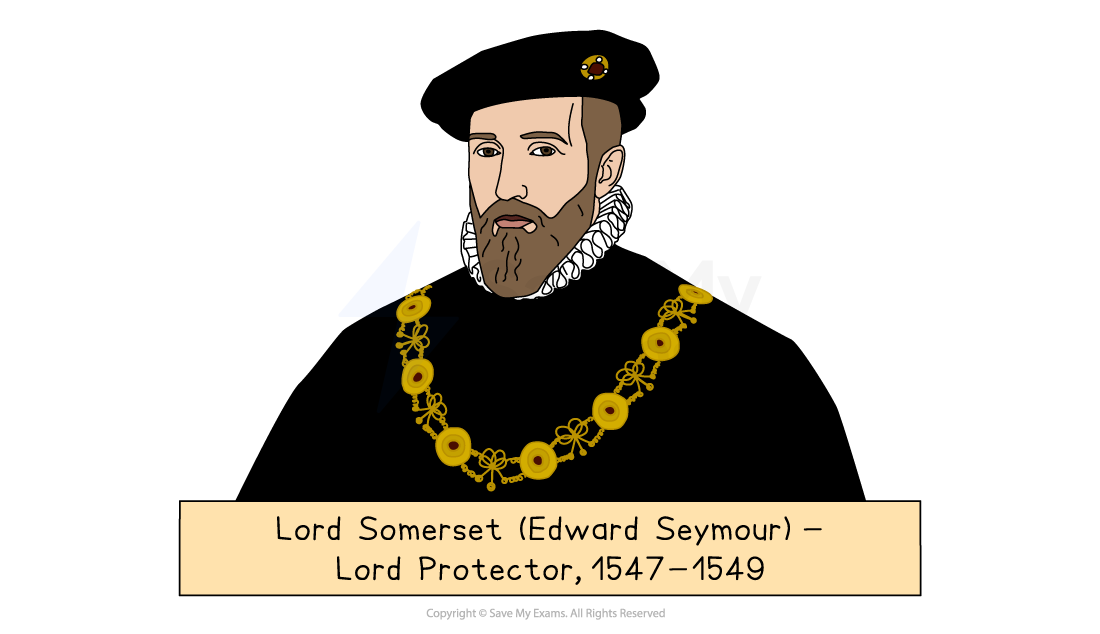
Somerset (Edward Seymour, Earl of Hertford) was a proven soldier and a genuine reformer
However, his arrogance and poor political judgement destroyed him within two years
Character
A skilled military commander
He had served Henry VIII in the Scottish and French campaigns
His victory at Pinkie (1547) gave him further status
The battlefield was where his real ability lay
Arrogant and autocratic
He repeatedly bypassed the Privy Council, issuing proclamations in the king's name without consultation
This concentrated political resentment on a single individual
Overconfident due to family ties
He was the king's uncle, which gave him an advantage that he used to justify his dominance
It also made him overconfident; he acted as if his position was permanent, but it was not
Aims
A moderate Protestant settlement
Reform without the schism
He wanted to move the Church in a Protestant direction without provoking outright rebellion
Genuine sympathy with Protestant ideas
He worked closely with Archbishop Cranmer and allowed a degree of religious experimentation from the start of the reign
Alliance with Scotland
Through a proposed marriage between Edward VI and Mary Queen of Scots
This was the centrepiece of his foreign policy
Protection of the rural poor
Attempted this through enclosure reform
He believed the Crown had a duty to address the social dislocation caused by converting arable land to sheep pasture
Key policies
Somerset's policies across religion, foreign affairs and the economy were well-intentioned but consistently poorly executed
Religious policy
Somerset repealed the Six Articles (1539) and the old heresy laws in 1547, along with some treason legislation restricting religious discussion
He implemented:
Chantries Act (1547)
Abolished chantries, raising money for the Scottish War
Act of Uniformity (1549)
Imposed a single standard of worship
New Prayer Book (1549)
In English for the first time
Deliberately vague on the Eucharist in an attempt to satisfy both sides
Assessment
Moderate reform, but too ambiguous to sustain
Reformers pushed for more, conservatives resisted change
The vagueness satisfied nobody and contributed to the Western Rising in Cornwall and Devon
Foreign policy
Somerset resumed the Scottish war to secure a proposed marriage between Edward VI and Mary Queen of Scots
The Battle of Pinkie was fought, on September 1547:
A decisive English victory, but it was extremely expensive
French troops arrived in Scotland (1548)
Mary, Queen of Scots, was sent to France for protection
Assessment
Military success, but little strategic value
The campaign united Scotland against England, rather than dividing it
The Franco-Scottish alliance was strengthened, not broken
England gained nothing lasting
Social and economic policy
An enclosure commission was launched in 1548 to investigate illegal enclosures
New taxes were placed on sheep and cloth (1548)
Government inspectors toured the countryside to monitor activity
Assessment
Well-meaning but misjudged
The commissions raised expectations among the poor that the government could not meet
The sheep tax alienated the gentry
Both groups had turned against Somerset by 1549
Examiner Tips and Tricks
Somerset is often judged as personally well-intentioned but politically incompetent. The best answers show why these two things are not contradictory. His desire to help the poor was genuine, but raising expectations he could not then fulfil was more destabilising than doing nothing would have been.
The Fall of Somerset, 1549: Why was he Overthrown?
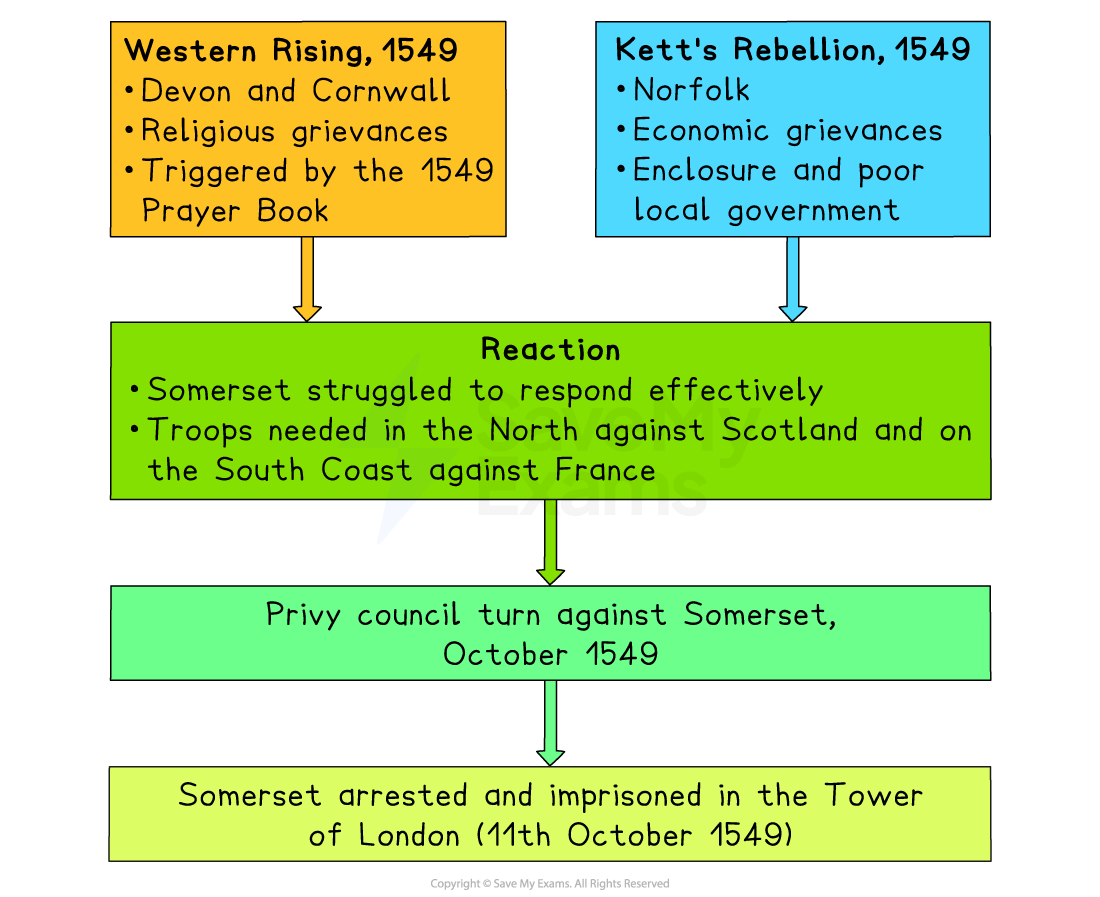
Somerset's fall was caused by political isolation and personal arrogance
The 1549 rebellions can be seen as the trigger, and the Council’s accumulated hostility as the underlying cause
The 1549 rebellions: a brief summary
In summer 1549, two major rebellions broke out simultaneously
The Western Rising in Devon and Cornwall was triggered by the 1549 Prayer Book
Its grievances were primarily religious
Kett's Rebellion in Norfolk was driven by economic grievances:
Enclosure, rising rents and poor local government
Both were eventually suppressed, but Somerset was paralysed by having to deal with both at once while also facing threats from Scotland and France
Around 4,000 people were killed across both risings in total
For the full causes, events and significance of both rebellions, see the Economy and Rebellion Revision Note
Somerset's Fall
Reasons | Why did this lead to the fall of Somerset? |
|---|---|
Paralysis during the rebellions |
|
Alienation of the gentry |
|
Council opposition |
|
Personal arrogance |
|
Somerset was arrested in October 1549
He was released in February 1550 and allowed to rejoin the Council
In early 1552, he was arrested again on charges of plotting against his rivals
He was executed in January 1552
Examiner Tips and Tricks
Questions on rebellion often ask whether social and economic grievances or religious discontent was the most important cause. In 1549, the answer is both, but differently. The Western Rising was primarily religious; Kett's was primarily economic. Both came from Somerset's failures. Name the events, locations and specific grievances, as vague references to 'rebellion' will not score highly.
The Duke of Northumberland: Government, Policies & Ambition
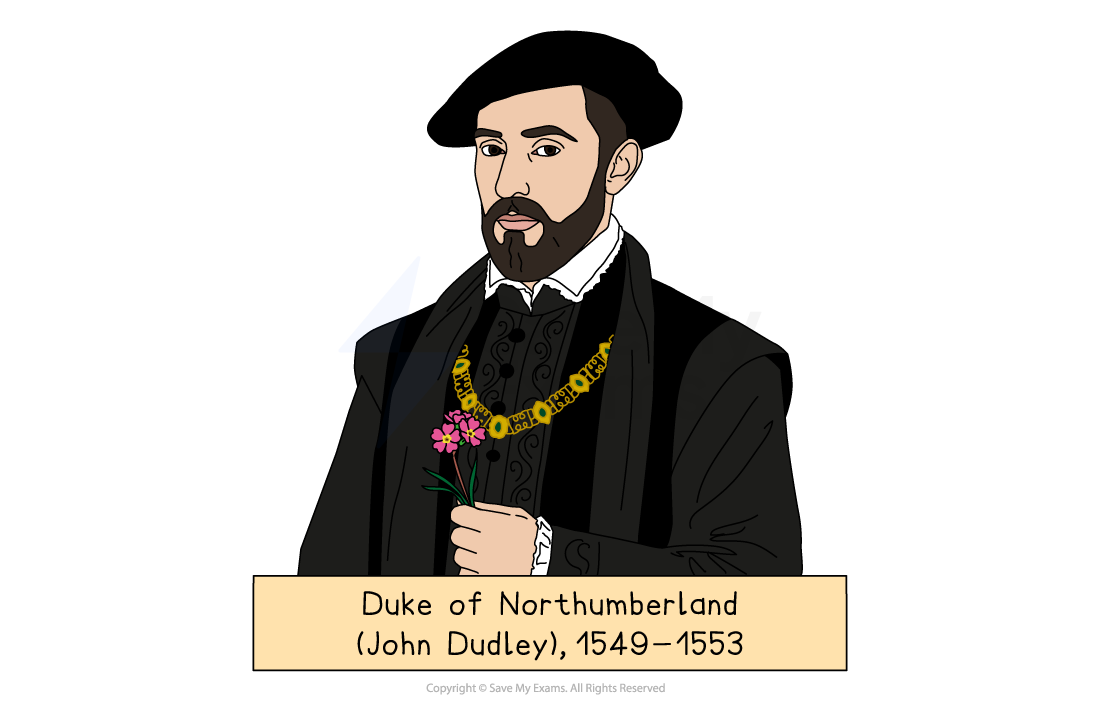
Northumberland governed more effectively than Somerset
But he did so in less difficult circumstances
His power depended entirely on Edward VI staying alive
How did Northumberland govern differently?
His title was Lord President of the Council, not Lord Protector
This was deliberate
It placed collective Council authority at the centre of the regime, not personal power
He worked through the Council, not around it
This dispersed resentment rather than concentrating it on a single target, as Somerset had done
He removed conservative opponents
Bishop Gardiner was imprisoned in the Tower
Bishop Bonner was deprived of his diocese
The Council was built around reformers
He encouraged Edward VI to take an active role in government
This gave legitimacy to the regime
It allowed Northumberland to build a genuine working relationship with the king
He was a pragmatist
Traditional historians called him a ruthless opportunist
Revisionist historians argue he was a capable governor making the best of difficult circumstances
Key policies
Northumberland's policies were more pragmatic and more effective than Somerset's
Where Somerset raised expectations he could not meet, Northumberland focused on stabilising what he had
Religious policy
Northumberland implemented:
Second Act of Uniformity (1552)
Attendance at Church of England services was made compulsory
Prayer Book (1552)
Removed all traces of Catholicism from the Mass
42 Articles (1553)
Listed the doctrines of a clearly Protestant Church of England
Altars were replaced by communion tables
Clergy were ordered not to wear vestments
Assessment
The most complete Protestant settlement of the reign
Achieved without civil war or foreign intervention
Foreign policy
Peace of Boulogne (1550)
Ended the French and Scottish wars
England returned Boulogne to France and withdrew garrisons from Scotland
Alliance with France agreed
Edward VI betrothed to Elizabeth, daughter of the French king Henry II
Assessment
Widely seen as humiliating, but it freed up resources and stabilised England’s position
Social policy
A new Poor Law (1552)
Parishes were made responsible for collecting money for the deserving poor
Acts were passed to protect arable farming against further enclosure
Anti-enclosure legislation was enforced through normal courts rather than divisive commissions
Assessment
Practical and lasting
Northumberland balanced gentry and rural interests without the confrontation Somerset had caused
Trade and exploration
New trade routes to West Africa were opened by 1553
The 1553 voyage of Richard Chancellor opened the way for the later Muscovy Company
Explorers searched for a north-east passage to reduce English dependence on Antwerp
Assessment
The origins of the commercial expansion that would flourish under Elizabeth
A long-term strategic response to the slump in Antwerp cloth exports
How ambitious was Northumberland?
The traditional view held that Northumberland was a ruthless self-seeker
The 1553 succession plot seemed to confirm this
Revisionist historians argue that he was a competent governor working in near-impossible circumstances
His Council management was skilled
His economic and religious reforms were effective
Matthew Christmas (History Today, 1997) argues the Devise for Succession originated with Edward VI himself, not Northumberland
Edward's Protestant convictions drove the attempt to exclude Mary from the throne
Examiner Tips and Tricks
Try not to just present Northumberland as a 'self-seeker'. His reforms were substantive. Arguably his governing style was better adapted to minority conditions than Somerset's. The best answers acknowledge both sides and offer a clear, supported judgement.
Northumberland's Economic Reforms: Addressing Debasement & Inflation
The economic crisis of the late 1540s was perhaps the most serious domestic challenge of the reign
Northumberland addressed its root causes more directly than Somerset had managed
Causes of the mid-Tudor economic crisis | What happened? |
|---|---|
Debasement of the coinage |
|
Rising population |
|
Poor harvests |
|
Cloth trade difficulties |
|
Northumberland's solutions
Northumberland's solution to the most pressing economic problem was the revaluation of the coinage (1551), overseen by William Cecil and Thomas Gresham:
It addressed the root cause of inflation rather than its symptoms
It was the most important economic measure of the reign
It helped restore confidence in the currency and stabilise prices, though inflation remained a problem in the short term
The Devise for Succession: Lady Jane Grey & the Crisis of 1553
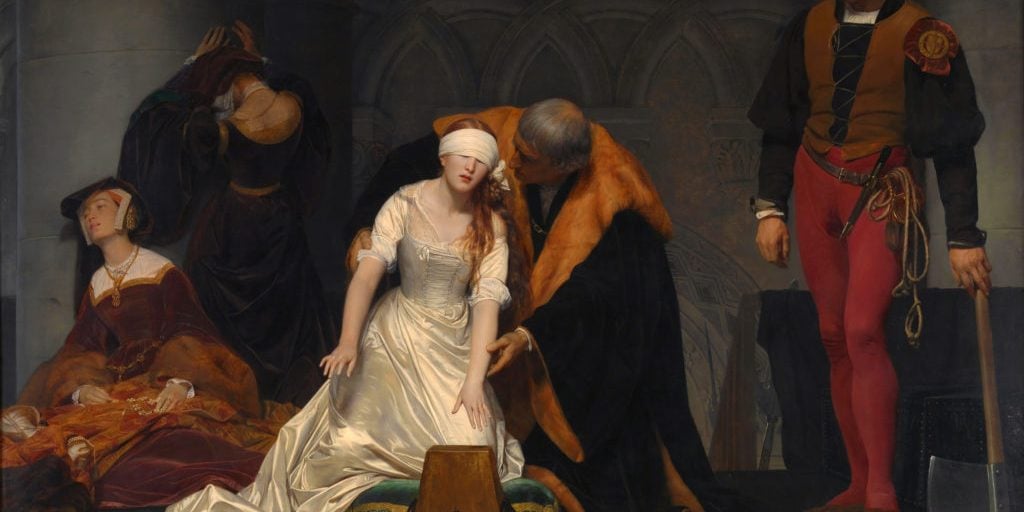
The crisis of 1553 was the ultimate test of minority government
It showed how fragile the regime had become and how resilient the Tudor succession remained
Background
Spring 1552:
Edward VI survived measles and smallpox, his death was not anticipated
January 1553:
The first signs of a serious chest illness appeared
It became clear that he would not survive
Under Henry VIII's will and the 1544 Succession Act, the Crown was to pass to Princess Mary
She was a committed Catholic who had spent Edward's reign in open opposition to his religious reforms
Northumberland feared that Mary's accession would reverse everything
His religious reforms and his political position would be undone
The Devise
A Devise was a legal document setting out the succession to the throne
Edward VI used it to override Henry VIII’s will and redirect the Crown away from Mary Tudor, reflecting his own Protestant convictions
Matthew Christmas (History Today, 1997) argues the Devise originated with Edward VI himself, not Northumberland
Edward’s own Protestant convictions drove the plan to exclude Mary from the throne and shaped the direction of the Devise
Mary and Elizabeth were both excluded on the grounds of illegitimacy, though both had been restored to the succession by Henry VIII's will
Lady Jane Grey was named as heir under Edward's Devise
She was the Protestant great-granddaughter of Henry VIII's sister Mary
May 1553:
Jane married Northumberland's son, Guildford Dudley
Northumberland tied his family to the Protestant succession, aligning himself with Edward's plan
Edward VI finalised and signed the Devise in June 1553, confirming his personal commitment to excluding Mary shortly before his death in July at the age of 15
Why did the plot fail?
Most ruling elites backed Mary's legitimate claim, whether Catholic or Protestant
The Privy Council's initial support for Jane had been thin and conditional
Northumberland had not had time to prepare
Edward's chest infection grew worse quickly
There was no provincial network, or reliable army
The Tudor succession proved stronger than any individual regent
The only serious attempt to overturn the Tudor succession, it lasted just nine days
Examiner Tips and Tricks
The Lady Jane Grey episode in the succession crisis is something used only as evidence of Northumberland's ambition. It is also good to approach it as evidence of what minority government does to political stability. Northumberland's entire power base depended on a 15-year-old staying alive.
How Effectively was England Governed under Edward VI?
Use the evidence below to build your own analytical argument
The question asks you to weigh structural constraints against individual performance, and to judge whether the achievements outweigh the failures
Evidence that England was not governed effectively
Somerset's paralysis during the 1549 rebellions was damaging
Two simultaneous uprisings exposed his inability to govern under pressure
The Western Rising was a direct consequence of Somerset's religious policy
His 1549 Prayer Book failed to satisfy either reformers or conservatives and triggered rebellion in the south-west
Kett's Rebellion grew from Somerset's economic failures
His enclosure commissions raised expectations among the poor that the government could not then meet
The Scottish war was extremely expensive and achieved nothing lasting
France and Scotland were more closely allied at the end of Somerset's foreign policy than at the beginning
Somerset was overthrown by his own Council and eventually executed
This raises questions about the stability of a government that removes its own chief minister
Economic problems persisted throughout the reign
Inflation, bad harvests in the early 1550s, the Antwerp cloth slump of 1551 and continued population pressure
The Devise for Succession revealed the ultimate fragility of the regime
Evidence that England was governed more effectively than often credited
Northumberland restored order after 1549 and held it for four years
The most serious popular uprisings of the Tudor century had just occurred
Protestant reform was advanced without full civil war
The 1552 Prayer Book and 42 Articles created a more Protestant church
No foreign military intervention followed
The revaluation of the coinage in 1551 addressed the root cause of inflation
It was the most important economic measure of the reign
The new Poor Law (1552) placed responsibility for the deserving poor on parishes
It was a practical, lasting piece of local government
Commercial expansion began under Northumberland
West African trade routes, the Muscovy Company (1553) and the search for a north-east passage all took place
England's maritime commercial future was being built
The Tudor dynasty survived
Mary's succession followed after just a nine-day interlude with Lady Jane Grey
Legitimate succession held
Key historian
D. Hoak, 'Rehabilitating the Duke of Northumberland: Politics, and Political Control, 1549–1553' (1980) |
|
|---|
Examiner Tips and Tricks
Questions on how effectively England was governed invite comparisons between Somerset and Northumberland on the same criteria: political stability, religious policy, economic management and foreign affairs. Judge both men against those criteria and reach a clear overall judgement. Be careful of letting the narrative of Somerset's fall dominate at the expense of Northumberland's genuine achievements.

Unlock more, it's free!
Join the 100,000+ Students that ❤️ Save My Exams
the (exam) results speak for themselves:

Was this revision note helpful?
