Edward VI: Foreign Policy (AQA A Level History: Component 1: Breadth study): Revision Note
Exam code: 7042

Summary
Edward VI inherited two expensive, unresolved wars: one with Scotland and one with France
Both conflicts had already cost Henry VIII over £2 million with little to show for it
Somerset continued the Scottish war through the Rough Wooing: military pressure to force a marriage alliance
He won the Battle of Pinkie (1547) but could not hold Scotland permanently
The French sent troops to Scotland in 1548
Mary, Queen of Scots, was sent to France to marry the French heir
Northumberland abandoned the wars and made peace with France in the Treaty of Boulogne (1550)
England returned Boulogne and withdrew from Scotland
It was widely seen as a humiliating
Historians disagree on how successful Edward VI's foreign policy was
Somerset's campaigns are often seen as costly failures
Northumberland's peace is seen by some as a necessary retreat and by others as a damaging climb-down
Somerset's War with Scotland: The Battle of Pinkie, 1547
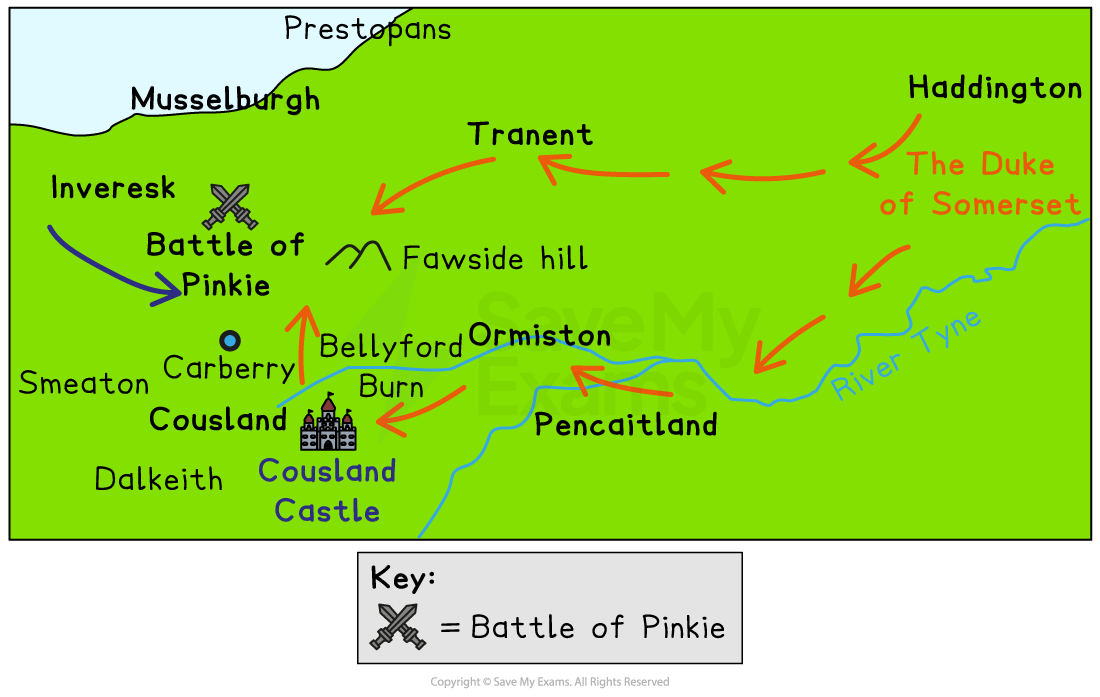
Somerset had to deal with two ongoing wars from Henry VIII: one with Scotland and one with France
Both were expensive
Context: What was the Rough Wooing?
The Rough Wooing was Henry VIII's attempt to force Scotland into a marriage alliance
Henry VIII wanted Edward VI to marry Mary, Queen of Scots
This would unite the English and the Scottish crowns under a Protestant king
When the Scots refused, Henry used military raids to pressure them into accepting
Somerset inherited this policy in 1547 and chose to continue it
Somerset's aims
To secure the proposed marriage between Edward VI and Mary, Queen of Scots
To garrison the Scottish border and hold territory rather than just raid and withdraw
To win over Scottish Protestants and ordinary Scots, rather than simply intimidate them
To prevent France from using Scotland as a base to threaten England from the north
The invasion: scale and strength
Somerset led a combined land and naval invasion from Berwick-upon-Tweed in September 1547
16,000 infantry and 4,000 cavalry on land
30 warships and 50 supply ships at sea
A second force of 2,000 advanced from Carlisle in the west
The Battle of Pinkie, 10 September 1547
The Scottish army was larger but poorly equipped
It had fewer cannon and little effective cavalry
The English won a decisive victory at Pinkie Cleugh, just south of Edinburgh
Somerset gained control of the border region and began building a chain of garrison forts in Scotland
Why did the strategy run into trouble?
The garrison network was enormously expensive
Somerset could win battles but could not occupy Scotland permanently
England did not have enough troops to hold the country
The victory united Scottish resistance
Many Scots who had been neutral or sympathetic now rallied against the English
France responded quickly
Henry II of France sent around 4,000 troops to Scotland in the summer of 1548
With French military support, Scotland strengthened its resistance and Somerset's garrisons came under pressure
Mary, Queen of Scots, sent to France
In August 1548, Mary, Queen of Scots was evacuated to France aged five
In France, she was betrothed to the French Dauphin (Francis II)
This was the opposite of what Somerset had intended
The entire campaign had been to secure Mary's marriage to Edward VI
Instead, Scotland and France were now more closely bound together than before
Somerset withdraws
By summer 1549, Somerset faced the Western Rising and Kett's Rebellion at home simultaneously
He withdrew troops from Scotland to deal with the domestic crisis and to guard the south coast against a possible French invasion
The garrison strategy was abandoned
Somerset's Scottish policy had collapsed without achieving any of its aims
Examiner Tips and Tricks
Questions about Somerset's foreign policy often appear as part of a wider question on his effectiveness as Lord Protector. Military detail matters here: name the battle, give the numbers and show the cost. Then show the gap between the military outcome and the strategic outcome. Pinkie was a military victory but a strategic reversal.
Northumberland's Foreign Policy: Peace with France & Scotland
Northumberland reversed Somerset's foreign policy completely
He prioritised stability at home over military ambition abroad
Why did Northumberland change direction?
The treasury was empty
Somerset's wars were extremely costly; there was no money to continue
The wars had achieved nothing
Scotland was more hostile than before
France was now deeply involved in Scotland
England needed a period of peace
Northumberland had just come through the worst domestic rebellions of the Tudor century
He also recognised that the main long-term threat to Protestant England came from Catholic Spain and the Holy Roman Empire, not France
A French alliance would counterbalance the greater threat from the Habsburgs, who were both Catholic and directly linked to Mary Tudor
The Treaty of Boulogne, March 1550
Northumberland signed a peace treaty with France in March 1550
Terms of the Treaty | What did it mean? |
|---|---|
England returned Boulogne to France |
|
England withdrew all remaining garrisons from Scotland |
|
The border between England and Scotland was restored to its pre-war position |
|
England received a financial payment from France as compensation for returning Boulogne |
|
An alliance with France was agreed |
|
Relations with Charles V
Charles V was Holy Roman Emperor and ruler of Spain
A committed Catholic
Hostile to England's increasingly Protestant religious direction under Northumberland
Cousin of Princess Mary, who remained Catholic throughout Edward's reign
Northumberland's alliance with France helped counterbalance the threat from Charles V without triggering open conflict
Catholic reform and anti-Protestant pressure were growing across Europe
Catholic powers were mobilising to reverse Protestant gains
England under Northumberland sought to avoid direct confrontation with this movement
Examiner Tips and Tricks
The Treaty of Boulogne is the key turning point in Edward VI's foreign policy. You need to understand what England gave up and why. Northumberland's peace is often criticised, but it can also be defended.
How Successful was Edward VI's Foreign Policy?
Use the evidence below to build your own argument
Consider the aims of each policy, what it achieved and what it cost
Evidence that foreign policy was not successful
Somerset spent a significant amount of money (around £600,000) on the Scottish campaign, and achieved none of his aims
Pinkie was a military victory but changed nothing lastingly
English garrisons were abandoned within two years
The Franco-Scottish alliance was strengthened, not broken
The campaign united Scottish resistance behind France
Mary, Queen of Scots was sent to France to marry the French heir
This was the opposite of what the campaign hoped to achieve
England returned Boulogne without military defeat
Henry VIII had spent vast sums capturing it
This was seen as humiliating
All English garrisons were withdrawn from Scotland
England's influence to the north of the border was sharply reduced
The wars left the government near-bankrupt
They contributed directly to the economic crisis of the late 1540s
There was no consistent foreign policy strategy across the reign as a whole
Somerset and Northumberland pointed in completely opposite directions
Evidence that foreign policy was more successful than often credited
Northumberland stabilised England's international position
The peace ended wars England was struggling to win
Continuing these would have damaged the treasury further
The French alliance was strategically sensible
It balanced the threat from Catholic Spain and the Holy Roman Empire
England avoided a direct confrontation with Charles V
Despite its increasingly Protestant religious settlement
Trade expansion began under Northumberland
New routes to West Africa, the 1553 voyage that later led to the Muscovy Company and the search for a north-east passage
These are the origins of Elizabethan commercial expansion
Northumberland helped shift England's foreign policy away from expensive European warfare and towards trade
Examiner Tips and Tricks
Foreign policy questions reward precise factual knowledge. Strong answers show the gap between what was intended and what was achieved. Somerset and Northumberland had very different approaches: compare them on the same criteria to build a structured argument.

Unlock more, it's free!
Join the 100,000+ Students that ❤️ Save My Exams
the (exam) results speak for themselves:

Was this revision note helpful?
