Henry VIII: Society & Rebellion (AQA A Level History: Component 1: Breadth study): Revision Note
Exam code: 7042

Summary
Society and rebellion under Henry VIII was defined by the social disruption caused by the Reformation, the dissolution of the monasteries and the government's attempts to extend royal authority into the regions
English society remained rigidly hierarchical and land-based
The dissolution greatly expanded and enriched the gentry, creating a class with a strong stake in the Protestant settlement
Regional issues were most acute in Ireland and the North:
Both were conservative, attached to Catholicism, and economically dependent on institutions the Crown was dismantling
The Lincolnshire Uprising (1536) and the Pilgrimage of Grace (1536–1537) were the largest popular rebellions of Henry's reign, triggered by the dissolution, religious change and economic grievances
The Pilgrimage was uniquely dangerous:
Around 40,000 men joined, including nobles, gentry, clergy and commons
Henry could not safely suppress it in the field and instead relied on negotiation and broken promises
Historians debate whether the rebellions were genuinely threatening (Guy argues they represented a broad popular ideology) or ultimately limited in significance because they failed to reverse a single policy
Social Structure under Henry VIII: Elites & Commoners
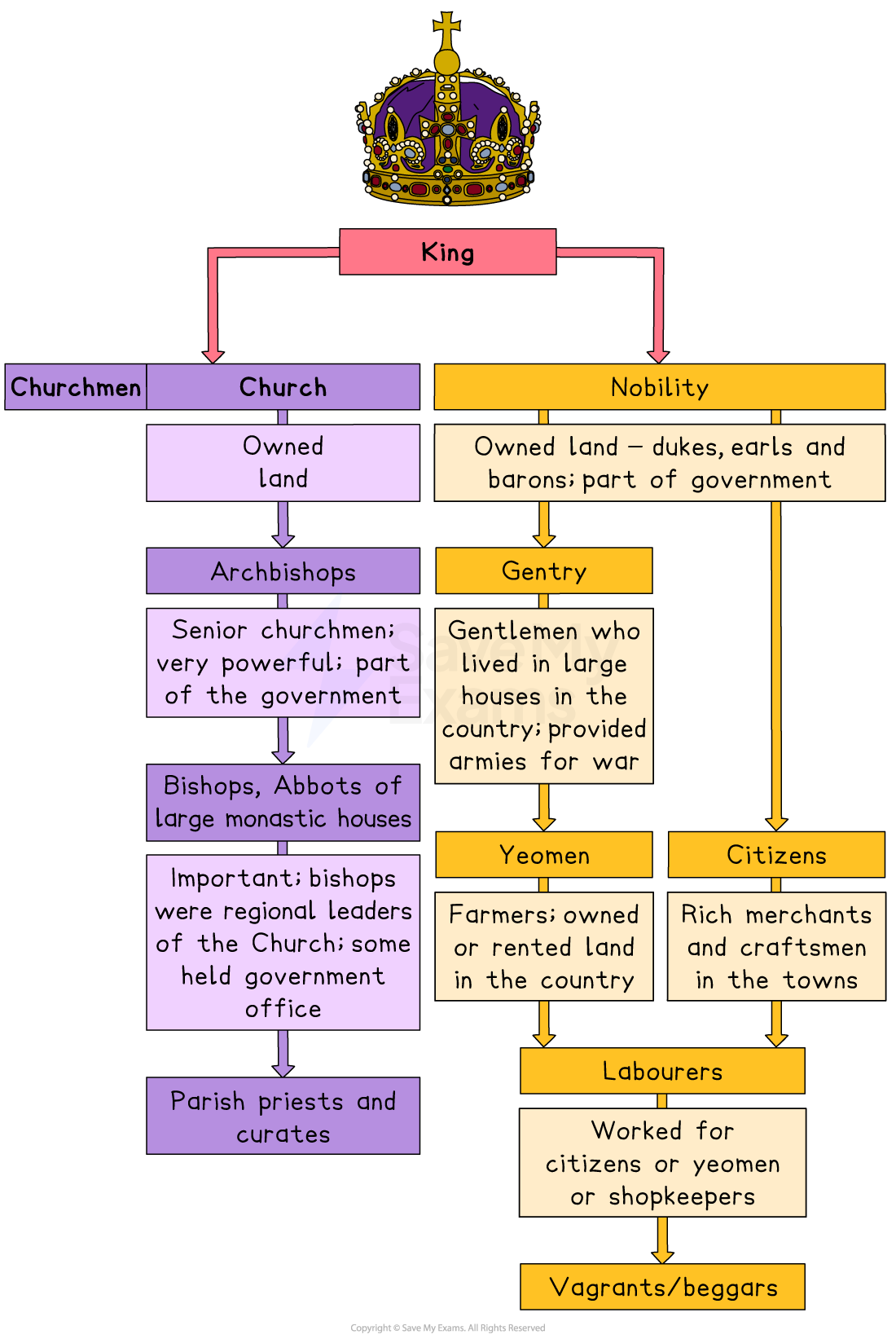
The social hierarchy
English society was rigidly hierarchical and land-based: rank was determined by birth, land ownership and proximity to the Crown
The nobility:
Around 50 to 60 titled families (dukes, earls, barons)
Power rested on land, local office-holding and access to the king
Henry kept them in check through patronage, attainders and the occasional execution
The Church:
One of the largest landowners in England before the dissolution
Bishops and abbots sat in the House of Lords
The Reformation fundamentally disrupted the Church's social and economic position
The gentry:
The expanding class below the nobility
They served as JPs, MPs and local administrators
The dissolution of the monasteries dramatically accelerated their growth by making monastic land available for purchase
The merchants:
Growing in wealth and influence, particularly in London
The cloth trade underpinned much of their prosperity
The yeomen:
Free farmers who owned or leased land
These were a relatively prosperous middling group, largely stable through the upheavals of the reign
The labourers and rural poor:
The vast majority of the population
They were vulnerable to enclosure, harvest failure and rent increases
The population was rising from the 1520s onwards, putting pressure on food supply, wages and housing
Key social changes under Henry VIII
Dissolution of the monasteries
The dissolution was the largest redistribution of wealth since the Norman Conquest
It enriched the gentry and created a new propertied class with a stake in the Protestant settlement
Gentry families who bought monastic land had a direct financial reason to resist any return to Catholicism
Local communities lost sources of charity, healthcare and support from the monasteries, which were not fully replaced
Enclosure
Enclosure continued to displace rural communities throughout the reign
Landowners found it more profitable to convert common arable land to sheep pasture for the booming cloth trade
This displaced poorer tenants and labourers, increasing poverty and resentment that fed into the rebellions of the 1530s
Rising population
Social tensions worsened across the reign partly because of a rising population
More people competed for the same land, jobs and food supply
This led to falling real wages and greater pressure on housing and food for ordinary people
The government had no effective mechanism for managing this structural pressure
Examiner Tips and Tricks
Social structure questions often invite a sweeping answer about "continuity". Push back on this: the dissolution created real structural change in who owned land and who had a stake in the religious settlement. That change was permanent and had long-term consequences for the stability of Protestantism in England.
Regional Issues: Wales, Ireland & the North
Henry faced very different regional challenges across his kingdom:
Wales was brought firmly under control
Ireland and the North proved far more resistant to his authority
Wales |
|
|---|---|
Ireland |
|
The North |
|
Examiner Tips and Tricks
The Acts of Union with Wales are frequently overlooked in Henry VIII questions. They are a significant constitutional achievement: Wales was formally incorporated into the English state, the Council of Wales was strengthened and the Welsh gentry were brought into the governing class. This is worth mentioning as evidence of effective regional management.
Ireland and the North make a useful contrast. In Wales, Henry won over the local elite. In Ireland and the North, he failed to do so. The difference helps explain why Wales was quiet and the other two were not.
The Social Impact of Religious Upheaval under Henry VIII
Before the 1530s, ordinary parish life was largely unchanged from the medieval pattern
Latin Mass, prayers for the dead, saints' days, religious guilds and fraternities defined local religious culture
Most people had no reason to question any of this and no framework for doing so
What change occurred/did not occur?
The dissolution removed institutions that had served as hospitals, schools and sources of poor relief
Monasteries had provided shelter for travellers, medicine for the poor and education for the wealthy
These services were not fully replaced after the closures
The English Bible (1537/1538) was ordered to be placed in parish churches
For the first time, ordinary people could hear scripture in their own language
This was genuinely revolutionary for those who could read or hear it read aloud
But only the educated and devoted would understand the theological debates it opened up
The Ten Articles (1536) reduced the sacraments from seven to three, a Protestant move
The Six Articles (1539) then reasserted Catholic doctrine, confusing the picture further
Most ordinary churchgoers experienced contradiction and uncertainty rather than clear direction
Studies of wills and churchwardens' accounts show much continuing use of traditional Catholic language in the last years of Henry's reign and beyond
Henry had been accepted as Supreme Head, but widespread acceptance of Protestant beliefs was much slower
Many people were reluctant to abandon centuries-old traditions, especially those involving ceremonies and rituals
Why was change slow?
There was no single clear moment when the old Church ended and a new one began
Changes came piecemeal and were sometimes reversed, making it hard to know what to believe
Most ordinary people were not interested in theological debates
What they cared about was whether their local church was open and whether the familiar rituals continued
Religious change was largely imposed from above by Parliament and the Crown rather than driven by widespread popular demand
In many northern and rural communities, the changes created anxiety and resentment rather than enthusiasm, although some urban areas showed growing support for Protestant ideas
Examiner Tips and Tricks
Don't overstate how much ordinary people experienced the Henrician Reformation. The evidence is clear: most people continued using Catholic language and traditional practices well into the reign. The big change was constitutional (the Royal Supremacy), not spiritual.
The English Bible is the most significant change for ordinary people's experience of religion. It is worth distinguishing it from doctrinal changes: the Bible gave people access to scripture in their language, but this did not automatically make them Protestants.
The Lincolnshire Uprising, 1536: Causes & Significance
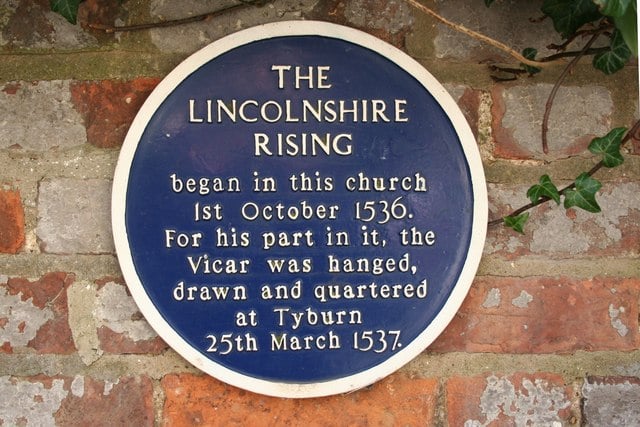
Causes
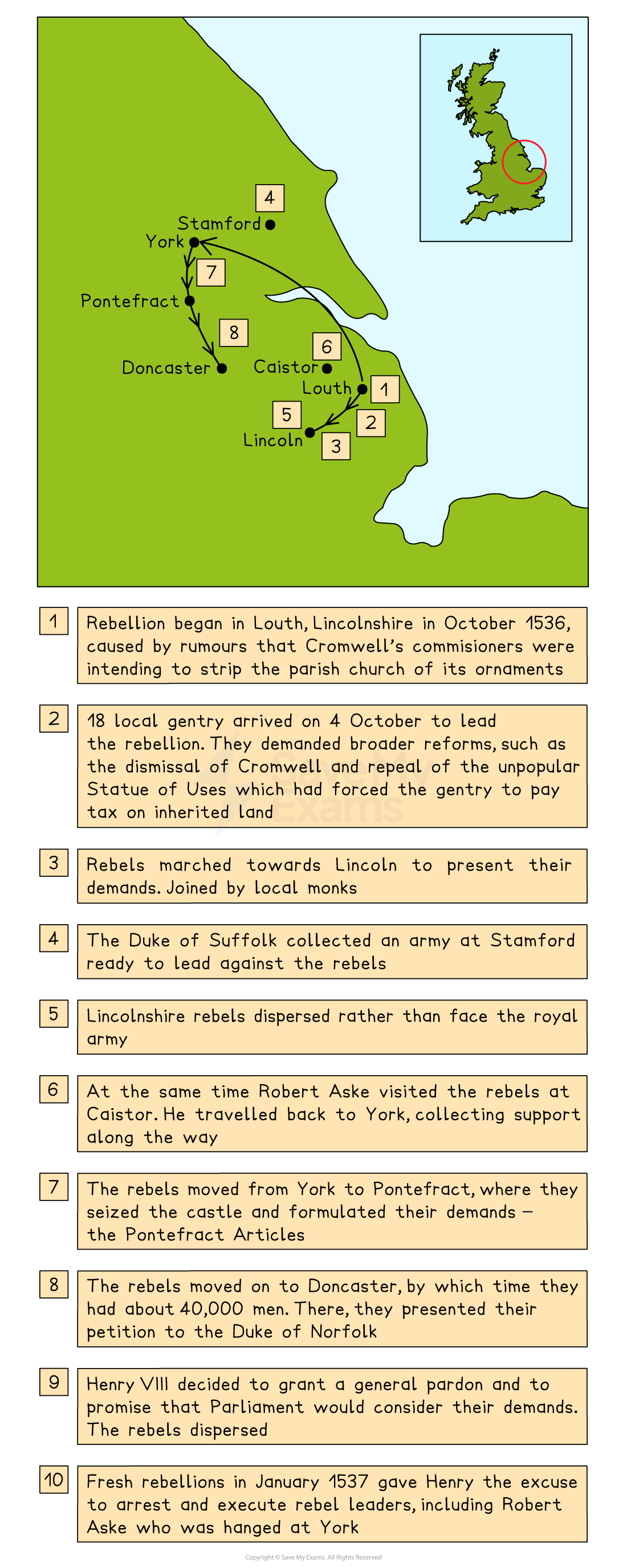
The uprising began in Louth, Lincolnshire in October 1536, triggered by the arrival of royal commissioners
Commissioners had come to dissolve the monasteries and assess the value of Church goods
The town had a large monastery that was being closed and was proud of its recently completed church spire
Wild rumours spread rapidly through the community
That all parish churches would be closed and their plate and ornaments confiscated
That new taxes on baptisms, marriages and burials were coming
That the king's ministers were going to strip the Church of everything of value
Local gentry joined the rebellion within days, broadening its social base
They demanded broader reforms: the dismissal of Cromwell and other low-born councillors, and the restoration of the "old religion"
The Statute of Uses was also a major grievance
This law affected how nobles and gentry inherited land
It was widely resented as an unfair tax on aristocratic inheritances
Events
Around 10,000 rebels assembled and marched toward Lincoln
Henry sent a furious letter refusing all negotiations and demanding unconditional surrender
The Duke of Suffolk assembled a royal army at Stamford
The rebels dispersed without a battle: they lacked the nerve to face the royal army
Significance
It demonstrated the depth of popular anxiety about the pace of religious and social change in the North
It exposed the government's lack of immediate military control in the North
It did not need to suppress the rebellion in battle: the mere presence of a royal army was enough to force the rebels to disperse
Henry’s willingness to make uncompromising demands before his forces were fully in position was a significant gamble
Examiner Tips and Tricks
The Lincolnshire Uprising is often treated as a mere prologue to the Pilgrimage of Grace, but it is worth examining in its own right. It shows that the trigger for rebellion was rumour as much as reality: the commissioners had not actually closed any parish churches, but the fear that they would was enough to set off a rising of 10,000 men.
The Statute of Uses is easy to overlook but appeared consistently in rebel demands. It is evidence that economic and legal grievances were just as important as religious ones in causing these rebellions.
The Pilgrimage of Grace, 1536–1537: Causes, Events & Significance
Causes: religious, economic and political
Religious:
The dissolution of the smaller monasteries; fear of further religious changes; attachment to traditional Catholic practice in the north
Robert Aske himself claimed the dissolution was the greatest cause of the rising
Monasteries in the North were not just religious houses: they were centres of welfare, education and community life
Economic:
Enclosure, rack-renting, poor harvests in 1535 and 1536
The Subsidy Act (1534) was deeply resented: it taxed people in peacetime, which was seen as unprecedented and unjust
The Statute of Uses was seen as a feudal tax on aristocratic inherited land
Political:
Hostility to Cromwell and his low-born advisers; the desire to restore the old order
Rebels saw Cromwell and his circle as a "greedy Crown regime" attacking northern traditions and institutions
The North saw itself as under attack from a distant government that did not understand its needs
Events
October 1536: rebellion spread from Lincolnshire into Yorkshire under Robert Aske, a lawyer from a gentry family
The rebels named their movement the "Pilgrimage of Grace" and wore the badge of the Five Wounds of Christ
This was deliberate:
It framed them as defenders of the faith, not rebels against the king personally
By November, around 40,000 men had joined: nobles, gentry, clergy and commons together
This was the most broad-based rebellion in Tudor England, uniting groups that rarely acted together
Rebels seized Pontefract Castle and issued the Pontefract Articles
Demands included:
Restore the monasteries
Return to papal obedience
Dismiss Cromwell
Repeal the Statute of Uses
The Duke of Norfolk met the rebels at Doncaster and negotiated on Henry's behalf
Henry granted a general pardon and promised a free Parliament at York to consider grievances
The rebels dispersed, trusting Henry's word
The betrayal and its aftermath
Fresh rebellions broke out in January 1537
Henry used these as a pretext to withdraw the pardon and arrest the rebel leaders
Around 200 people were executed, including nobles, gentry and commons
Robert Aske was hanged in chains at York in July 1537
Henry's handling of the aftermath revealed his strategy: deception rather than military force
He had no army he could safely deploy against 40,000 men in the field
His promises were never genuine and he was waiting for an opportunity to reassert control
Why did the Pilgrimage fail?
The rebels' conservative loyalty to the king personally prevented them from pressing their military advantage
They could not bring themselves to march on London against their anointed monarch
The rebels lacked clear coordination and long-term planning, limiting their ability to sustain the movement
The noble leadership was unwilling to take the final step into outright treason
Lords Darcy and Hussey joined the rising but hesitated at the critical moment
No foreign support materialised
The Pope and Charles V offered sympathy but no troops or money
The dissolution continued regardles
Not a single policy was reversed as a result of the Pilgrimage
Examiner Tips and Tricks
The Pilgrimage of Grace is one of the most important events of Henry's reign and appears very frequently in exam questions. The key analytical point is that Henry could not suppress it militarily, he had to resort to deception. This reveals the genuine limits of central power in the North.
The rebels' loyalty to Henry personally is both their greatest strength and their fatal weakness. It made the movement seem legitimate (they were protesting against evil councillors, not the king), but it also meant they could never take the final step of marching on London.
Make sure you can distinguish between the causes clearly: religious, economic and political motivations all overlapped. The strongest answers show how these worked together rather than treating them as separate lists.
How Significant were the Rebellions of Henry VIII's Reign?
The rebellions of Henry VIII's reign raise a fundamental question about the nature of Tudor power
Use the specific evidence below to build and support your own argument
Evidence that the rebellions were highly significant
The Pilgrimage of Grace was the largest popular uprising in Tudor England
Around 40,000 men joined: a force Henry could not meet in the field
The coalition was uniquely broad and dangerous
Nobles, gentry, clergy and commons acted together, sharing a common ideology
Most Tudor rebellions were either elite coups or popular risings: the Pilgrimage was both at once
Henry was forced to resort to deception rather than force
He granted a pardon which he later withdrew once the rebels had dispersed
This reveals the genuine limits of central authority in the North
The Pontefract Articles were a coherent alternative political programme
Not just a riot but a set of specific demands covering religion, politics and economics
The rebellions showed how vulnerable the Reformation was to popular resistance in conservative regions
Had the rebels marched south, the outcome might have been very different
Key historian
J. Guy, Tudor England (1988) |
|
|---|
Evidence that the significance of the rebellions has been overstated
The Lincolnshire Uprising collapsed without a battle
When faced with a royal army, the rebels dispersed immediately
Their willingness to accept Henry's uncompromising demands revealed how limited their resolve was
The Pilgrimage failed because the rebels would not cross the line into outright treason
Conservative loyalty to the king personally prevented them from pressing their military advantage
Henry exploited this loyalty brilliantly by making promises he never intended to keep
The apparent unity of the rebels can be overstated
Different groups had different priorities:
Nobles focused on restoring influence and removing Cromwell
Commons were more concerned with taxation, enclosure and local grievances
This coalition was fragile and based on short-term shared aims rather than long-term agreement
Once Henry offered concessions, many were willing to abandon the wider movement
Not a single major policy was reversed as a result of the rebellions
The dissolution of the monasteries continued and was completed by 1540
Cromwell remained in power until 1540, falling for entirely different reasons
No rebellion after 1537 came close to matching the scale of the Pilgrimage
The Council of the North was strengthened afterwards, extending royal authority in the region
The executions of Aske and the other leaders served as a powerful deterrent
Key historians
Lucy Wooding, Senior Lecturer in Early Modern History, King's College London (cited in The Tudors, England 1485–1603) |
|
|---|
Examiner Tips and Tricks
The strongest answers on rebellion significance make a clear distinction between immediate threat and long-term consequences. Guy's argument is about immediate threat (the coalition was genuinely dangerous). Wooding's is about long-term consequences (Henry created lasting division). Both can be true at the same time.
Avoid the trap of saying the rebellions were "unsuccessful therefore insignificant". The Pilgrimage forced Henry to rely on deception rather than direct enforcement, exposing the practical limits of royal authority in the North, even if it did not lead to any lasting change in policy.

Unlock more, it's free!
Join the 100,000+ Students that ❤️ Save My Exams
the (exam) results speak for themselves:

Was this revision note helpful?
