Elizabeth I: Character, Aims & the Early Consolidation of Power (AQA A Level History: Component 1: Breadth study): Revision Note
Exam code: 7042

Summary
Elizabeth came to the throne on 17 November 1558, aged 25
She was England's second queen regnant
Her early life was traumatic: her mother's execution, claims of illegitimacy, the Seymour episode and imprisonment in the Tower under Mary I
This shaped her into a cautious and politically intelligent ruler
Her immediate aims were to consolidate her position, settle religion and end the war with France
Elizabeth reduced the Privy Council to under 20 members
She appointed Sir William Cecil as Principal Secretary on the day of her accession
She used her coronation in January 1559 as a calculated display of legitimacy and popular appeal
Elizabeth I: Character, Aims & the Challenge of a Female Monarch
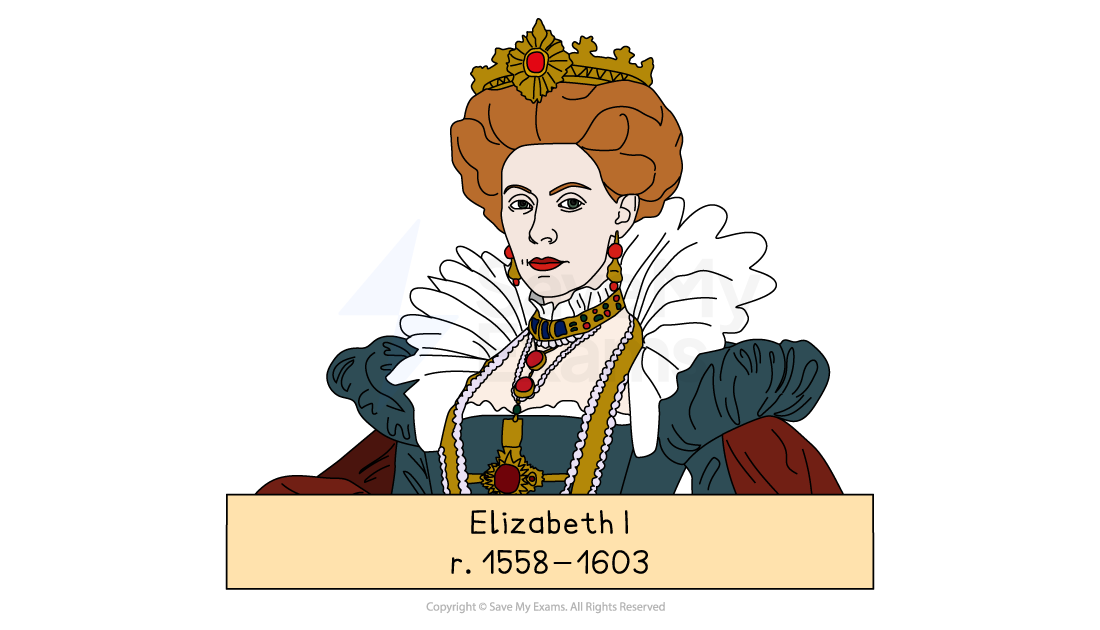
Early life
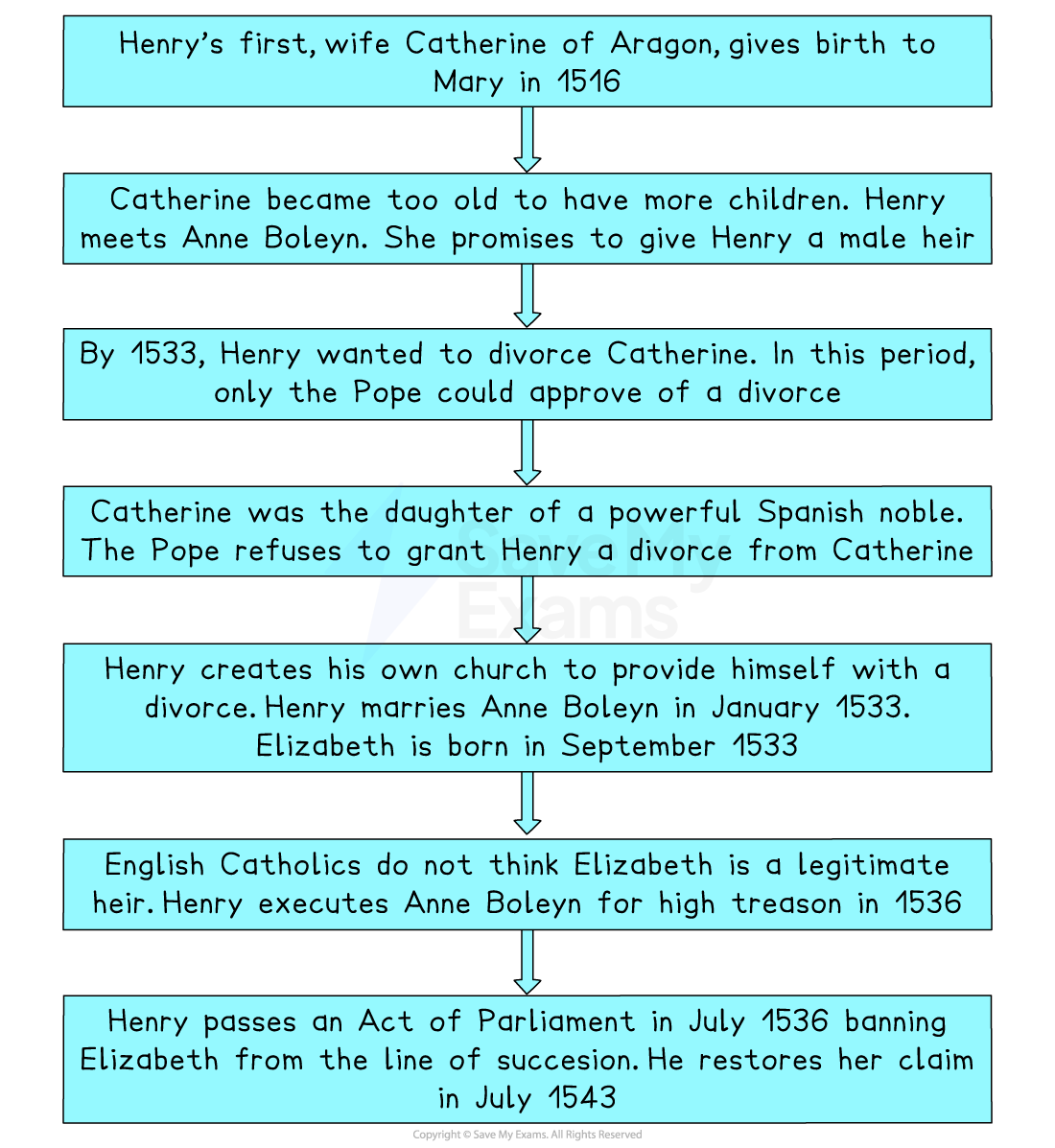
Elizabeth was born on 7 September 1533, the daughter of Henry VIII and Anne Boleyn
When Elizabeth was less than three, her mother was accused of adultery and treason and was executed
Elizabeth was declared illegitimate and excluded from the succession
Elizabeth was restored to the succession by the Succession Act of 1544, named third after Edward and Mary
She found stability in the household of Henry's final wife, Catherine Parr, who took her under her wing
It was here that she developed moderate Protestant beliefs within the Church of England created under Henry VIII
She was educated by Roger Ascham and William Grindal in humanist and Protestant ideas
She was fluent in Latin, Greek, French and Italian by her early teens
The Thomas Seymour episode
After Henry VIII's death, Catherine Parr married Thomas Seymour, younger brother of Lord Protector Somerset
Allegedly, Seymour paid the young Elizabeth inappropriate attention
Including visiting her bedchamber
When Catherine Parr died in childbirth, he encouraged rumours that he intended to marry Elizabeth
Somerset arrested his own brother for treason
Seymour was executed in 1549
Elizabeth feared for her own life but was cleared of any involvement
Historians generally agree that this left a lasting impression on the young Elizabeth
She was emotionally cautious with men afterwards
Some argue it partly explains why she never married, though there is no direct evidence for this claim
Elizabeth under Mary I
Mary's accession in 1553 made Elizabeth immediately vulnerable as the Protestant heir to the throne
After Wyatt's Rebellion in 1554, Elizabeth was arrested and taken to the Tower of London, traditionally said to have entered through Traitor’s Gate
She expected execution
Mary refused to see her
She was released when no evidence of involvement could be found
During Mary's reign, Elizabeth outwardly conformed to Catholicism while privately retaining Protestant sympathies
These years taught her patience, caution and the value of political survival
Character
Well educated and intellectually confident
Fluent in several languages
Schooled in humanist thought
Could engage directly with councillors, ambassadors and Parliament on equal terms
Cautious and reluctant to make final decisions
Her years under Mary had made her careful
She delayed decisions on religion, marriage and succession to avoid creating enemies
This frustrated councillors but preserved her position
Decisive when it mattered
She acted quickly on key appointments
She managed the coronation with confidence
She performed royal authority with skill from the beginning
Moderate Protestant
Genuinely Protestant but conservative in matters of ceremony
This made a middle-ground religious settlement both possible and necessary
Image-conscious
She understood the power of pageantry and public display from the outset
The cult of Elizabeth began early
Aims at accession
Short-term aims:
Consolidate her position
Settle the religious question
End the war with France
Long-term aims:
Maintain royal authority
Preserve England's independence from France and Spain
Manage the marriage and succession questions on her own terms
The challenge of female monarchy
Elizabeth was England's second queen regnant
The challenges she faced as a woman were different from Mary's
Mary’s troubled reign and contemporary criticism of female rule (such as John Knox’s First Blast of the Trumpet Against the Monstrous Regiment of Women, 1558) reinforced doubts about women as rulers
Mary had tried to solve the problem by marrying
Elizabeth refused to let any husband share her power
Elizabeth was fully aware that men in authority would expect her to defer to them
Her strategy was to appear to consult widely while maintaining ultimate control
She took the title of Supreme Governor of the Church, rather than Supreme Head
This sidestepped objections to a woman holding the title “Supreme Head” of the Church, without reducing her practical authority
Her central challenge was to ensure her own voice remained dominant among the many men clamouring to advise her
Examiner Tips and Tricks
The challenge of female monarchy is easy to reduce to a general point. The stronger answers show how Elizabeth responded to it differently to Mary. Mary married and appeared to lose control of foreign policy to Spanish interests, whereas Elizabeth refused to marry and used deliberate ambiguity as a political tool throughout her reign.
Elizabeth’s Inheritance: The Condition of England in 1558
It is a common myth that the whole nation greeted Elizabeth's accession with unreserved joy
In reality, there were genuine fears about how the young queen would cope
"The Queen poor, the realm exhausted, the nobility poor and decayed. Lack of good captains and soldiers. The people out of order. Justice is not executed. All things are dear. Divisions among ourselves. Wars with France and Scotland. The French king bestriding the realm, having one foot in Calais and the other in Scotland. Steadfast enmity but no steadfast friendship abroad."
Armigil Waad, Clerk to the Privy Council (1558)
Armigil Waad was an insider with direct knowledge of the government's position. His summary was written at the moment of accession and captures how bleak the situation appeared to those closest to power.
Problems
Problem | Detail |
|---|---|
Financial |
|
Military and diplomatic |
|
Religious |
|
Social and economic |
|
"I never saw England weaker in strength, men, money and riches."
Sir Thomas Smith, Protestant councillor, writing in 1560
Sir Thomas Smith was a Protestant humanist and one of Elizabeth's own councillors, writing two years into the reign looking back at the moment of accession. His verdict was unsparing, and all the more striking for coming from a supporter, not a critic.
Examiner Tips and Tricks
Use the inheritance analytically, not just descriptively. Each problem shaped a specific early decision: financial weakness explains Elizabeth's caution in foreign policy; religious division explains why she chose a careful middle path in the settlement rather than an outright Protestant revolution. Show how the inheritance drove the aims.
Consolidation of Power: Elizabeth’s Privy Council & First Ministers
Elizabeth moved cautiously but decisively in her first weeks as queen
Her early decisions set the tone for the whole reign
The coronation
Elizabeth I was crowned on 15 January 1559 at Westminster Abbey
The coronation was carried out by Owen Oglethorpe
Most senior bishops, who remained Catholic after the reign of Mary I, refused to officiate
This reflects wider uncertainty and unease about Elizabeth’s religious position
A grand procession through London took place the day before the coronation
It was highly popular and carefully staged to engage the public
Pageantry and symbolism were used to reinforce Elizabeth’s legitimacy and authority
The coronation was more elaborate and more carefully staged for popular appeal than Mary I’s
It formed part of a deliberate strategy to secure popular support at the start of the reign
Restructuring the Privy Council
Mary I's Privy Council had around 40 members
It was too large, factional and slow
Elizabeth reduced her Privy Council to under 20 members, with around ten attending regularly
This made the Council more manageable
It also reduced the influence of the traditional nobility
Of Mary’s councillors, 11 were reappointed to Elizabeth’s Council
This provided continuity of administrative experience
The most notable 'carry-over' was the Marquess of Winchester, Lord Treasurer since 1550, who had served under three monarchs
Key appointments
Appointment | Who and why it mattered |
|---|---|
Sir William Cecil (Principal Secretary, later Lord Treasurer) |
|
Sir Nicholas Bacon (Lord Keeper of the Great Seal) |
|
Robert Dudley (Master of the Horse) |
|
Examiner Tips and Tricks
Strong answers go beyond description to explain how Elizabeth secured her position as queen. The coronation should be used to demonstrate how she established legitimacy and public support, while Privy Council reforms show how she improved efficiency and control of government. Key appointments, particularly William Cecil, should be linked to the direction and stability of the new regime. Higher-level responses make clear connections between legitimacy, control and policy, rather than simply narrating events.

Unlock more, it's free!
Join the 100,000+ Students that ❤️ Save My Exams
the (exam) results speak for themselves:

Was this revision note helpful?
