Mary I: Character & Royal Authority (AQA A Level History: Component 1: Breadth study): Revision Note
Exam code: 7042

Summary
Mary I was England's first queen regnant: the first woman to rule in her own right
She came to the throne aged 37 in 1553 on a genuine wave of popular support
Her aims were clear: restore Catholicism, secure the succession through marriage, and assert royal authority
She was deeply pious and inflexible
Her Catholic faith was genuine and shaped every decision she made
Her key ministers were Gardiner (Lord Chancellor), Paget (a senior councillor, later Lord Privy Seal) and Cardinal Pole (Archbishop of Canterbury)
Both Gardiner and Paget advised caution on the pace of religious change
Mary often ignored their advice
Mary defeated Wyatt's Rebellion (1554) through decisive personal action, but the rebellion showed how quickly popular support had eroded
Her government carried out genuine administrative reforms, including rebuilding the navy and modernising revenue collection
Historians disagree on her rule
Elton calls her arrogant and unsuited to rule
Revisionist historians argue she faced structural problems no male monarch would have faced
Mary I: Character, Aims & Her Claim to the Throne
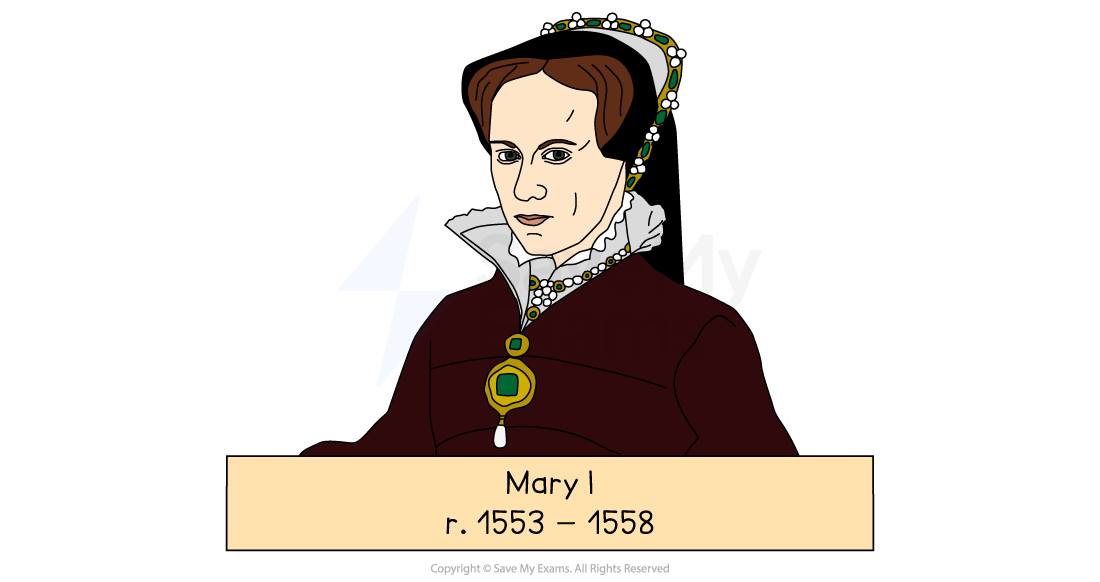
Mary I became queen in July 1553
She was England's first queen regnant (the first woman to rule in her own right, not as regent or consort)
Her claim to the throne
Mary was the daughter of Henry VIII and Catherine of Aragon
She was declared legitimate at birth and initially treated as heir to the throne
Henry's annulment of the marriage in 1533 made her illegitimate in English law
She was restored to the succession by the 1544 Succession Act, though never formally re-legitimised
Her claim was reinforced by Henry VIII's will, which placed her ahead of Elizabeth and Lady Jane Grey
When Northumberland's coup collapsed, widespread popular support carried her to the throne
Gentry and nobility rallied to her at Framlingham Castle in Suffolk, Catholic and Protestant alike
They backed her on grounds of legitimacy, not religion
Character
Deeply pious
Her Catholic faith was not a political position; it was the defining feature of her personality
She had been raised a Catholic by her mother, Catherine of Aragon
Henry VIII's treatment of her mother, her faith and her own legitimacy had left her resilient but inflexible
Brave and decisive
She acted with courage in the succession crisis and in the face of Wyatt's Rebellion
Politically inexperienced
During her younger years, she had been in enforced isolation
She had never held office, nor even been trained to govern
Impatient
She interpreted popular support at her accession as enthusiasm for Catholicism
She moved too quickly to reaffirm Catholicism
Poor health
She was 37 at accession and suffered recurring illness
Time pressure, therefore, shaped many of her decisions
Aims
Mary's aims were clear and consistent from the start of her reign
Aim | What this meant in practice |
|---|---|
Restore Catholicism |
|
Secure the succession |
|
Assert royal authority |
|
Restore England's Habsburg alliance |
|
The challenge of being a female monarch
Mary was England's first queen regnant; no woman had ruled England in her own right before
Contemporary political thinking held that women were unsuitable rulers: too emotional and too easily manipulated
A queen was expected to need a husband, and the husband was expected to dominate proceedings
Mary knew her position, and the thinking around her; she worked hard to assert her authority and limit Philip's role
But the widespread assumption that Philip would take control undermined her authority in public perception
When Philip left England for extended periods, her government was visibly weakened
Examiner Tips and Tricks
The challenge of women's rule is often underestimated in answers about Mary. She faced structural problems that no male monarch would have faced. When assessing how effectively she established royal authority, make sure to account for these constraints alongside her personal failings.
Mary I & her Ministers: Gardiner, Paget & Pole
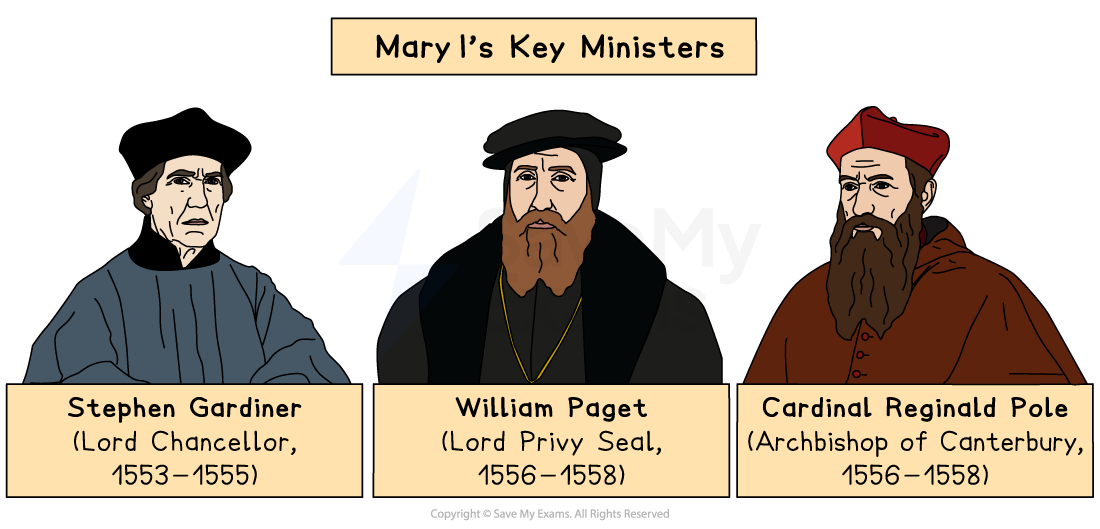
Mary selected a large Privy Council of around 40 members
It drew on Catholic conservatives from Henry VIII's reign and experienced officials from Edward VI's government
This gave her a breadth of experience but made the Council unwieldy and prone to faction
Her three most important ministers were the following:
Minister | Role and background | Significance |
|---|---|---|
Stephen Gardiner (Lord Chancellor, 1553–1555) |
|
|
William Paget (Lord Privy Seal, 1556–1558) |
|
|
Cardinal Reginald Pole (Archbishop of Canterbury, 1556–1558) |
|
|
Simon Renard: the Imperial Ambassador
Simon Renard was Charles V's ambassador in London
He was not a minister, but he was crucial to how Mary actually made decisions
He became Mary's most trusted confidant on the question of Spanish marriage
Mary consulted Renard before consulting her own Privy Council on the marriage plans
This was seen as a serious political error
It undermined Council trust
It gave the impression that English foreign policy was being made by Spain
The problem with Mary's Council
Gardiner and Paget both advised caution on the pace of religious restoration
Mary largely ignored them
The Council was too large to function efficiently
Committees were needed to manage specialised business
Factional rivalry between conservatives and pragmatists meant the Council rarely spoke with one voice
Mary's tendency to rely on personal confidants (Renard, later Pole) rather than the Council weakened collective government
Examiner Tips and Tricks
When answering questions about how effectively Mary governed, the ministers section rewards precise names and roles. Know what each minister argued for and how Mary responded. The pattern of her ignoring good advice is a theme that runs through the whole reign.
Royal Authority under Mary I: How Effectively Did She Govern?
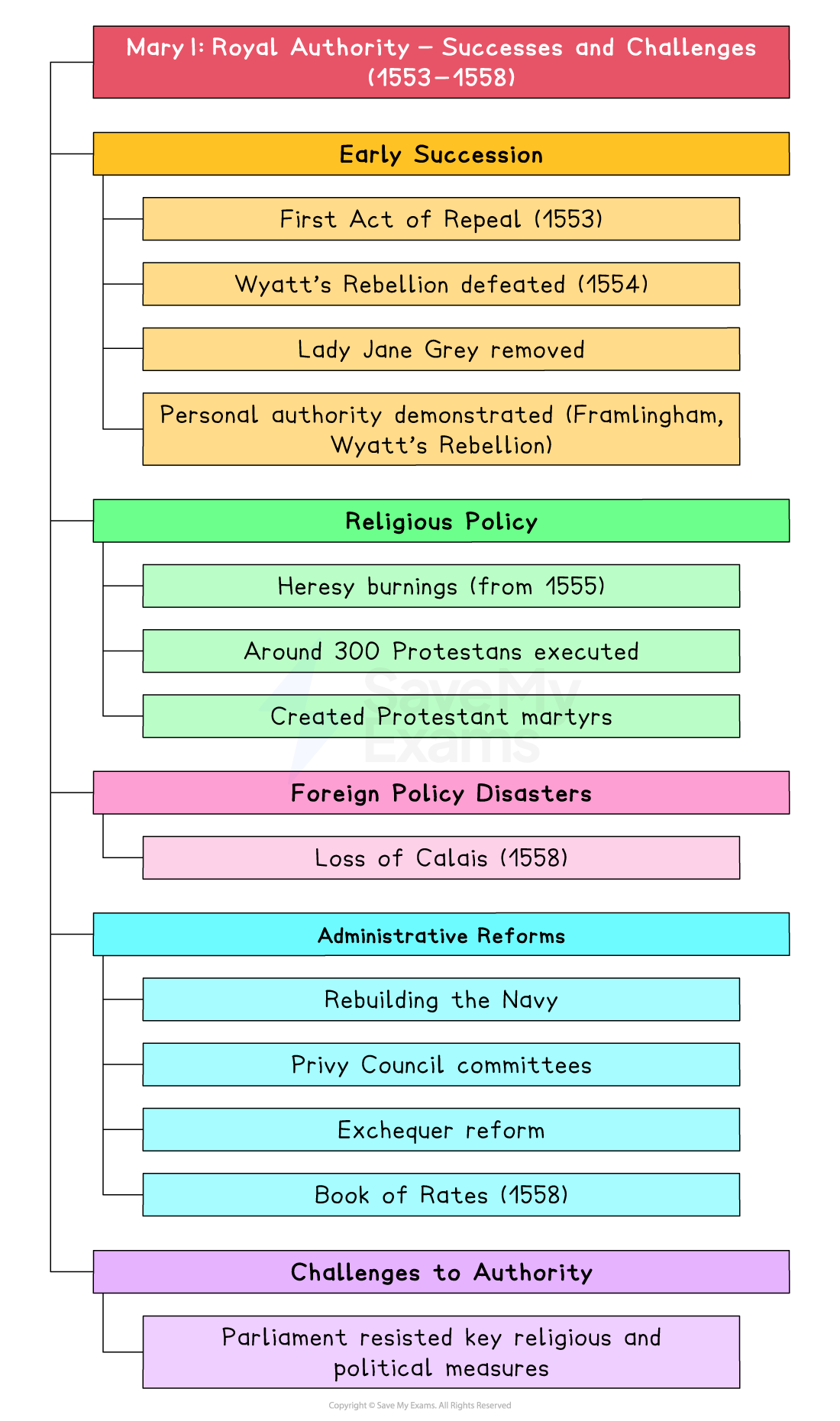
Mary came to the throne with genuine popular support
The key question is why this support eroded so quickly and whether her government was ever truly secure
Early strengths
The succession crisis
Mary acted decisively at Framlingham
She rallied support personally, refused to be intimidated and moved quickly
The only serious coup against the Tudors lasted just nine days
First Act of Repeal (October 1553)
This swept away all Edwardian religious legislation
It was passed by Parliament with little opposition
This suggests that Protestantism had not taken deep root among the political nation
Parliament had supported Edward’s reforms, but was equally willing to reverse them under Mary
The marriage treaty (January 1554)
This was carefully negotiated to limit Philip's power
Philip was to be styled King, but his powers were strictly limited by the marriage treaty
Foreigners were forbidden from holding English government offices
Philip had no claim to the throne if Mary died childless
Wyatt's Rebellion, February 1554
When plans for the Spanish marriage became public, Sir Thomas Wyatt, a Kentish gentleman, led a rebellion
Around 3,000 rebels marched on London
London Bridge was closed against them
Mary responded with personal courage
She stayed in London and addressed the city directly
The rebellion collapsed within a week
Wyatt was executed
Lady Jane Grey and her husband (Guildford Dudley) were also executed
Mary had been reluctant to act against Jane, but Wyatt's rebellion made keeping her alive too dangerous
Princess Elizabeth was arrested on suspicion of complicity
She was released when no evidence was found
Wyatt's Rebellion showed how quickly the Spanish marriage had converted popular support into suspicion
Administrative reforms
Mary's government carried out several genuine reforms that are often overlooked in accounts focused on persecution and religious failure
Reform | Detail and significance |
|---|---|
Privy Council reform |
|
Revenue reform |
|
Book of Rates (1558) |
|
Naval rebuilding |
|
Militia Act (1558) |
|
Where was royal authority challenged?
The Spanish marriage damaged Mary's standing far more than any rebellion
It made her look like a tool of Habsburg interests
Parliament resisted some of her proposals
A 1555 bill to include Philip in proposed treason legislation was rejected
A bill to confiscate the property of Protestant exiles was also blocked
The heresy burnings (from February 1555) undermined her authority in public perception over time
Around 300 Protestants were burned in total
In London, this created Protestant martyrs rather than eliminating dissent
Philip's absences left Mary visibly weakened
He visited England briefly, but spent most of his time in Spain and the Netherlands
The loss of Calais (January 1558) was a catastrophic blow to royal prestige
England's last territory in France was lost after war was declared to support Philip's campaign against France
Mary died in November 1558, leaving the throne to Protestant Elizabeth
The opposite of everything Mary had worked for
Examiner Tips and Tricks
The debate question asks how effectively Mary established royal authority. This is not the same thing as asking whether her reign was a success. Royal authority is about control of government, Parliament and the political nation. She had real successes here: she defeated rebellion, passed legislation and reformed administration, although some measures and legislative proposals were resisted in Parliament. The failures (marriage, burnings and Calais) are a separate question.
How Effectively Did Mary I Establish Royal Authority?
Use the evidence below to build your own argument
The question asks specifically about royal authority, not about whether her reign was a good or a bad one overall
Evidence that Mary established royal authority
She overcame the succession crisis through decisive personal action
The coup in favour of Lady Jane Grey lasted only nine days
She defeated Wyatt's Rebellion without leaving London
Her personal courage held the city
Parliament cooperated in repealing Edwardian legislation
The First Act of Repeal passed with little opposition
The marriage treaty protected English sovereignty
Philip's powers were carefully limited by negotiation
Administrative reforms strengthened the machinery of government:
Privy Council committees
Exchequer reform
The Book of Rates
The navy was rebuilt
Mary gave Elizabeth the naval foundation for her foreign policy
The Militia Act (1558) modernised England's military structure
Evidence that Mary failed to establish royal authority
The Spanish marriage converted popular support into suspicion within months
It made her look dependent on Habsburg interests
Parliament resisted key proposals
Including legislation on Protestant exiles
The heresy burnings created Protestant martyrs rather than eliminating dissent
They raised questions about what was worth dying for
She failed to produce an heir
The fundamental purpose of the marriage was not achieved
Philip's absences left the government visibly weakened in public perception
The loss of Calais was a humiliation that damaged royal prestige beyond repair
Mary died leaving Protestant Elizabeth as heir
The religious restoration she had worked for was undone within a year of her death
Key historian
G.R. Elton, Reform and Reformation, England 1509 to 1558 (1977) |
|
|---|
Examiner Tips and Tricks
Elton's view is strong, but traditionally one-sided. The best answers use it as the starting point for a counterargument: yes, she lacked political flexibility, but the structural problems she faced (being a female monarch in a culture that did not accept female rule, and inheriting a country that had changed religiously for a generation) would have tested any ruler. Use Elton, then challenge him.

Unlock more, it's free!
Join the 100,000+ Students that ❤️ Save My Exams
the (exam) results speak for themselves:

Was this revision note helpful?
