Henry VIII: Foreign Policy After the Break with Rome, 1529-1547 (AQA A Level History: Component 1: Breadth study): Revision Note
Exam code: 7042

Summary
Henry VIII's foreign policy after the Break with Rome was transformed by diplomatic isolation following the excommunication of 1538
England became diplomatically isolated from Catholic Europe and faced the genuine threat of invasion
Cromwell's response was to seek Protestant allies in Europe through the Schmalkaldic League
Henry's rejection of Anne of Cleves destroyed this strategy and contributed to Cromwell's fall
Relations with France and the Habsburgs after 1534 were defined by constant repositioning as Henry tried to prevent the two powers from uniting against him
Henry's six wives and the three Acts of Succession were not just personal matters:
Some had significant diplomatic dimensions that shaped England's international position
Henry's last major military venture, the capture of Boulogne (1544), ended with Boulogne being promised back to France under the Treaty of Ardres (1546): a costly and ultimately fruitless campaign
Historians offer contrasting views:
Ives sees Henry as embodying regal magnificence and military success
Elton argues the later reign wasted resources and left England’s survival to chance rather than sound judgement
The Diplomatic Consequences of the Break with Rome
England's new diplomatic position
Before 1534, England had been a respected player in European diplomacy
After the Act of Supremacy and excommunication, it became a schismatic outcast in Catholic Europe
Pope Paul III excommunicated Henry in 1538
This released Henry’s subjects from their oaths of loyalty in theory
It also sanctioned rebellion and legitimised invasion by Catholic powers
Both Charles V and Francis I were orthodox Catholic rulers and could not publicly ally with a heretical king
Charles V was also Catherine of Aragon's nephew, giving him a personal grievance against Henry
The invasion threat, 1538–1539
In June 1538, Charles V and Francis I signed the Truce of Nice, temporarily ending their long conflict
For the first time, England faced the prospect of a united Catholic Europe directed against it
Henry responded with a major programme of coastal fortification
The Device Forts were built along the south coast, including Deal, Walmer and Camber Castles
They represented a genuine and lasting defensive achievement
Henry also struck at potential figureheads for a Catholic invasion at home
The Exeter Conspiracy (1538) led to the execution of Henry Courtenay, Marquess of Exeter, and Henry Pole, Lord Montague
Both had Plantagenet blood and could have been used as rival claimants by a Catholic invasion force
The threat receded by 1540 when France and Charles V’s Habsburg Empire returned to war with each other
But it had demonstrated how vulnerable England's diplomatic isolation had made it
Cromwell's Protestant alliance strategy
Cromwell's answer to isolation was to seek allies among the Protestant princes of Germany
The Schmalkaldic League was the alliance of German Protestant rulers who had broken with Rome
A marriage alliance with a Protestant German state would give England a powerful continental partner
This strategy led directly to the Anne of Cleves marriage (1540)
Anne was the sister of the Duke of Cleves, a significant Protestant ruler in north-west Germany
Henry found her physically repulsive (calling her a "great Flemish mare") and had the marriage annulled after six months
The collapse of the Anne of Cleves marriage destroyed Cromwell's broader diplomatic strategy
It also gave his enemies at court the ammunition they needed to bring him down
With Cromwell's fall, the Protestant alliance strategy was abandoned
Examiner Tips and Tricks
The invasion threat of 1538 to 1539 is underused by most students. It shows that the diplomatic consequences of the Break with Rome were genuinely dangerous, not just inconvenient. The Device Forts are physical evidence of how seriously Henry took the threat.
Cromwell's Protestant alliance strategy directly links foreign policy to the Fall of Cromwell revision note. If you are asked about either topic, this connection between the Anne of Cleves disaster and Cromwell's execution is essential analytical material.
Relations with France, Spain & the HRE after 1534
After 1534, Henry's foreign policy became increasingly reactive and expensive
He constantly sought to prevent France and the Habsburgs from uniting against him
The pattern was familiar from Wolsey's era: shifting alliances, diplomatic spectacle and limited lasting results
1534–1538 |
|
|---|---|
1538–1539 |
|
1540 |
|
1543 |
|
1544 |
|
1546 |
|
The broader verdict on relations with France and Spain
Henry never achieved a stable alliance with either France or the Habsburgs after 1534
Both powers used England when it suited them and abandoned it when it did not
Charles V allied with Henry in 1543 only to make a separate peace a year later
The wars of the 1540s were ruinously expensive
Henry spent the wealth accumulated from the dissolution on campaigns in France and Scotland
More than half of all monastic lands were sold off between 1543 and 1547 to fund the wars
England's actual strategic position in 1547 was little improved from 1534
No new territory had been permanently gained
The dynasty was secure, but largely thanks to the birth of Edward in 1537 rather than foreign policy success
Examiner Tips and Tricks
The capture of Boulogne in 1544 is often cited as evidence of foreign policy success. Push back on this: Charles V abandoned Henry almost immediately after the capture. The net result was financial ruin for a temporary trophy.
Don't confuse the Treaty of Utrecht (1543) with the Treaty of Ardres (1546). The first brought England into the war; the second ended it in embarrassing circumstances. Knowing both treaties shows command of the chronology.
Securing the Succession: Henry's Six Wives & the Acts of Succession
Henry's marriages were never purely personal:
Some had clear diplomatic purposes, while others had indirect consequences for England's international position
A disputed succession invited foreign intervention:
Both France and the Habsburgs had potential claimants they could have backed
The six wives and their diplomatic significance
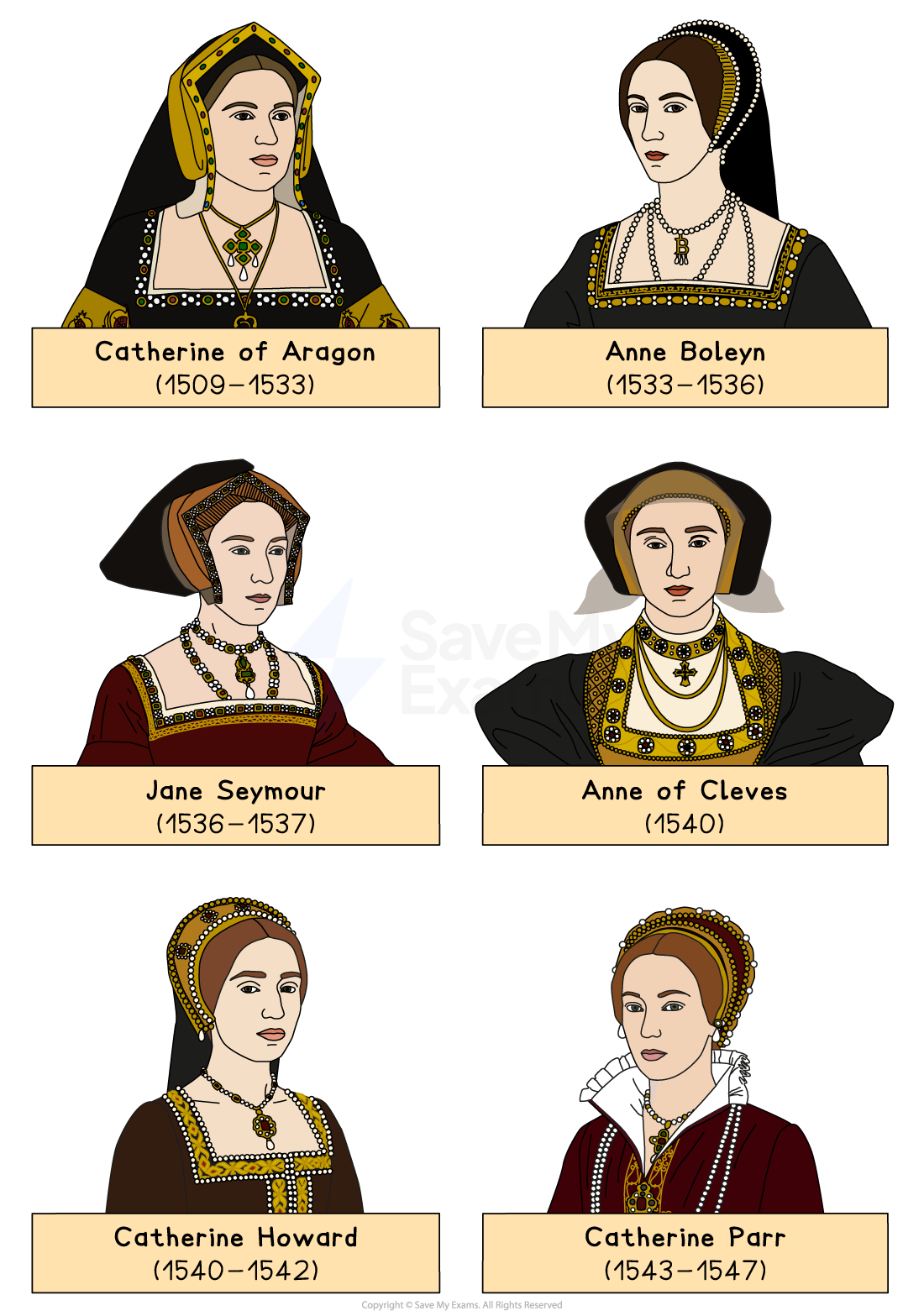
Catherine of Aragon (1509–1533) |
|
|---|---|
Anne Boleyn (1533–1536) |
|
Jane Seymour (1536–1537) |
|
Anne of Cleves (1540) |
|
Catherine Howard (1540–1542) |
|
Catherine Parr (1543–1547) |
|
The three Acts of Succession
First Act of Succession (1534): declared Mary illegitimate and made the children of Anne Boleyn heirs to the throne
It required all subjects to swear an oath accepting this
Refusal was treated as treason:
More and Fisher were executed partly for refusing
Second Act of Succession (1536): declared both Mary and Elizabeth illegitimate after Anne Boleyn's execution
It left the succession dangerously unclear if Jane Seymour failed to produce an heir
Third Act of Succession (1544): restored both Mary and Elizabeth to the succession in the order Edward, Mary, Elizabeth
This was the most significant settlement
It gave England a clear line of succession for the first time since 1509
It reduced the risk of foreign-backed rival claims and stabilised the dynastic position in the short term
But the religious differences between Edward, Mary and Elizabeth helped to create the instability of the mid-Tudor period
The order was confirmed in Henry's will and shaped the reigns of all three of his children
Examiner Tips and Tricks
The three Acts of Succession are frequently confused. The key one for exam purposes is the Third Act (1544), which restored Mary and Elizabeth and created the line of succession that actually played out after Henry's death. Make sure you know which Act did what.
The six wives question is not just about Henry's personal life. Each marriage tells you something about the diplomatic context and the factional struggle at court. Anne of Cleves is the most diplomatically significant wife of the post-1529 period and the one most likely to appear in foreign policy questions.
How Successful was Henry VIII's Foreign Policy?
This question covers the whole of Henry's reign, drawing on both foreign policy revision notes
Use the specific evidence below to build and support your own argument
Evidence that Henry VIII's foreign policy was successful
England's prestige was significantly raised in the early reign
The campaigns of 1513, the Treaty of London (1518) and the Field of the Cloth of Gold positioned England at the heart of European diplomacy
Flodden (1513) neutralised Scotland as a military threat for a generation
It was a more decisive strategic victory than anything achieved in France
England survived the potentially catastrophic threat of a united Catholic Europe in 1538/1539
The Device Forts provided a lasting coastal defence
The Exeter Conspiracy executions removed potential figureheads for invasion
Boulogne was captured in 1544
Henry became the first English king to take French territory in over a century
Whatever its later fate, the capture was a genuine military achievement
The Third Act of Succession (1544) gave England the clearest dynastic settlement since 1509
This reduced the risk of foreign intervention over a disputed succession
Henry died with his throne intact and the Tudor dynasty secure
Key historian
Eric W. Ives, Oxford Dictionary of National Biography (2004) |
|
|---|
Evidence that Henry VIII's foreign policy failed to achieve its objectives
The Break with Rome created a diplomatic isolation that was never fully resolved in Henry's lifetime
England was excommunicated, cut off from Catholic Europe and threatened with invasion
No stable continental alliance was ever established after 1534
The wars of the 1540s were enormously expensive and produced no lasting gains
Boulogne was captured in 1544 and agreed to be returned to France under the Treaty of Ardres (1546), though it was not actually handed back until 1550
Charles V abandoned Henry almost immediately after Crépy to make a separate peace
Henry squandered the wealth of the dissolution on futile campaigns
More than half of all monastic lands were sold off between 1543 and 1547 to fund wars
The Crown lost the long-term income these lands would have generated
The Rough Wooing of Scotland (1543–1550) backfired
Henry's brutal military campaigns in Scotland pushed it closer to France rather than delivering union
The Treaty of Greenwich collapsed and the French alliance with Scotland strengthened
Henry left a 9-year-old son as his heir with no secure continental ally
England's diplomatic vulnerability in 1547 was arguably worse than in 1509
Key historian
G. R. Elton, Reform and Reformation: England, 1509–1558 (1977) |
|
|---|
Examiner Tips and Tricks
The overarching judgement question rewards a clear line of argument, not a list of facts on both sides. A strong approach is to argue that Henry succeeded by contemporary standards (magnificence, military glory, dynastic security) but failed by modern strategic ones (no lasting territorial gains, financial strain, diplomatic isolation). Use Ives for the first and Elton for the second.

Unlock more, it's free!
Join the 100,000+ Students that ❤️ Save My Exams
the (exam) results speak for themselves:

Was this revision note helpful?
