Mary I: Foreign Policy, Marriage & the Succession (AQA A Level History: Component 1: Breadth study): Revision Note
Exam code: 7042

Summary
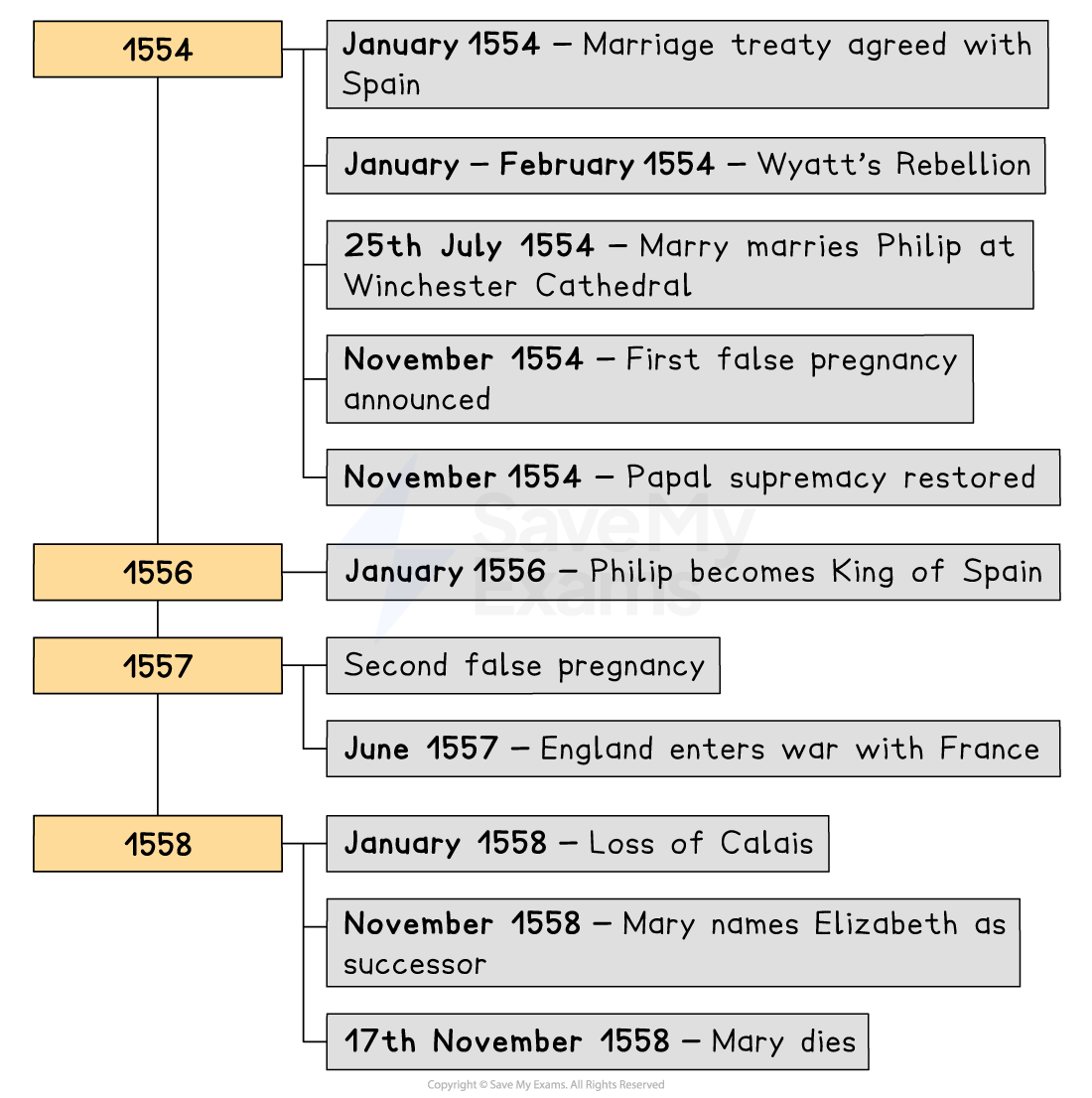
Mary married Philip of Spain in July 1554
The marriage was designed to secure a Catholic succession by producing a Catholic heir
Philip was given the title of King but his powers were strictly limited by the marriage treaty
The Wyatt Rebellion (February 1554) was triggered primarily by opposition to the Spanish marriage
It was the most serious domestic rebellion of the reign
Mary's personal courage was central to its defeat
Mary declared war on France in June 1557 to support Philip's campaign against the French
England lost Calais in January 1558, its last territory in France, held for over 200 years
Mary's two false pregnancies (1554 and 1557) meant no Catholic heir was produced
Mary accepted Elizabeth as her successor shortly before her death
Much of what she had worked for was undone within a year
Mary's Marriage to Philip II of Spain: Causes & Consequences
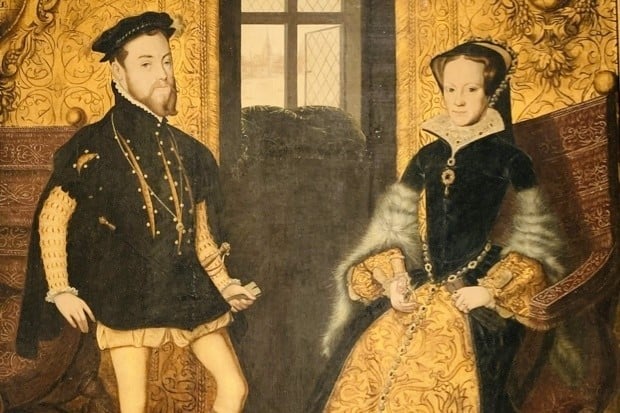
The Spanish marriage was the central political decision of Mary’s reign
Many of the major events of the reign (the rebellion, the war with France, the loss of Calais) stemmed from it
Why did Mary want to marry Philip?
The succession problem:
Mary was 37 at her accession
Without a Catholic heir, Protestant Elizabeth would succeed
The Habsburg connection:
Mary's mother was Catherine of Aragon
Mary was close to the Spanish royal family and had been considered a potential wife for Charles V himself
Personal feeling:
Mary appears to have developed genuine affection for Philip; he did not reciprocate
Religious logic:
A Spanish alliance would strengthen the Catholic cause in England and across Europe
Opposition to marriage
Domestic opposition in England
Opposition came from across the political spectrum, not just from Protestants
These concerns translated into widespread unease and unpopularity at home, particularly among the political nation
Philip was a staunch Catholic
Protestants feared he would strengthen Mary's religious policy
Philip was heir to Spain and its vast empire
Many feared England would become a tool of Spanish ambitions
Xenophobic concerns
There was growing fear that Spanish advisers would dominate government and that England would be drawn into Habsburg wars
Parliament sent a delegation to dissuade Mary from the match
She ignored it
Gardiner proposed Edward Courtenay, Earl of Devon, as an English alternative
Which would have avoided foreign influence and reassured the political nation
Mary refused, as the match offered no strong international alliance and was politically less advantageous
International reaction
France was alarmed that England and Spain might encircle them
This increased the likelihood of England being drawn into European conflict
The marriage treaty, January 1554
The treaty was carefully negotiated to limit Philip's power and protect English interests
Term of the treaty | What it meant |
|---|---|
Philip received the title of King but had no executive power |
|
Foreigners were forbidden from holding English government offices |
|
Philip had no claim to the English throne if Mary died childless |
|
England would not be obliged to fight in Philip's wars |
|
The marriage in practice
The marriage took place at Winchester Cathedral in July 1554
Philip was received coldly by the English public
He found England politically and socially unwelcoming and spent as little time there as possible
In 1554, Parliament rejected a bill that would have extended treason laws to include Philip, which would have made opposition to him equivalent to treason against the Crown
In 1555, Parliament prevented Philip's coronation as King of England
Philip became King of Spain in January 1556
From that point, England became more closely aligned with Spanish interests
Mary had two apparently false pregnancies, in 1554 and 1557
Both were deeply damaging to her credibility and authority, raising expectations that were then disappointed and weakening confidence in the regime
Examiner Tips and Tricks
Questions about the Spanish marriage reward precise knowledge of the treaty terms. The key analytical point is the gap between the treaty (which was carefully designed to protect England) and the reality (which was that Philip used England as a tool against France). Show that gap to build a strong argument.
The Wyatt Rebellion, 1554: Causes, Events & Significance
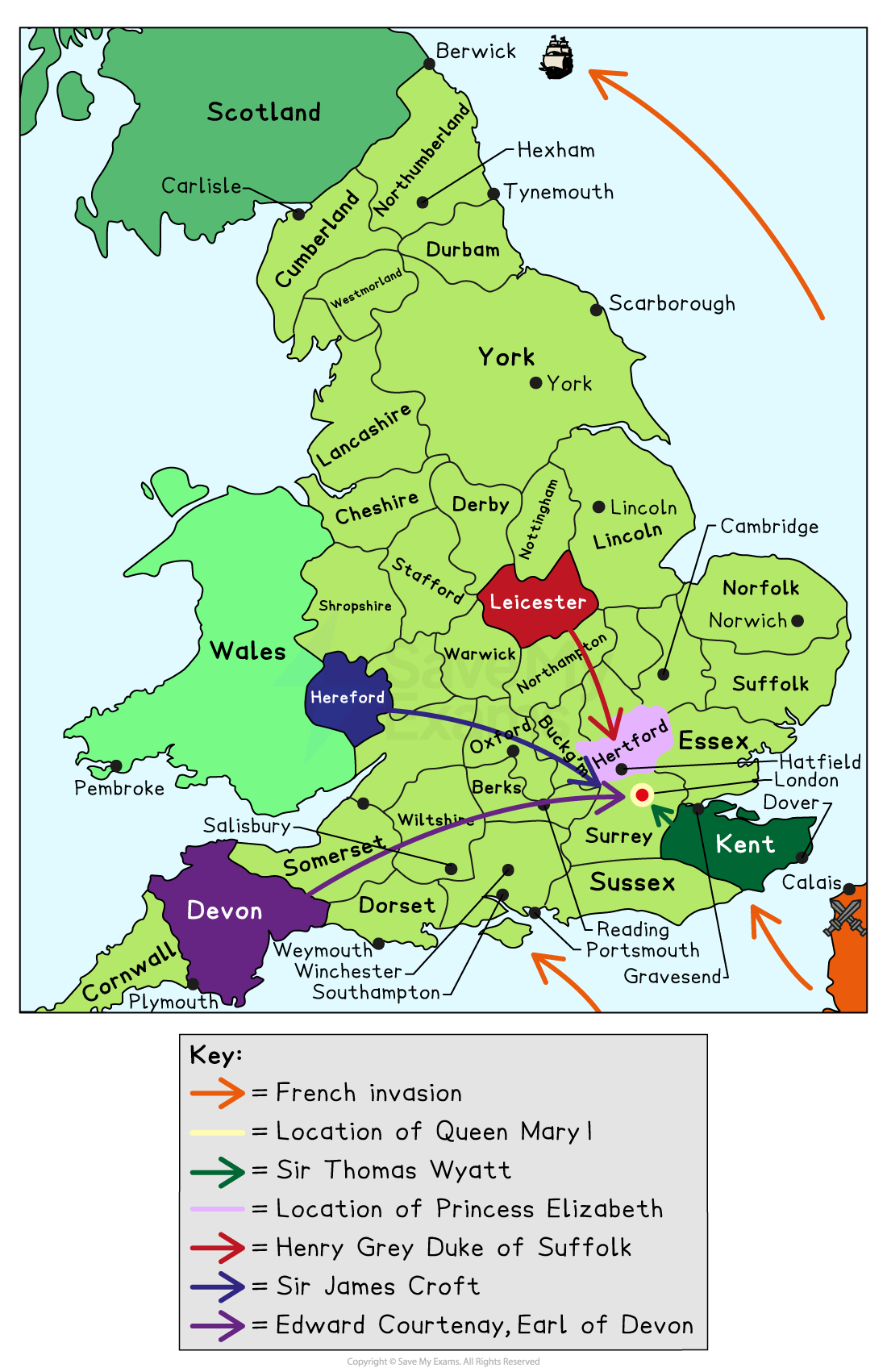
Wyatt's rebellion was the most serious domestic challenge of Mary's reign
It came within weeks of the announcement of the Spanish marriage
Causes |
|
|---|---|
Events |
|
Significance |
|
Examiner Tips and Tricks
Questions about Wyatt's Rebellion ask students to assess causes. The key debate is whether this was primarily an anti-Spanish rebellion or a Protestant one. The government's own propaganda said it was religious, but the government had a strong reason to frame it that way. The primary cause was the Spanish marriage. Be specific about the evidence for each cause.
Relations with Spain & France: The Loss of Calais, 1558
England's entry into the Habsburg-Valois War was the direct consequence of the Spanish marriage
It ended in the worst foreign policy disaster of the Tudor period
The Habsburg-Valois conflict
The dominant European conflict of the mid-16th century was between Habsburg Spain and Valois France
Henry VIII had been drawn into this conflict repeatedly at great expense
Northumberland had made peace with France in 1550 (Treaty of Boulogne), ending English involvement
Mary's marriage to Philip immediately re-entangled England with the Habsburg side
The road to war
Philip made no secret of wanting English military and financial support against France
Mary's own Council was divided
Many pointed out that the marriage treaty specified England was not obliged to fight in Philip's wars
Philip visited England briefly in 1557 to persuade Mary to declare war
Mary declared war on France in June 1557, sending English troops across the channel
English and Spanish forces together won the Battle of Saint-Quentin in August 1557
But Spain was financially exhausted and could not follow up the victory
The loss of Calais, January 1558
Calais had been in English hands since 1347, over 200 years
It was England's last territory in France and held enormous symbolic importance
French forces under the Duke of Guise launched a surprise attack in January 1558
The English garrison was outnumbered
Mary could not send adequate reinforcements in time
Calais fell within days
Why did the loss of Calais matter?
Symbolic significance
Calais was the last remnant of England's medieval empire in France
Strategic significance
It had served as a base for English military operations on the continent for generations
Political significance
It was a direct consequence of entering Philip's war
The English public drew this conclusion clearly
Personal significance
For Mary, it confirmed that the marriage had made England a tool of Spain, not a genuine partner
Examiner Tips and Tricks
The loss of Calais is often the endpoint of answers on Mary's foreign policy. Do not treat it as simply bad luck. It was a direct consequence of the Spanish marriage and the decision to join Philip's war against France. Showing that chain of causation is what makes an answer analytical rather than descriptive.
Problems of Succession under Mary I
The failure to produce a Catholic heir was the defining failure of Mary's reign
Everything she achieved was undone within a year of her death
Why was producing an heir so difficult?
Age:
Mary was 37 at accession
This was old by Tudor standards for beginning a reign and attempting pregnancy
Philip's absences:
He spent most of his time outside England, limiting any possibility of conception
Poor health:
Mary suffered recurring illness throughout her reign
Two false pregnancies:
In 1554 and 1557
Both were probably phantom pregnancies caused by serious illnesses (possibly uterine or ovarian cancer)
The 1554 pregnancy raised hopes across Catholic Europe
When it came to nothing, Mary's credibility was severely damaged
Elizabeth as successor
Under Henry VIII's will and the 1544 Succession Act, Elizabeth was next in line to the throne after Mary
To many contemporaries, Mary’s failure to produce an heir could also be interpreted as divine judgement on her policies, further weakening her religious authority
Mary deeply resented Elizabeth
She associated her with the breakdown of her parents' marriage (Elizabeth's mother was Anne Boleyn) and with Protestantism
Mary had Elizabeth imprisoned after Wyatt's Rebellion but could not prove her involvement
Pressure from Philip and from the Council forced Mary to accept that Elizabeth must succeed
Philip actively lobbied for Elizabeth's release from the Tower in 1554
His reasons were strategic
He needed England to remain within the Habsburg sphere of influence after Mary's death
Mary named Elizabeth as her successor six days before her death on 6 November 1558
Philip and the succession
Philip's attitude to the succession was calculating rather than hostile
He needed England to remain an ally after Mary's death
He feared that England might pass to the French-backed Mary Queen of Scots if Elizabeth was excluded
He later proposed marriage to Elizabeth himself after Mary's death
A sign of how strategically important England remained to Spain
Why did the failure of the succession matter?
Mary's entire religious and political project depended on a Catholic heir
Without one, Protestant Elizabeth would succeed and reverse everything
This is exactly what happened
Within a year of Mary's death, the Elizabethan Settlement had restored Protestant worship
The Spanish marriage, specifically designed to solve the succession problem, failed in its primary purpose
Examiner Tips and Tricks
The succession is sometimes treated as a separate topic from foreign policy. In this reign, they are inseparable. The marriage was about the succession, the war was about the marriage, the loss of Calais was about the war. Showing how these things are interconnected is what makes a strong argument.
How Successfully Did Mary I Handle Foreign Policy and the Succession?
Use the evidence below to build your own argument
Consider aims, outcomes and the constraints Mary faced
Evidence that Mary handled foreign policy and succession poorly
The Spanish marriage alienated popular opinion almost immediately
Wyatt's Rebellion followed within months
The marriage treaty was effectively overridden
England was drawn into Philip's war against France despite the treaty’s intention to protect England from being drawn into Habsburg wars
Calais was lost
England's last French territory, held for over 200 years (since 1347), was lost as a direct consequence of joining Philip's war
No heir was produced
The fundamental purpose of the marriage was not achieved
Elizabeth succeeded
Mary failed to secure a Catholic succession, and Protestant Elizabeth succeeded
Philip used England as a tool against France rather than as a genuine partner
The marriage served Spanish interests more than English ones
Evidence that Mary faced impossible constraints
Any Tudor monarch needed to marry and produce an heir
For Mary, the pressure was even greater: without an heir, Protestant Elizabeth would succeed
The marriage treaty was a genuine attempt to protect English sovereignty
Its failure reflects Philip's power, not Mary's lack of effort
Wyatt's Rebellion was defeated
Mary's personal courage at the Guildhall was decisive
The rebellion collapsed within a week
Calais was increasingly difficult and expensive to defend in the long term
The Elizabethan Settlement reversed Mary's work so quickly partly because Mary died young
Had she lived longer, the religious restoration may have taken deeper root
Mary faced a unique combination of challenges, including female rule, religious reversal and dependence on a foreign husband
Examiner Tips and Tricks
Questions on Mary's foreign policy often carry a judgemental framing. Be specific about which failures were the result of Mary's decisions and which were the result of constraints she could not control. The marriage was her choice, Philip's absences were not. The loss of Calais followed from entering a war she did not have to enter. These distinctions matter.

Unlock more, it's free!
Join the 100,000+ Students that ❤️ Save My Exams
the (exam) results speak for themselves:

Was this revision note helpful?
