Elizabeth I: Early Economic, Social & Religious Developments (AQA A Level History: Component 1: Breadth study): Revision Note
Exam code: 7042

Summary
Elizabeth's government tackled the debasement problem directly, carrying out a full coinage revaluation between 1560 and 1561
The Statute of Artificers (1563) regulated wages, apprenticeships and labour movement through a national framework
The Poor Law (1563) strengthened parish poor relief by allowing compulsory contributions from those who refused to give voluntarily
This was a significant step towards a national welfare system
Catholic practice persisted in many parishes despite the settlement
Only around half of Justices of the Peace (JPs) in 1564 could be actively relied upon to support it
The Council of Trent (1563) hardened Catholic Europe's position and made compromise with Rome increasingly unlikely
By 1563, England was more stable than in 1558
But the "mid-Tudor crisis debate" shows there is genuine disagreement about whether the period 1547 to 1563 should be called a crisis at all
Economic Conditions in England, 1558–1563
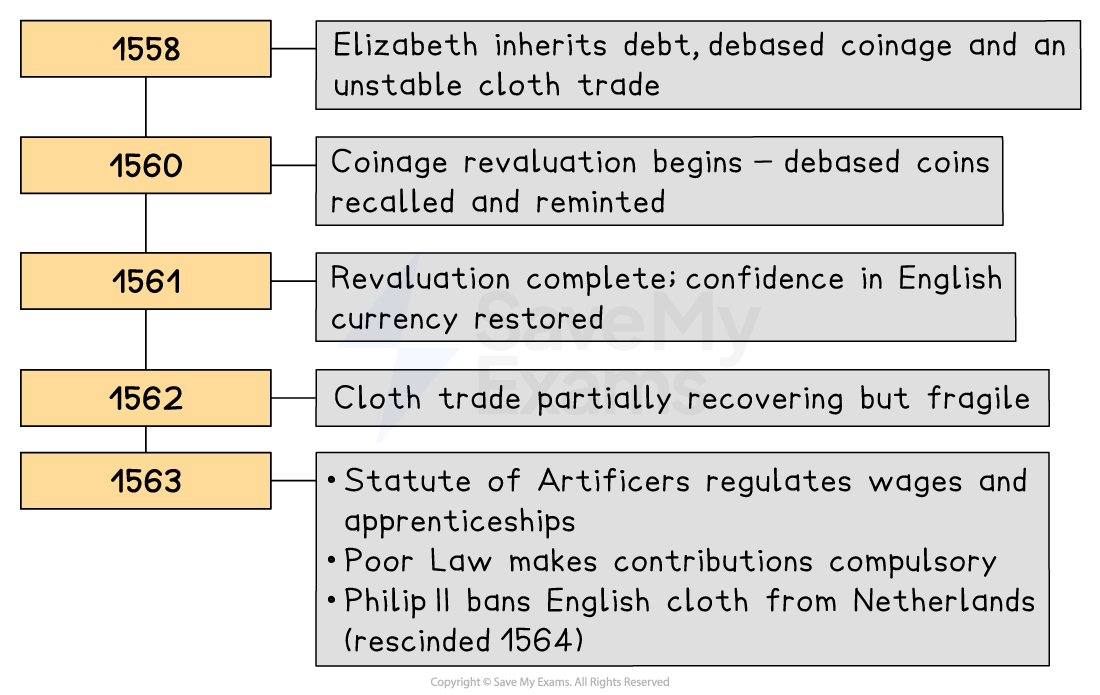
The economic problems Elizabeth inherited were structural and long-term
They were not caused by Mary I's government alone
Population growth, inflation and the legacy of debasement had shaped the economy across the Tudor period
The coinage revaluation, 1560–1561
The most important economic action of Elizabeth's early reign was the coinage revaluation
Debased coins had driven inflation and undermined confidence in English currency since the 1540s
Mary's government had planned a revaluation but did not carry it out
Thomas Gresham, the Crown's financial agent in Antwerp, led the revaluation
Debased coins were recalled, melted down and reminted with proper silver content
This reflected what later became known as Gresham’s Law: bad money drives out good
The process was largely complete by 1561
It did not solve inflation, which had deeper structural causes, but it restored confidence in English currency and removed one source of instability
The cloth trade
The cloth trade had crashed in 1551 and remained unstable under Mary
Under Elizabeth, it began a partial recovery
Philip II of Spain temporarily banned English cloth imports to the Netherlands in 1563
Officially it was to prevent plague spreading; in reality, it reflected trade tensions
Both sides backed down and trade carried on as normal in 1564
This episode showed how vulnerable English exports remained to political decisions made in Madrid and Brussels
The Statute of Artificers, 1563
The Statute of Artificers was a major piece of economic legislation passed in Parliament in 1563
What it did | Why it mattered |
|---|---|
Wages to be assessed annually by Justices of the Peace based on local conditions |
|
Apprenticeships set at a minimum of seven years in most trades |
|
Workers could not leave their employer without a written certificate |
|
The Statute was a sign of active economic management
The government was responding to disruption caused by debasement, population growth and enclosure, not simply reacting to events
The Poor Law, 1563
The Poor Law of 1563 built on earlier legislation (1552) to strengthen poor relief
For the first time, contributions to poor relief became compulsory
Those who refused to contribute could be taken to court and imprisoned
This legislation was a significant step
For the first time, the state compelled citizens to fund welfare
The later Poor Laws of 1597 and 1601 developed this further
Examiner Tips and Tricks
When answering questions about the economy, students often focus on problems without acknowledging what the government actually did to solve them. The coinage revaluation, the Statute of Artificers and the Poor Law of 1563 were all genuine achievements. The economy was not solved, but it was being actively managed. Make sure you show that distinction.
Social Change & Regional Issues in Elizabeth’s Early Reign
The basic social structure of Tudor England was unchanged by the upheavals of 1547 to 1563
The Crown, Church, nobility, gentry, yeomanry and poor occupied the same positions as before
The gentry consolidated their position
One significant social development across the mid-Tudor period was the growing strength of the gentry
The dissolution of the monasteries had put large quantities of former Church land onto the market
The gentry benefitted the most, buying or leasing former monastic estates
The number and influence of gentry families increased significantly across the Tudor period
The rising gentry was not a destabilising force
They had a strong interest in social order and stable government
Population pressure and poverty
Population growth was the underlying driver of social stress across the whole Tudor period
The population had risen from around 1.5 million in 1470 to around 3 million by the 1550s
A surplus of labour meant wages could not keep pace with prices
Around 50% of the rural and urban poor lived at or below subsistence level
When harvests failed, suffering was acute
Vagrancy was a persistent concern, addressed by successive Poor Law legislation
Some historians argue the effects of enclosure have been exaggerated
Research suggests that, in good weather, there was sufficient farmland to support the population
Regional variation
England in the early 1560s was not economically or socially uniform; regional differences mattered
Region | Social and economic character |
|---|---|
London and the south-east |
|
North (Lancashire, Yorkshire, Durham) |
|
East Anglia |
|
South-west (Devon and Cornwall) |
|
Examiner Tips and Tricks
Regional variation is one of the most effective analytical tools for questions on social stability. Rather than making a sweeping claim that England was stable or unstable, show that different regions had different experiences. The north was broadly stable and Catholic; London was more volatile and more Protestant. Both these things were true at once.
Religious Tensions & Developments in Elizabeth’s Early Reign
The gap between legislation and reality
The Acts of Supremacy and Uniformity outlined what the Church of England was supposed to be
In many parishes, priests simply continued Catholic practice and ignored the new Prayer Book
A survey of Justices of the Peace in 1564 found that only around half could be actively relied upon to enforce the settlement
Fines for non-attendance at church (recusancy) were small and rarely enforced in the early years
The government deliberately allowed time for change rather than forcing immediate compliance
Why the settlement was accepted in most parishes
Most ordinary people were neither strongly Catholic nor strongly Protestant
They wanted familiar religious practice, not theological argument
The conservative visual appearance of the settlement helped: vestments, crosses and a familiar Prayer Book gave continuity
Catholic recusancy in practice
Around 400 clergy refused the settlement and lost their livings
Almost all Marian bishops were dismissed
This gave Elizabeth the opportunity to appoint an enthusiastic Protestant episcopal leadership
Catholic practice persisted longest in Lancashire, Yorkshire and Durham
This is where traditional Catholic loyalties were strongest and Protestant reform had made the least impact
For most recusants in this period, it was a quiet non-compliance rather than active resistance
The deeper Catholic challenge (seminary priests, Jesuit missions and Papal excommunication) came after 1563
Early Puritan pressures
Puritan dissatisfaction was present from the start but manageable in the early years
The 39 Articles (1563) nearly fell to Puritan pressure, but passed very narrowly in Convocation
Puritan pressures become much deeper in 1566 with the Vestiarian Controversy and parliamentary clashes
The Council of Trent, 1563
The Council of Trent had been meeting since 1545; it concluded in 1563
It produced hardline decrees that ended any possibility of compromise between Catholicism and Protestantism
It reflected a broader reinvigoration of Catholicism across Europe against both Protestants and the Ottoman Turks
Some Catholics wanted Elizabeth excommunicated immediately after the Council of Trent, but Philip II resisted, hoping she might still be brought back into the Catholic fold for political reasons
The Council of Trent's conclusions had long-term significance
England was now definitively Protestant, and the gap with Catholic Europe was hardening
The papal excommunication of Elizabeth eventually came in 1570
Examiner Tips and Tricks
The key distinction in this section is between the legislative settlement and what actually happened in parishes. Questions on religious stability in the early reign need you to show both: the settlement was in place, but enforcement was patchy and compliance was uneven. This was not the same as failure; gradual and uneven enforcement helped avoid provoking widespread resistance.
How Stable Was England by 1563?
This is a synoptic question spanning government, economy, society, religion and foreign policy across the whole period 1558 to 1563
Evidence of stability by 1563 |
|
|---|---|
Evidence of continuing instability |
|
Examiner Tips and Tricks
The stability question rewards a structured approach. Just like in the table above, group your evidence into factors, e.g. government, economy, foreign policy. This allows you to directly compare and evaluate. Remember that England in 1563 was more stable than in 1558 in most areas, but several underlying problems remained unresolved. Show both sides of that.
To What Extent was there a Mid-Tudor Crisis?
This is the major synoptic debate question for this section of the course
It spans the period from Henry VIII's last years (approximately 1540) through to 1563
Make sure you are drawing upon evidence from the reigns of Edward VI, Mary I and early Elizabeth simultaneously
What does "crisis" mean?
The word crisis is key in this question, you need to have a clear meaning to approach it properly
A simple definition is "a time of intense danger or difficulty"
Below is how it may be approached with regards to the factors we have explored
Factor | Was there a crisis? |
|---|---|
Government |
|
Religion |
|
Society |
|
Economy |
|
Foreign policy |
|
The strongest answers show that evidence is different for each dimension
What looks like a crisis in one area may look like manageable difficulty in another
Below is some evidence for each side, the list is not exhaustive
Make sure you use evidence from the whole ''Instability and Consolidation: 'The Mid-Tudor Crisis', 1547–1563" section
Evidence that supports the "crisis" view
Government weakness
Somerset and Northumberland both fell from power violently
The Lady Jane Grey episode showed how close to breakdown the succession could come
The existence of Mary, Queen of Scots as a rival claimant created ongoing dynastic uncertainty
Religious upheaval
England experienced four religious changes in 11 years
Parishes were pulled in different directions repeatedly
Rebellions
The Western Rising and Kett's Rebellion (1549) showed how close to the edge the government came
Economy
Debasement, successive harvest failures, the cloth trade crash and plague created genuine misery for the poor
Especially in 1549 and 1556–1558
Foreign policy
Loss of Calais, French power in Scotland, dependency on Spain and the humiliation at Le Havre all pointed to England's weaknesses
Mary's reign specifically
The marriage to Philip II, the loss of Calais, the Marian persecutions and the harvest failures of 1555–1556 are all evidence that can be used here
Key historian
J. Warren, Elizabeth I: Meeting the Challenge, England 1541–1603 (2008) |
|
|---|
Evidence that challenges the "crisis" view
Government never actually collapsed
Northumberland stabilised government after 1549
Mary suppressed Wyatt's rebellion
Elizabeth inherited working institutions
No rebellion succeeded
The Western Rising and Kett's Rebellion were serious, but were suppressed
No challenger came close to toppling the Crown
The social hierarchy was never genuinely threatened
The gentry emerged from the period stronger, not weaker
Economic problems were structural and long-term
Population growth and inflation predated the "mid-Tudor crisis" and continued after it
Blaming specific governments is misleading
England avoided civil war
France and Germany descended into devastating religious conflict, England did not
Many reforms credited to Elizabeth were begun earlier
The coinage revaluation was planned under Mary
The Book of Rates, Exchequer reform and Privy Council professionalisation were all mid-Tudor achievements
Key historian
N. Heard, Edward VI and Mary: A Mid-Tudor Crisis? (2000) |
|
|---|
There are different ways to approach the question:
Different historians focus on different aspects
A historian studying government competence may reach a different verdict from one studying the experience of the poor
Perspective matters
Looking backward from Elizabeth's achievements makes the mid-Tudor period look weak. Looking forward from Henry VIII's reign makes it look more continuous
Personal viewpoints affect judgements
Historians sympathetic to Protestant martyrs under Mary may be more inclined to call the period a crisis than those focused on administrative history
Examiner Tips and Tricks
The mid-Tudor crisis question rewards a precise definition of 'crisis' at the start. A crisis of government is different from a crisis of society, which is different from a crisis of religion. Once you have defined what you mean, you can show that the evidence is mixed: there was genuine instability in some areas (religion, foreign policy, the economy for the poor) but not in others (the social hierarchy, the fundamental structures of government). That is a much stronger argument than a simple yes or no.

Unlock more, it's free!
Join the 100,000+ Students that ❤️ Save My Exams
the (exam) results speak for themselves:

Was this revision note helpful?
