Elizabeth I: The Elizabethan Religious Settlement, 1559 (AQA A Level History: Component 1: Breadth study): Revision Note
Exam code: 7042

Summary
The Act of Supremacy (May 1559) re-established royal supremacy over the Church
Elizabeth took the title "Supreme Governor", not Supreme Head
The Act of Uniformity (May 1559) set rules for worship and introduced a new Prayer Book (a fusion of the 1549 and 1552 Edwardian books)
The Thirty-Nine Articles (1563) defined Anglican doctrine for the first time
It was reportedly passed by a very narrow margin in Convocation
Catholic reaction was broadly muted
Around 400 (out of roughly 8,000) clergy refused the settlement
Almost all Marian bishops were dismissed
Puritan dissatisfaction was immediate
The settlement was too Catholic for reformers
Vestments, bishops and ambiguous Eucharist wording all caused friction
The settlement was a political compromise, not a theological vision
It kept the peace in most parishes but satisfied nobody completely
The Act of Supremacy, 1559: Elizabeth as Supreme Governor
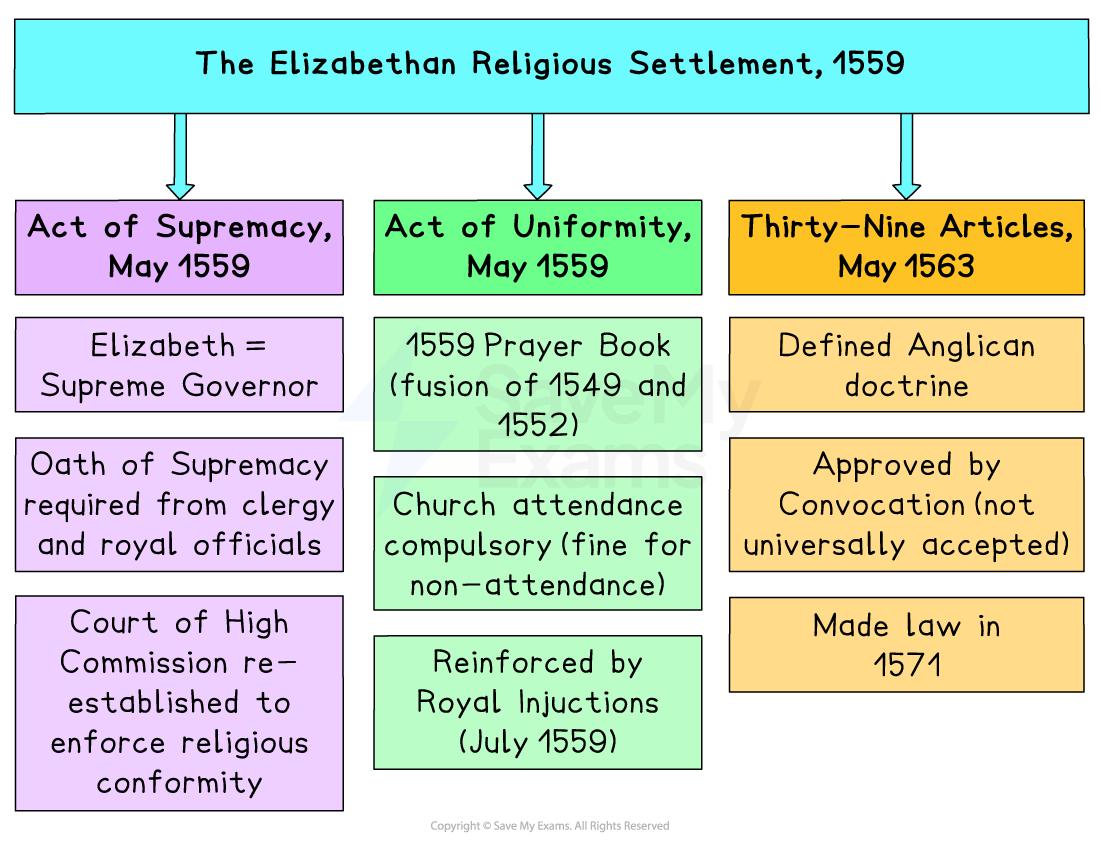
The Act of Supremacy was passed in May 1559, as part of Elizabeth's first Parliament
It re-established royal supremacy over the Church, reversing Mary I's restoration of papal authority
Supreme Governor
Elizabeth chose the title of "Supreme Governor" rather than "Supreme Head" (used by Henry VIII and Edward VI)
This was a deliberate and politically intelligent decision, made for three reasons:
The female monarchy problem
Some argued that a woman could not be the "head" of anything
"Governor" sidestepped the objection without reducing her practical authority
Catholic opinion
Those who still respected the Pope could accept a monarch who "governed" the Church's temporal affairs rather than claiming to be its spiritual head
Practical authority unchanged
In practice, her control over the Church remained extensive and largely unchanged from Henry VIII's and Edward VI's
The title change was cosmetic
Enforcement
All churchmen were required to swear an oath of loyalty to the Supreme Governor
Commissioners were sent to parishes to check compliance
The Court of High Commission was was established to enforce religious conformity
Church structure
The national organisation of the Church was largely unchanged
England kept its two archbishops (Canterbury and York) and its bishops
This was distinctly un-Protestant
Protestant churches in Europe had abolished bishops
Keeping bishops gave Elizabeth direct control over church appointments
It was a political decision as much as a religious one
Examiner Tips and Tricks
The choice of the title "Supreme Governor" is a key detail often used in higher-level answers. Strong responses explain why it was chosen: it avoided the issue of a female monarch as head of the Church, made the settlement more acceptable to moderate Catholics and did not reduce Elizabeth’s actual authority. This demonstrates an understanding of the settlement as a pragmatic political compromise, rather than a purely doctrinal decision.
The Act of Uniformity, 1559 & the New Prayer Book
The Act of Uniformity was passed in May 1559 alongside the Act of Supremacy
It set out rules for the appearance of churches and the conduct of worship
Key features of the Act
Practices that had existed in 1549 (the first Edwardian Prayer Book) could still be followed
This set a conservative baseline
Altars were replaced by communion tables
Protestant in principle
Catholic artefacts such as crosses and candles could remain on communion tables
Catholic in appearance
Vestments (priestly clothing) were retained
Protestants objected to this strongly, as it felt Catholic
Church attendance was compulsory
Fines for non-attendance were small and rarely enforced
Attendance at Catholic Mass was a serious offence with a heavy fine
Saying Mass was illegal and punishable by fines or imprisonment (with harsher penalties introduced later in the reign)
The 1559 Prayer Book
The new Prayer Book was a fusion of the two Edwardian Prayer Books
It combined the moderate language of the 1549 book with the more openly Protestant wording of the 1552 book
The key compromise was on the Eucharist (the central theological dispute between Catholics and Protestants)
The differences between the three Prayer Books with regards to the Eucharist are below
1549 Prayer Book |
|
|---|---|
1552 Prayer Book |
|
1559 Prayer Book |
|
The Royal Injunctions, July 1559
Parliament could not cover everything in two Acts
Further instructions, the Royal Injunctions, were issued in July 1559
There were 57 injunctions, key ones included:
Preachers had to be licensed by a bishop before they could preach
Every church had to display an English Bible
Pilgrimages were outlawed
Further destruction of church furnishings was to be controlled rather than encouraged
Preachers had to deliver at least one sermon a month
Examiner Tips and Tricks
The key analytical point about the 1559 Prayer Book is that its ambiguity was deliberate. The Eucharist wording was designed so that both Catholics and Protestants could hear what they wanted to hear. Most people cared less about theology than about whether their church looked familiar. Keeping vestments, crosses and candles was the settlement's wisest move.
The 39 Articles, 1563: Defining the Elizabethan Church
The Acts of Supremacy and Uniformity established how the Church was organised and how services looked
However, they did not set out what Anglicans believed; this required a separate document (The 39 Articles)
What were the 39 Articles?
They were drawn up by Convocation (the Church's own parliament) in 1563
Confirmed by an Act of Parliament in 1571
They produced a definitive statement of Anglican doctrine
They remain the essential statement of belief in the Church of England today
They revised and replaced Cranmer's 42 Articles of 1553
Key doctrines
Doctrine | What did the Articles say about it? |
|---|---|
Transubstantiation |
|
Papal authority |
|
Scripture |
|
Justification by faith |
|
Bishops |
|
Sacraments |
|
The significance of the vote
The 39 Articles reportedly passed by a very narrow margin in Convocation
Puritan clergy nearly succeeded in forcing a more thoroughly Protestant statement of doctrine
The narrow margin shows how contested the settlement remained even among the clergy themselves
Examiner Tips and Tricks
The 39 Articles are sometimes overlooked. They matter because they show that the settlement was not complete in 1559. It took until 1563 to define what Anglicans believed, and even then it was passed with a very narrow margin. Puritan clergy were deeply dissatisfied with the Articles. This shows how fragile the consensus really was.
Catholic & Puritan Reactions to the Settlement
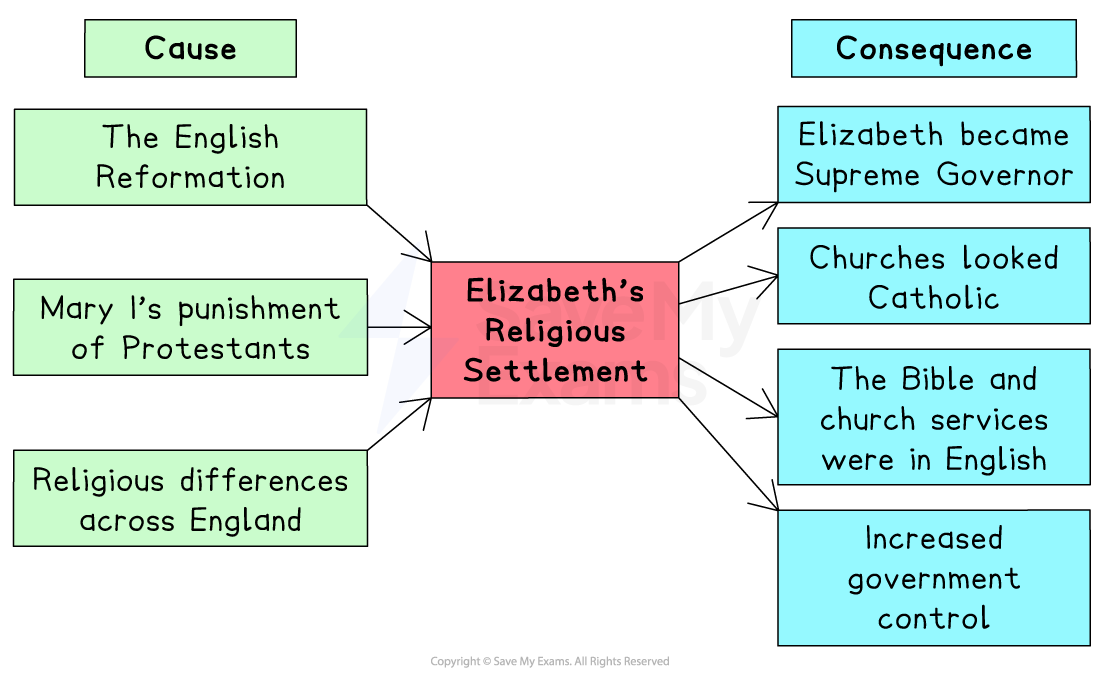
This covers the initial reactions to the settlement up to 1563
The longer-term Catholic and Puritan challenges, including the papal excommunication of 1570, the Northern Rebellion of 1569 and the Vestiarian Controversy of 1566, are all covered later
Catholic reactions (broadly muted)
The initial Catholic reaction was less severe than might be expected
Around 400 clergy lost or resigned their positions because they would not accept the settlement
Virtually all Catholic bishops appointed by Mary refused the oath of supremacy and were dismissed
This gave Elizabeth the opportunity to appoint an entirely new episcopal leadership who were enthusiastic about her reforms
Compared to the c.800 Protestants who had fled abroad during Mary's reign, the scale of refusal was relatively smaller
In many parishes, some priests simply ignored the new Prayer Book and continued Catholic practice
A survey of Justices of the Peace in 1564 found that only about half could be actively relied on to support the settlement
Regional variation
Catholic practice persisted longest in the north and west, where traditional loyalties were strongest
The Act of Exchange, 1559
Elizabeth followed Henry VIII in treating the Church as a financial resource
The Act of Exchange allowed her to take over property belonging to bishops and force them to rent land to her
In practice, it was often used as leverage to discipline or pressure bishops
It was unpopular but it reinforced Elizabeth's control over the episcopate
Puritan reactions (immediate dissatisfaction)
"Puritan" in 1559 describes those who felt the Reformation had not gone far enough to advance Protestantism
It was not yet a defined movement
Puritan dissatisfaction was immediate
The settlement's compromises felt like half-hearted reform to them
Key Puritan grievances
Grievance | Why did it matter? |
|---|---|
Vestments |
|
Bishops |
|
Eucharist wording |
|
Crosses and candles |
|
Three strands of Puritan thought
Moderate Puritans
Accepted the Church's structure
But pressed for reform of beliefs and practices along continental Protestant lines
Presbyterians
Wanted to abolish bishops and reform the Church's structure on the Calvinist model
As in Scotland
Separatists
Broke away from the national church entirely to pursue their own radical Reformation at parish level
The 39 Articles (1563) were nearly derailed by Puritan pressure (passed by a very narrow margin)
Foreign reactions
Philip II initially hoped to persuade Elizabeth to change the settlement
He did not break with England immediately
The Council of Trent, concluding in 1563,reinforced hardline Catholic doctrines that made peaceful compromise with Protestantism impossible
The Pope did not excommunicate Elizabeth immediately
That came in 1570
Examiner Tips and Tricks
Make sure you are including specific numbers in your revision, especially with regards to the disagreement on the settlement. The figures show that the settlement was not universally accepted, but also that large-scale refusal did not materialise.
How Successful Was the Elizabethan Religious Settlement?
Use the evidence below to build your own argument
The question asks how successful the settlement was, not whether it was popular or whether it was theologically consistent
Did it achieve what it set out to achieve?
What did the settlement set out to achieve?
It set out to create a workable national Church acceptable to the majority of English people
It hoped to avoid the religious warfare seen in France and the German states
It aimed to give Elizabeth full control over the Church as a political institution
Evidence that the settlement was successful
It avoided civil war
England did not descend into the religious violence seen in France
By that standard alone, it was a remarkable achievement
The broad middle majority accepted it
Reaction was muted compared to the upheaval of Mary's reign
Elizabeth gained full control of the Church
Appointments, doctrine and organisation were all under royal authority
The new episcopal leadership was enthusiastic
Dismissing the Marian bishops allowed Elizabeth to build a Church sympathetic to her settlement
The visual conservatism worked
By keeping vestments, crosses and familiar ceremonies, the settlement was acceptable to most ordinary people who cared more about familiarity than theology
It proved durable
The Church of England still rests on these foundations more than 450 years later
Evidence that the settlement had significant weaknesses
Around 400 clergy refused to accept
This was a significant minority
Around half of Justices of the Peace (JPs) in 1564 were considered reliably supportive
Local enforcement was patchy
The Puritan challenge was immediate
The 39 Articles passed with a very narrow margin
Puritan dissatisfaction did not go away
Catholic practice persisted
Especially in the north and the west
The settlement was not uniformly accepted
The deliberate ambiguity satisfied nobody completely
It was a political compromise
Both sides knew it
It depended on enforcement
Where enforcement was weak, which was in many areas, compliance was patchy
Examiner Tips and Tricks
The strongest answers to this question distinguish between two different things: whether the settlement was successful as a political strategy, and whether it was successful as a religious one. As a political strategy, creating stability and control, it was largely successful. As a religious settlement, genuinely resolving the doctrinal disputes, it was not. It stored up both Catholic and Puritan problems for later in the reign. Show that distinction.

Unlock more, it's free!
Join the 100,000+ Students that ❤️ Save My Exams
the (exam) results speak for themselves:

Was this revision note helpful?
