Mary I: Economic & Social Change (AQA A Level History: Component 1: Breadth study): Revision Note
Exam code: 7042

Summary
Mary inherited serious economic problems from Henry VIII and Edward VI
Ongoing inflation, debasement (partially addressed under Northumberland) and population pressures served as the key structural pressures during her reign
The harvest failures of 1555 and 1556 caused malnutrition and starvation among the poor
Plague outbreaks intensified from 1556 and continued intermittently into Elizabeth's reign, compounding the social distress
The cloth trade remained unstable
The Book of Rates (1558) attempted to improve Crown revenues but provoked hostility from merchants
Mary's government made genuine financial reforms, including planning the revaluation of the coinage
Economic and religious experiences varied significantly by region
The north and west were generally more supportive of the restoration
London and the south-east showed more resistance
Historians disagree on how serious the problems were
Heard argues the government was never in danger of collapse
Others point to genuine crisis conditions in 1556 and 1558
Economic Problems under Mary I: Trade, Harvests & Financial Reform
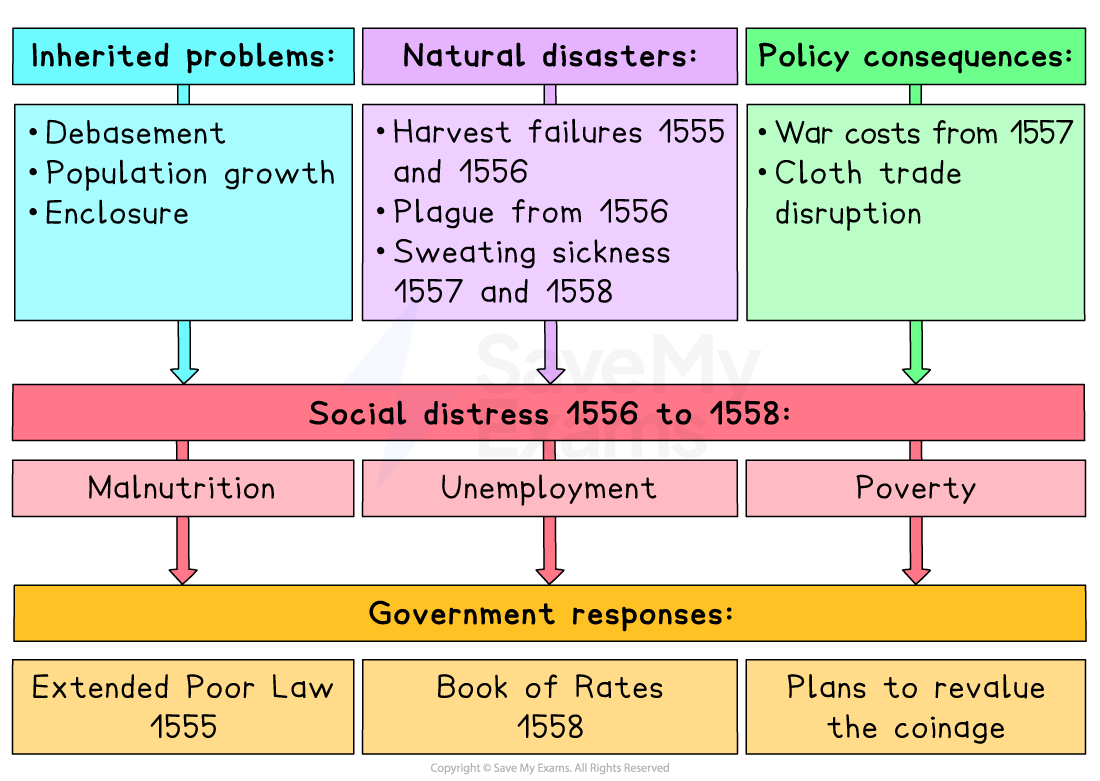
Mary inherited a deeply unstable economy
Debasement (partially addressed by Northumberland), inflation and population pressures were ongoing problems from previous reigns
The harvest failures
The most serious economic problems specific to Mary's reign were the harvest failures
Poor harvests:
1555: Food prices rose sharply
1556: Among the worst of the mid-Tudor period
Impact:
The combination of the two successive harvest failures caused severe malnutrition and episodes of famine among the poor
Grain prices reached extreme levels
This meant that bread, the staple food of the poor, became unaffordable for many
Plague and epidemic disease
Severe outbreaks of plague began in 1556 and continued into Elizabeth's reign
Sweating sickness (a fast-acting and poorly understood epidemic disease) struck in 1557 and 1558
Impact:
These epidemics compounded the effect of the harvest failures
Population growth increased demand for food and land, pushing up prices and placing pressure on wages and resources
The combination of the famine and epidemic diseases in 1556 and 1558 was among the worst conditions experienced in decades
The cloth trade
England's economy was heavily dependent on cloth exports to Antwerp
The cloth trade had already slumped badly in 1551
Under Mary, it partially recovered but remained unstable
The war with France from 1557 further disrupted trade routes
The new Book of Rates (1558) significantly increased Crown customs income (roughly tripling it)
But it coincided with another collapse in cloth demand
The timing provoked serious hostility from the merchant community, who felt they were being taxed during a downturn
Currency revaluation plans
Mary's government drew up plans to address the debasement problem that had driven inflation since the 1540s
They were not implemented until Elizabeth I's reign, but much of the groundwork was laid under Mary
This is one of several administrative achievements that are often credited to Elizabeth
Examiner Tips and Tricks
When answering questions on Mary's economic problems, it is easy to list failures without asking why they happened. Not everything was the government's fault. The harvest failures and plague were natural disasters outside anyone's control. The strongest answers distinguish between problems Mary's government caused, problems it inherited and problems no government could have prevented.
Social Change & Regional Issues under Mary I
Social conditions under Mary were shaped by two overlapping forces:
The harvest and plague crises of 1556–1558
The effects of religious change on parish life
The impact on ordinary people
The harvest failures and plague hit the rural poor hardest
Rising food prices meant the basic necessities of life became unaffordable for many at the bottom of society
Cloth workers in East Anglia and the west faced unemployment from the trade slump
Urban workers were also affected as trade disruption reduced employment
Government responses to social problems
The government took steps to address social distress
Extended Poor Law (1555)
Licensed beggars were given badges
Parishes were encouraged to organise charitable giving more formally
Enclosure conversion
Encouragement was given to converting pasture back to arable land
Urban employment
The movement of industries from towns to the countryside was discouraged to protect urban employment
These were modest measures
The scale of the problems outpaced the government's response
The social impact of religious change
The restoration of Catholicism was welcomed in many areas
Familiar practices returned to parishes
In some areas, people had continued Catholic practices during Edward VI’s reign
The restoration felt like a return to normality
The removal of married clergy caused disruption
Priests with families were forced to choose between their parishes and their households
Regional variation
England in the 1550s was not a religiously or economically uniform country
Region | Character and conditions |
|---|---|
North (Durham, Lancashire and Yorkshire) |
|
London and south-east |
|
South-west (Devon and Cornwall) |
|
East Anglia |
|
Wales |
|
Examiner Tips and Tricks
Regional variation is a useful analytical tool. It allows you to qualify general statements. Rather than saying "the burnings were disastrous' or 'the restoration was popular", show that both statements were true in different parts of England at the same time.
How Serious were the Economic & Social Problems under Mary I?
Use the evidence below to build your own argument
The question asks how serious the problems were, not whether the reign was a success or failure overall
Evidence that the problems were serious
The harvest failures of 1555 and 1556 caused genuine malnutrition and starvation
This was one of the worst subsistence crises of the century
Incidences of plague from 1556 compounded the effects from the harvests
The combination of famine and epidemic disease created conditions of acute social distress from 1556 to 1558
The cloth trade remained unstable
Unemployment among textile workers in East Anglia and the west was a recurring problem
The war with France from 1557 added to the financial burden at exactly the moment when the economy was already under severe strain
Government responses were modest
The extended Poor Law and enclosure conversion encouragement were real but insufficient given the scale of the crises
The debasement problem was not resolved during Mary's reign
The revaluation plans were drawn up but not implemented
Evidence that the problems were less serious than often suggested
The harvest failures and plague were natural disasters
They were not caused by government policy and were outside any government control
Financial administration was being strengthened
The currency plans show a government that was actively addressing structural problems
Social order was maintained
There were no major rebellions under Mary comparable to 1549
The government managed social pressures without losing control
Regional variation means the picture was uneven
Economic distress was concentrated in particular areas and periods
Not uniform across the country
Many reforms credited to Elizabeth began under Mary's government
The administrative groundwork for financial recovery was laid during this reign
For many people, life continued relatively normally for many people
The crises, though real, affected specific groups and regions rather than the whole population simultaneously
Key historian
N. Heard, Edward VI and Mary: A Mid-Tudor Crisis? (2000) |
|
|---|
Examiner Tips and Tricks
This debate question rewards precision about what "serious" means. Serious for whom? Serious where? Serious when? The harvest failures were genuinely catastrophic for the rural poor in 1556 to 1558. The overall structure of government and society was not in danger of collapse. Both things can be true at once, and showing that is what makes a strong answer.

Unlock more, it's free!
Join the 100,000+ Students that ❤️ Save My Exams
the (exam) results speak for themselves:

Was this revision note helpful?
