Mary I: The Marian Counter-Reformation, Restoring Catholicism (AQA A Level History: Component 1: Breadth study): Revision Note
Exam code: 7042

Summary
Mary restored Catholicism in two major legislative stages: the First Act of Repeal (1553) and the Second Act of Repeal (1555)
The Second Act restored papal authority, but church lands were not returned
Cardinal Pole directed a genuine reform programme: a better-trained clergy, visitations and new educational standards
The burnings began in February 1555
Around 280–300 Protestants were burned in total, including Cranmer, Latimer and Ridley
Foxe's Book of Martyrs (1563) recorded the persecutions in vivid detail
It shaped how later generations understood Mary's reign
Historians disagree on how successful the restoration was:
Turvey and Heard argue that Catholicism had genuine popular support
The traditional view sees the burnings as a catastrophic political error
The Restoration of Papal Authority & Catholic Doctrine under Mary I
Mary's religious restoration moved in three clear stages: legislation, then reconciliation with Rome, then practical reform of the Church
Stage one: First Act of Repeal, October 1553
Parliament repealed all of Edward VI's religious legislation
The Church of England was restored to the position it had been in at the time of Henry VIII's death
Catholic doctrine was back, but England was still under royal supremacy (not the Pope)
The act passed with little parliamentary opposition
Protestant roots among the parliamentary class were shallower than expected
Mary was advised not to go further at this stage
Restoring papal authority was too large a step to take immediately
Stage two: Second Act of Repeal, January 1555
Parliament abolished all doctrinal legislation passed since 1529
This was a decisive step
It included the 1534 Act of Supremacy
Henry VIII's break with Rome was formally reversed
The Pope's authority over the Church in England was restored
Cardinal Pole had arrived from exile in November 1554 as papal legate specifically to oversee this reunion
Parliament formally accepted papal authority over the English Church
A crucial limitation:
The Second Act of Repeal did not restore Church lands
Monastic and chantry properties sold since the 1530s remained in private hands
The parliamentary class and gentry who had bought former Church property would not vote to give it back
This was the price of parliamentary cooperation, and it permanently weakened the restored Church
Pole was deeply unhappy about this but recognised it was impossible to reverse
Stage three: reforming the church from within
Pole directed a genuine programme of internal Church reform, not just restoration of old practices
Pole's vision
Pole wanted genuine reform: better-educated clergy, improved preaching and pastoral care
His programme paralleled the principles of the Council of Trent (1545–1563), the wider Catholic reform movement
But it needed time, and Mary's reign was only five years
Reform | What did it involve? |
|---|---|
Clergy training |
|
Married clergy |
|
Senior clergy purge |
|
New materials |
|
The problem with the reform programme
The restored Church was structurally weaker than before
It had lost its endowments
Some areas, such as Durham and Lancashire, embraced reform enthusiastically
Many others did not
Pope Paul IV (from 1555) was a hardliner
He clashed badly with Pole, eventually declaring him a heretic in 1557
This conflict between the Pope and Mary's archbishop severely undermined the Counter-Reformation programme and weakened its authority
Mary died in 1558, with Pole dying on the same day
The reform programme never had time to mature
Examiner Tips and Tricks
The legislative programme is often reduced to just the Acts of Repeal. Pole's reform programme is significant too. It shows that Mary's restoration was not just about turning back the clock; it was an attempt at genuine Catholic renewal. The failure to restore the Church lands is the key structural weakness to flag.
The Marian Persecutions, 1555–1558: The Burning of Protestants
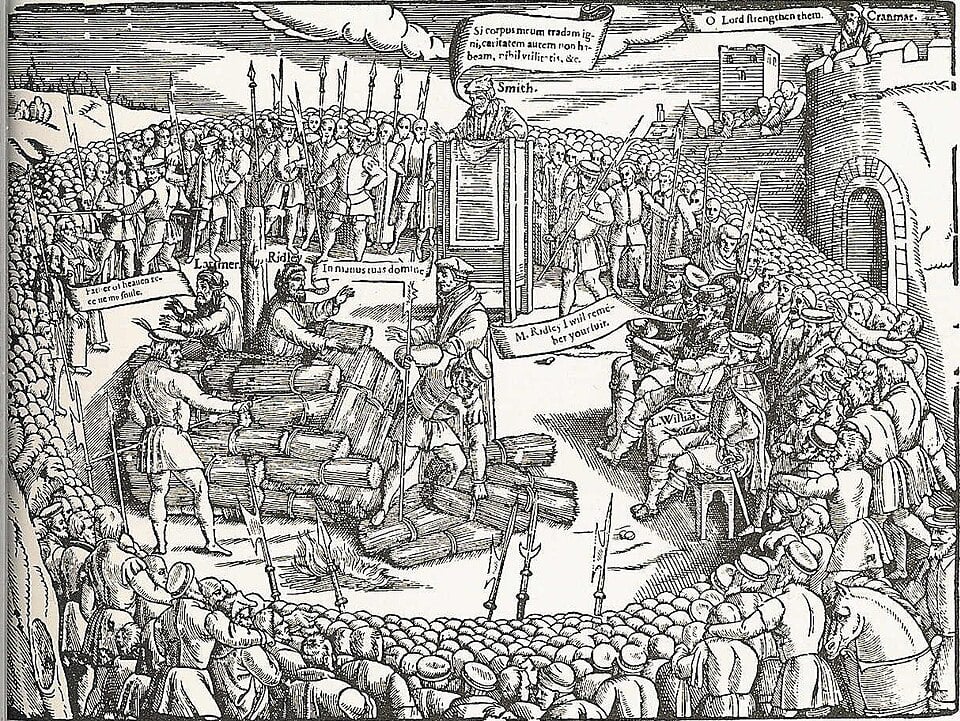
The Marian Persecutions were the most controversial aspect of Mary's reign
It earned her the nickname of "Bloody Mary", though the term was coined by Protestant propagandists after her death
The legal basis
Parliament revived the medieval heresy laws in 1554
These made it a capital offence to hold heretical views and refuse to recant
The same laws had operated under Henry VIII in the 1530s and 1540s
The executions began in February 1555
The scale and nature of the burnings
Around 280–300 Protestants were burned in total
Victims included both high-ranking churchmen and ordinary people, men and women of all social classes
Most burnings took place in London and the south-east
Key victims
Name | Role and significance |
|---|---|
John Rogers (February 1555) |
|
John Hooper (February 1555) |
|
Hugh Latimer and Nicholas Ridley (October 1555) |
|
Thomas Cranmer (March 1556) |
|
Mary's reasoning
Mary regarded the executions as necessary to cleanse England of heresy
In her view, allowing heretics to live was an act of cruelty to their souls; it left them in error
She did not wish to burn Cranmer, but believed she had no option once he withdrew his recantation
Her advisers were less convinced
As the death toll rose, opposition began to appear
Simon Renard, the imperial Ambassador, warned Philip II in February 1555 that the speed of the burnings "may well cause a revolt"
The impact of the burnings
The burnings created Protestant martyrs rather than eliminating Protestant dissent
They raised questions about what was so powerful about Protestantism that people were prepared to die for it
English Protestants who had fled abroad used this to produce propaganda associating Catholicism with intolerance
However, the impact must not be overstated
Outside of London, there is little evidence of strong reactions
The burnings were primarily a London phenomenon
In many areas, the restoration of familiar Catholic practices was welcomed
The history of the burnings has been heavily influenced by Protestant propaganda written after Mary's death, particularly Foxe's Book of Martyrs
Examiner Tips and Tricks
The burnings are the most debated part of Mary's reign. Avoid framing them simply as a disaster. Show that the impact was uneven: strong reactions in London, limited reactions elsewhere. The traditional "Bloody Mary" narrative comes largely from Protestant propaganda written under Elizabeth, not from contemporaries outside London.
Foxe's Book of Martyrs: Propaganda & Legacy
John Foxe's Book of Martyrs is one of the most influential books in English history
It shaped how Protestant England understood the Marian persecutions for generations
What was it?
John Foxe was an English Protestant who had fled to the continent during Mary's reign
He compiled a detailed record of the Protestant martyrs of Mary's reign
The book was first published in 1563, under Elizabeth I, five years after Mary's death
It documented the persecutions in vivid, often graphic, detail
It included eyewitness accounts, descriptions of the burnings and the last words of the martyrs
Purpose
The book was explicitly Protestant propaganda
It was designed to associate Catholicism with cruelty, tyranny and intolerance
It served the Elizabethan Protestant establishment's need to justify the religious settlement
It also created the image of England as a Protestant nation, providentially saved from Catholic persecution
Influence
In 1571, Foxe's Book of Martyrs was ordered to be placed in parish churches alongside the Bible
This gave it enormous reach across the whole country
Latimer's dying words, recorded by Foxe, became one of the most famous quotations of the English Reformation
The book created the lasting label "Bloody Mary" and embedded it in English Protestant consciousness
“Be of good cheer, Ridley; and play the man. We shall this day, by God's grace, light up such a candle in England, as I trust, will never be put out.”
John Foxe, Book of Martyrs
This account of Latimer's final words became one of the most powerful pieces of Protestant propaganda in English history. But it is worth remembering that Foxe was an exiled Protestant writing five years after Mary's death, under a Protestant queen. His account was shaped by that context, which is why historians treat it as a source that needs to be read critically, not taken at face value.
Limitations as a historical source
Foxe was not a neutral observer
He was a committed Protestant writing to serve a Protestant agenda
He wrote five years after Mary's death, under a Protestant queen
His account emphasised London reactions, which were the strongest
Reactions elsewhere were milder
Historians since the 1980s have tried to reconstruct the popular Catholic experience without relying too heavily on Foxe
Examiner Tips and Tricks
Foxe's Book of Martyrs is both a historical source and a piece of propaganda. In an extract question, if you encounter an extract from Foxe, always note his perspective. His agenda shaped everything he recorded. However, this is not a reason to dismiss him but a reason to read him critically.
Intellectual Developments & Humanist Thought under Mary I
The intellectual landscape of Mary's reign was more complex than simply a return to pre-Reformation Catholicism
Two opposing forces were at work
The two traditions in tension
Catholic humanism |
|
|---|---|
Counter-Reformation hardliners |
|
Pole's intellectual programme
Pole wanted to revive Catholic intellectual life in England, not just restore old practices
He patronised scholars and supported better education for the clergy
His approach was focusing on improving preaching, educating the clergy and guiding ordinary believers rather than relying on punishment
But his conflict with Pope Paul IV severely limited what he could achieve
Practical Catholic intellectual reform
Bishop Bonner of London published A Profitable and Necessary Doctrine, a clear guide to Catholic faith for ordinary parishes
New homilies (set sermons) were issued for clergy to read to congregations
The aim was practical:
Give ordinary people clear Catholic teaching after a generation of confusion
Protestants in exile
Many committed Protestants fled to Frankfurt, Geneva and Zurich during Mary's reign
Protestant exile communities formed and were deeply influenced by Calvinist ideas
John Knox and others brought radical Protestant thinking back to England and Scotland
When Elizabeth came to the throne, the returning exiles pushed for a more thoroughly Protestant settlement than Elizabeth herself initially wanted
The Marian exiles radicalised the Protestant movement and shaped the religious politics of Elizabeth's reign
Their absence during Mary’s reign also removed many committed Protestants from political life, helping to explain why Parliament proved relatively compliant with the restoration of Catholicism
Examiner Tips and Tricks
The intellectual developments section is sometimes neglected in revision. It matters because it connects Mary's reign to what came next. The Marian exiles returned under Elizabeth and drove the more radical Protestant agenda. Pole's conflict with Paul IV explains why the Counter-Reformation programme in England was weaker than it might have been.
How Successful was Mary I's Attempt to Restore Catholicism?
Use the evidence below to build your argument
Consider what was achieved legislatively, practically and in terms of popular response
Evidence that the restoration was making progress
The Acts of Repeal passed with little parliamentary opposition
This suggests Protestant roots among the political class were not as deep as the Edwardian legislation implied
In some areas, there was evidence of a positive response
People began restoring Catholic practices even before Mary ordered them to
Pole's reform programme was genuine
It addressed real weaknesses in the pre-Reformation Church: poorly trained clergy and inadequate pastoral care
Beyond London, reactions to the burnings were limited
The idea that the whole country was horrified by them comes largely from Protestant propaganda
Evidence that the restoration faced serious problems
Church lands were not restored
The economic foundation of the restored Church was permanently weakened
The conflict between Pole and Paul IV undermined the reform programme at the highest level
The burnings damaged Mary's reputation
Especially in London and gave propagandists powerful material
Mary died after only five years
The reform programme never had the time to take root properly
The Marian exiles returned under Elizabeth with more radical Protestant ideas than before
The exile had strengthened, not weakened, Protestantism
The Elizabethan Settlement reversed Mary's work within a year of her death
The restoration had not gone deep enough to survive
Key historian
R. Turvey and N. Heard, Change and Protest, 1536 to 1588 (2012) |
|
|---|
Examiner Tips and Tricks
The debate question rewards an argument about what was achievable in five years rather than a simple verdict of success or failure. The strongest answers note that the restoration was making genuine progress legislatively and pastorally, but that it faced structural problems (the church lands, the Pope Paul IV conflict, Mary's early death) that were difficult to overcome.

Unlock more, it's free!
Join the 100,000+ Students that ❤️ Save My Exams
the (exam) results speak for themselves:

Was this revision note helpful?
