Henry VIII: Religion & the Henrician Reformation (AQA A Level History: Component 1: Breadth study): Revision Note
Exam code: 7042

Summary
The Henrician Reformation transformed the organisation of the English Church but left its doctrine largely Catholic by 1547
Humanist ideas from Erasmus, Colet and Tyndale created the intellectual climate for reform
However, humanism itself was limited and internally divided and Henry exploited it for political rather than religious ends
The Ten Articles (1536), the English Bible (1537/1538) and the Bishop's Book (1537) introduced Protestant elements, while the King's Book (1543) reasserted Catholic doctrine
The Six Articles (1539) were a deliberate conservative backlash, driven by Howard factional dominance and Henry's personal conservatism, reasserting Catholic doctrine under severe penalties
By 1547, the Church of England was best described as “Catholicism without the Pope”: institutional change without consistent doctrinal transformation
Historians debate Henry's legacy:
Duffy argues popular Catholicism was strong and deeply rooted
Wooding sees Henry's legacy as unintended religious division lasting into the next century
Renaissance Ideas & Humanism: Their Influence on Religious Change
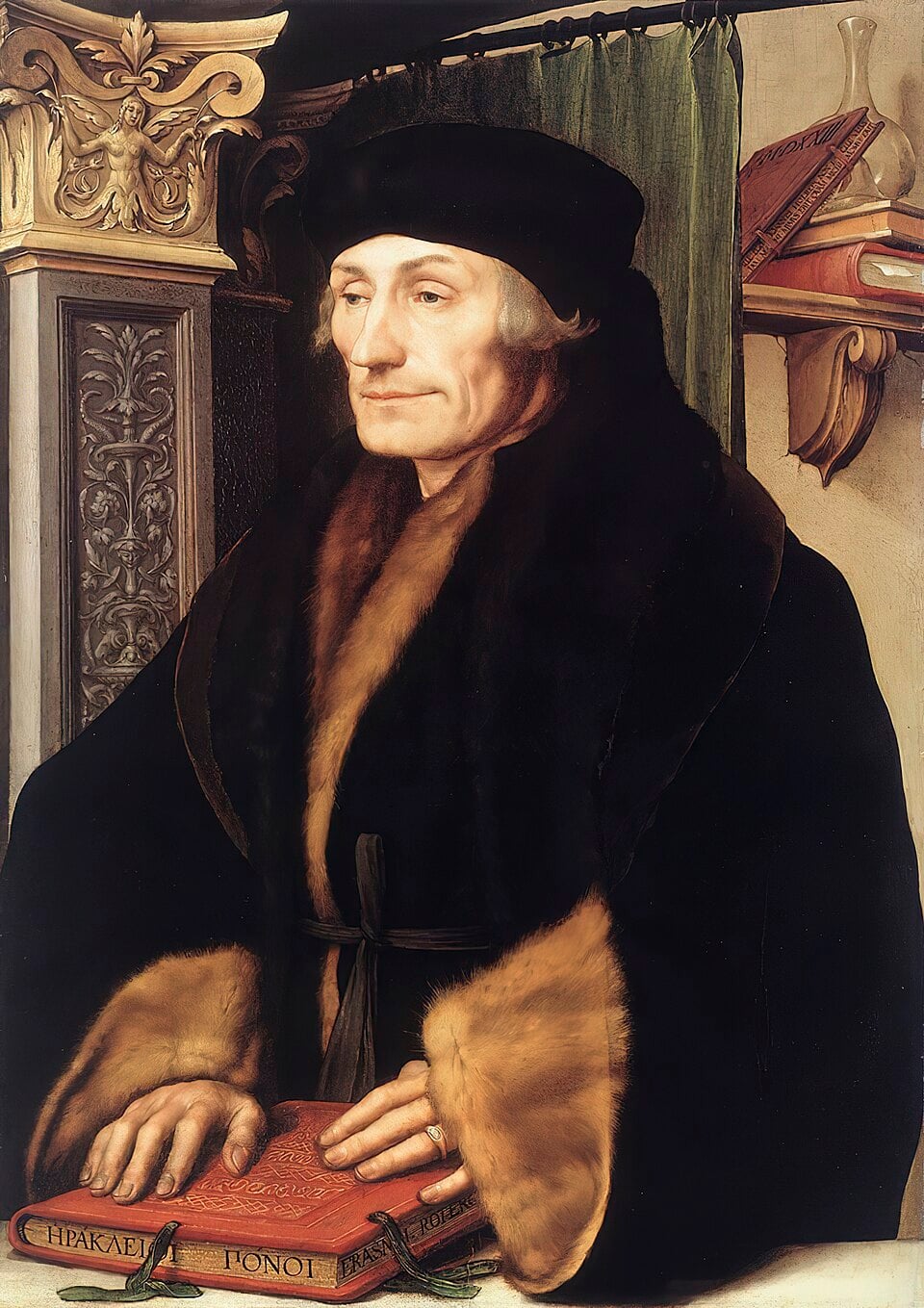
What was Christian humanism?
Humanism in England meant a return to original classical and biblical sources, combined with a desire for Church reform through education and reason rather than revolution
The key English humanists were Erasmus, John Colet and Thomas More
Erasmus:
His In Praise of Folly (1509) attacked Church corruption through satire
His Greek New Testament (1516) encouraged direct engagement with scripture
Colet (Dean of St Paul's):
Refounded St Paul's School as a centre of humanist education
Preached against clerical abuses
More:
His Utopia (1516) was a biting critique of the corruption of Christian society
All three were deeply critical of Church abuses, corruption and superstition, but wanted reform from within, not a break
They remained committed Catholics who opposed Luther's more radical challenge
How humanism shaped the conditions for the Reformation
Humanist criticism prepared educated opinion for the idea that the Church needed fundamental reform
The emphasis on returning to original scriptural sources directly supported Protestant arguments about the Bible's authority over Church tradition
From 1529, Henry found humanist scholars unexpectedly useful
Their arguments for reducing papal power could be turned to his advantage
William Tyndale's translation of the New Testament (1526), printed abroad and smuggled into England, drew on humanist scholarship but was also shaped by emerging Protestant ideas
Anne Boleyn drew Henry's attention to Tyndale's work and protected Protestant reformers at court
Tyndale's translation became the basis of the 1537 English Bible
Much of the New Testament in later English Bibles was based on Tyndale's work
The limits of humanism's influence
Humanism created the intellectual climate for reform but was not its direct cause
Henry's Reformation was primarily about royal power, not theological principle
The movement contained an internal tension that ultimately split its leading figures
More defended Catholic faith above all; Erasmus prioritised human reason over dogma
This split meant humanism could not present a unified front either for or against the Reformation
Protestant preachers (Bale, Crome, Barnes, Cranmer) eventually displaced the humanists as the driving force of religious change
Historians disagree about how far humanism genuinely shaped the Reformation and how far it was simply displaced by it:
Key historians
James K. McConica, English Humanists and Reformation Politics (1965) |
|
|---|---|
John Guy, Tudor England (1988) |
|
Examiner Tips and Tricks
Don't treat humanism and Protestantism as the same thing. Humanists wanted internal Church reform; Protestants wanted to break with Rome and change doctrine. Erasmus and More never became Protestants. The key argument is that humanism created the intellectual conditions for reform without determining its direction.
McConica and Guy make a classic pairing for a "how significant" question. McConica establishes that humanism was genuinely influential and well-patronised. Guy qualifies this: its internal fragility meant it was ultimately displaced by Protestant reformers as the driving force of change.
Doctrinal Changes: The Ten Articles (1536), the Bishop's Book (1537) & the King's Book (1543)
Doctrinal change under Henry was not a straight march towards Protestantism
It zigzagged between Protestant-leaning reform and Catholic reaction, reflecting factional struggle and Henry's personal conservatism
The Ten Articles, 1536
These were issued by Cromwell as Vicar-General, probably drafted by Cranmer, and passed by Convocation
They were the first official statement of doctrine for the new Church of England
Protestant elements:
They reduced the sacraments from seven to three
There was no mention of purgatory
Salvation by faith reflected Luther's beliefs
Catholic elements:
The Eucharist retained Catholic wording
Prayers for the dead were still permitted
It was deliberately vague on several points to avoid direct confrontation with Henry's conservatism
The Injunctions (1536 and 1538)
Two sets of official instructions to the clergy enforced and extended the Articles
The 1538 Injunctions were the most significant
They ordered an English Bible to be placed in every parish church
Clergy were to exhort congregations to read it as "the very lively word of God"
They attacked pilgrimage, veneration of images and saints, and other "superstitious" practices
These changes created a climate for change that proved difficult to fully reverse
The Bishop's Book, 1537
This was published as a guide accompanying the Ten Articles
It was more Protestant in tone
It reduced the status of four of the traditional seven sacraments
It was not officially authorised by Henry
This was a sign his conservatism was already reasserting itself
The English Bible, 1537–1538
The first officially sanctioned English Bible was published in 1537
It was based largely on Tyndale's translation, with contributions from Miles Coverdale
In 1538, a royal proclamation ordered a copy placed in every parish church
This was the single most significant change for ordinary people's experience of religion
But accessibility did not automatically produce Protestantism
Most ordinary people lacked the theological framework to interpret what they heard
The King's Book, 1543
This was a revised doctrinal statement replacing the Bishop's Book
It was significantly more Catholic in tone
It reasserted traditional practices and doctrine
It reflected the conservative reaction of the early 1540s under Howard faction influence
It provides clear evidence that Henry controlled the doctrinal direction personally and was willing to reverse course when it suited him
Period | Doctrinal direction |
|---|---|
1536–1538: Ten Articles, Injunctions, English Bible, Bishop's Book |
|
1539: Six Articles |
|
1540–1542: Cromwell falls, Catherine Howard at court |
|
1543: King's Book |
|
1543–1547: Catherine Parr, Cranmer survives |
|
Examiner Tips and Tricks
The doctrinal changes question rewards a clear sense of pattern. The key argument is that change was not linear: it zigzagged depending on who had influence at court. Henry always retained personal control over the direction.
Don't confuse the Ten Articles with the Six Articles. The Ten Articles (1536) moved cautiously towards Protestantism by reducing the sacraments. The Six Articles (1539) reversed this by reasserting Catholic doctrine under severe penalties. Knowing the direction of each is essential.
The Six Articles, 1539: A Conservative Backlash?
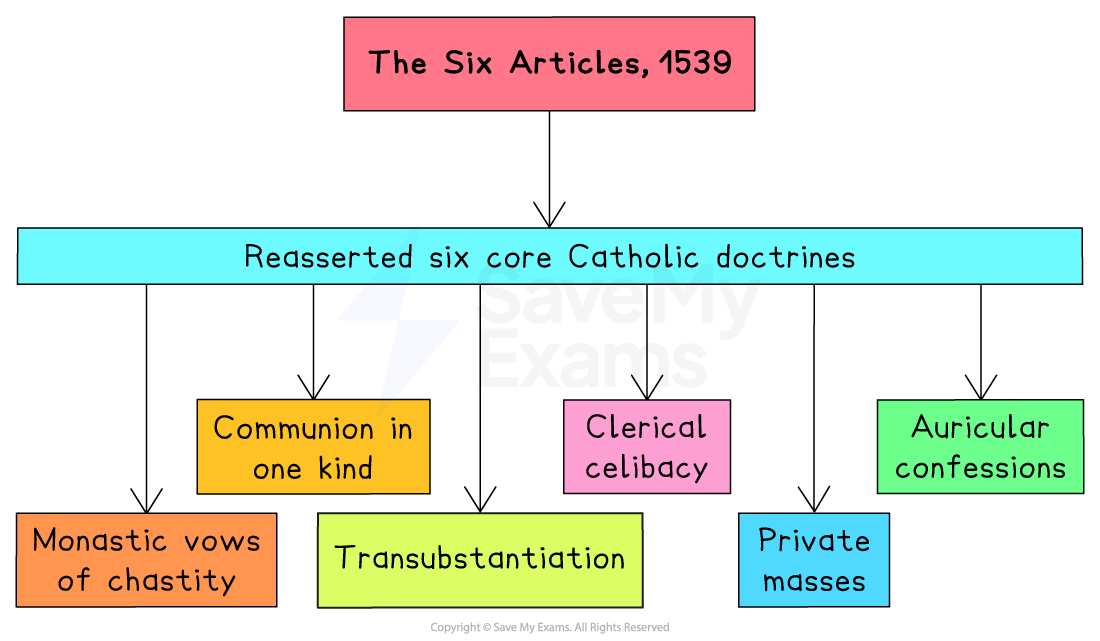
What the Six Articles said
These were pushed through Parliament by the Duke of Norfolk in 1539
They reasserted six core Catholic doctrines:
Transubstantiation
The bread and wine at Mass literally become Christ's body and blood
Communion in one kind
Only the bread for the laity, not the wine
Clerical celibacy
Priests could not marry
Private masses, auricular confession and monastic vows of chastity
All reaffirmed
It imposed severe penalties:
Denial of transubstantiation was punishable by death
Known by Protestants as "the whip with six strings"
The immediate impact
Protestant bishops Latimer and Shaxton resigned their positions immediately
Archbishop Cranmer discreetly sent his wife to Germany to comply with the celibacy requirement
Protestant reformers at court were temporarily silenced
Why did it happen?
Henry's own theological conservatism:
He had always seen the Reformation as a matter of Church governance, not doctrine
He never stopped attending Latin Mass or receiving the traditional sacraments
The Howard faction's dominance at court:
Norfolk pushed the Articles through Parliament while reformers had no equivalent champion
Diplomatic considerations also played a role:
Henry needed to signal moderation to potential Catholic allies
Was it a permanent reversal?
No: the Six Articles represented a temporary setback, not a permanent reversal
Catherine Howard's fall in February 1542 destroyed Howard influence at court
Henry's marriage to Catherine Parr (1543) brought reformers back into his circle
Henry personally protected Cranmer when the conservatives tried to have him arrested in 1543, handing him his own ring as a token of protection
By 1546, the reformers around Hertford and Cranmer had won the factional struggle
They were then positioned to govern under Edward VI
Examiner Tips and Tricks
The Six Articles are often misread as evidence that the Reformation had been reversed. It had not. They changed doctrine, not the Royal Supremacy. Henry remained Supreme Head of the Church of England. The Break with Rome was permanent; the doctrinal direction was not.
The best analytical point about the Six Articles is that they reveal Henry's view of the Reformation: it was about royal control, not Protestant theology. When it suited him politically to reassert Catholic doctrine, he did so without any sense of contradiction.
Continuity & Change in Religion by 1547: What was Henry VIII's Legacy?
How Protestant was England by 1547?
The question "how Protestant" requires three separate answers
Constitutionally:
Very Protestant : Royal Supremacy established, monasteries dissolved, English Bible in every church
Doctrinally:
Mixed and often reversed: Ten Articles gave way to Six Articles and the King's Book
In terms of popular belief:
Limited evidence of widespread Protestant belief: most ordinary people continued using Catholic language and practice
Use the specific evidence below to build and support your own argument
Evidence that Henry VIII's reign created lasting and fundamental religious change
The Royal Supremacy was permanent and constitutionally irreversible
Even Mary I had to use Parliament to restore Catholic doctrine
She could not simply reverse what Parliament had done
The Break with Rome proved permanent
No later English monarch permanently restored papal authority
The dissolution permanently destroyed Catholic institutional life in England
Centuries of monastic life were dismantled within a few years
The gentry who bought monastic land had a direct financial reason to resist any return to Catholicism
The English Bible was a genuinely transformative cultural achievement
Access to scripture in their own language gave people the tools to interpret faith independently of the Church
Tyndale's translation shaped the English language
Phrases still in common use today originated there
The Protestant establishment that governed under Edward VI was Henry's unintentional creation
Cranmer, Hertford and the reforming circle around Catherine Parr were perfectly positioned for Edward's minority
Henry had built the apparatus through which Protestant England would emerge after his death
Key historians
Lucy Wooding, Senior Lecturer in Early Modern History, King's College London |
|
|---|
Evidence that the Henrician Reformation left fundamental religious continuity intact
No doctrine changed until 1536 and even then the changes were partial and sometimes reversed
By 1547, the Church of England remained predominantly Catholic in doctrine
All seven sacraments, transubstantiation, Latin services and clerical celibacy were all unchanged
Henry never intended to create a Protestant Church: he wanted royal control, not theological revolution
The Six Articles (1539) and King's Book (1543) showed he would reassert Catholic doctrine whenever it suited him
Ordinary people's religious practice and beliefs changed very little by 1547
Evidence from wills and churchwardens' accounts shows Catholic language persisting well beyond Henry's death
The political change had been accepted, Henry as Supreme Head was largely uncontested
But widespread acceptance of Protestant beliefs was much slower:
Most people were reluctant to abandon centuries-old traditions
Under Edward VI, rapid Protestant reform met considerable popular resistance in many areas
When Mary I restored Catholicism in 1553, it was received without major controversy across most of the country
Both reactions confirm that most ordinary people's faith in 1547 remained essentially Catholic
Key historians
Eamon Duffy, The Stripping of the Altars (1992) |
|
|---|
Examiner Tips and Tricks
The legacy question rewards a clear distinction between intended and unintended consequences. Henry intended to create a Church under royal control with Catholic doctrine intact. What he actually created was the institutional and intellectual framework through which Protestant England would eventually emerge. The gap between intention and outcome is the strongest analytical argument.
Wooding goes on the change side and Duffy on the continuity side. But notice that they are not simply contradicting each other: Wooding acknowledges the impact of Henry’s policies, while Duffy emphasises the enduring strength of traditional religion. The most sophisticated answers recognise that both can be true at the same time: the structure changed permanently, while belief changed much more slowly.

Unlock more, it's free!
Join the 100,000+ Students that ❤️ Save My Exams
the (exam) results speak for themselves:

Was this revision note helpful?
