Electric Potential Energy (DP IB Physics: HL): Revision Note

Electric Potential Energy
In a system of two or more charges, electric potential energy is stored due to the electric forces between them
The electric potential energy of a system is defined as
The work done in bringing all the charges in a system to their positions from infinity
Electric potential energy can be positive or negative, depending on the charges involved
This is different from gravitational potential energy, which always has a negative value
Electric potential energy has a positive value when:
the electric force is repulsive i.e. between two similar charges
energy is released as charges become separated
Electric potential energy has a negative value when:
the electric force is attractive i.e. between two opposite charges
energy must be supplied to separate the charges
A graph of potential energy Ep against distance r can be drawn for two like charges and two opposite charges
The gradient of the graph at any particular point is equal to the electric force F at that point
Graph of electric potential energy against distance
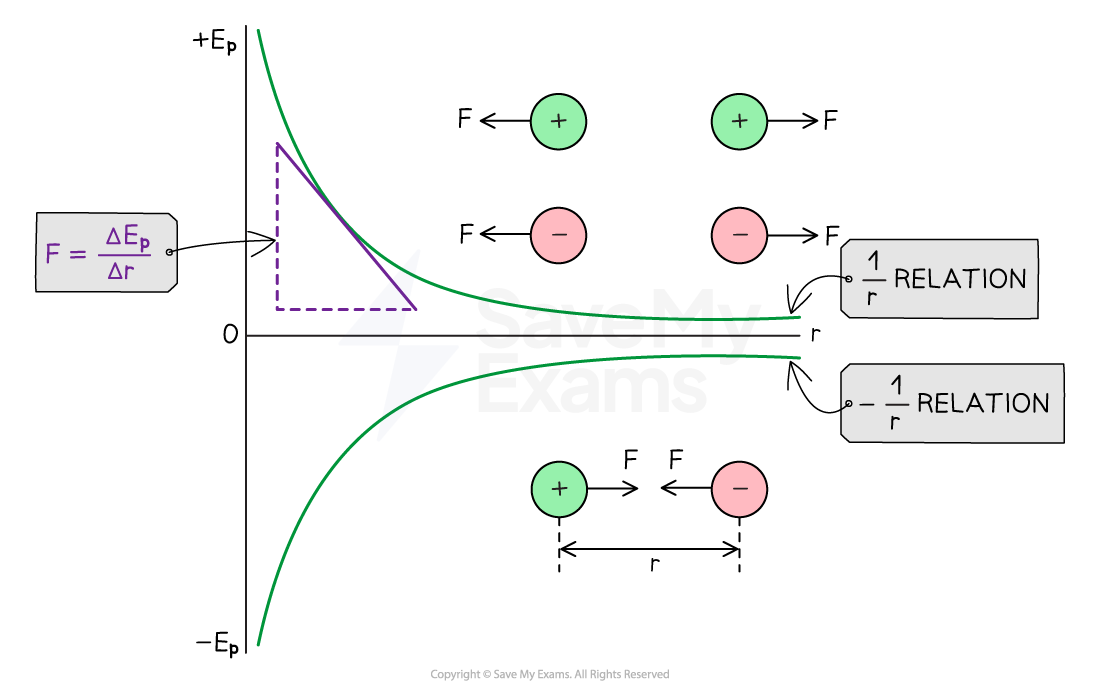
The electric potential energy of two similar charges decreases with distance and increases for two opposite charges
Electric Potential Energy Equation
The electric potential energy of two point charges is given by:
Where:
Ep = electric potential energy (J)
q1, q2 = magnitudes of the charges (C)
r = distance between the centres of the two charges (m)
k = Coulomb constant (N m2 C–2)
Similar to electric potential, values of electric potential energy depend on the signs of q1 and q2
By definition, potential V = 0 at infinity, therefore Ep = 0 at infinity
The electric potential energy of two charges separated by a distance R can also be determined from the area under a force-distance graph
However, determining this area for distances between R and infinity is difficult, so it is much simpler to use the equation above
Determining area under an electric force-distance graph
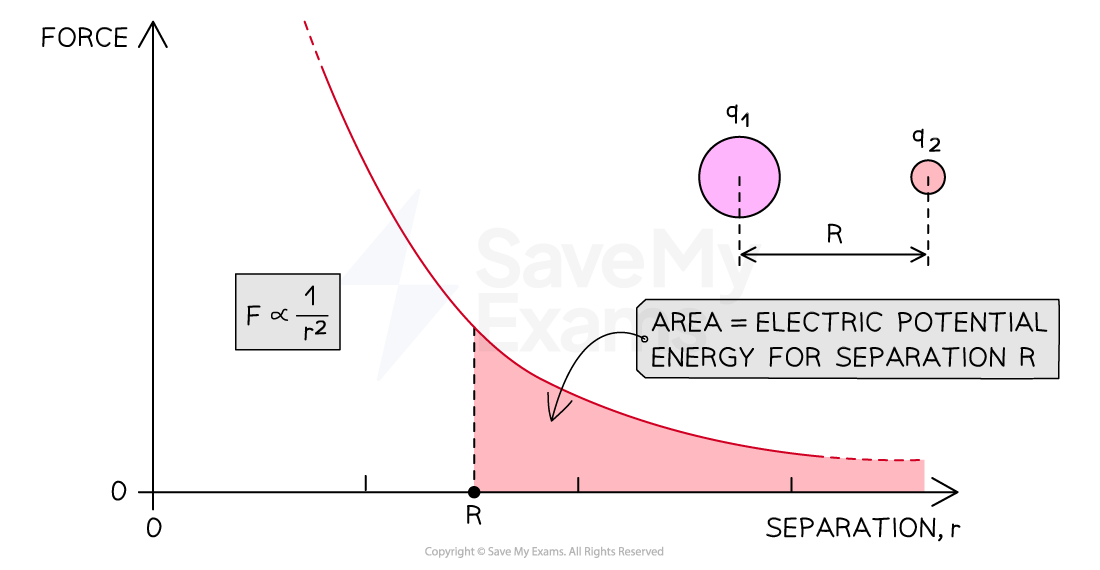
The area under the force-distance graph represents the electric potential energy of two similar point charges separated by R
Change in Electric Potential Energy
There is a change in electric potential energy when one charge moves away from another
This is because work must be done on the field to bring similar charges together, or to separate opposite charges
Conversely, work is done by the field to separate similar charges, or to bring opposite charges together
When a charge q2 moves away from a charge q1, the change in electric potential energy is equal to:
Where:
r1 = initial separation between charges (m)
r2 = final separation between charges (m)
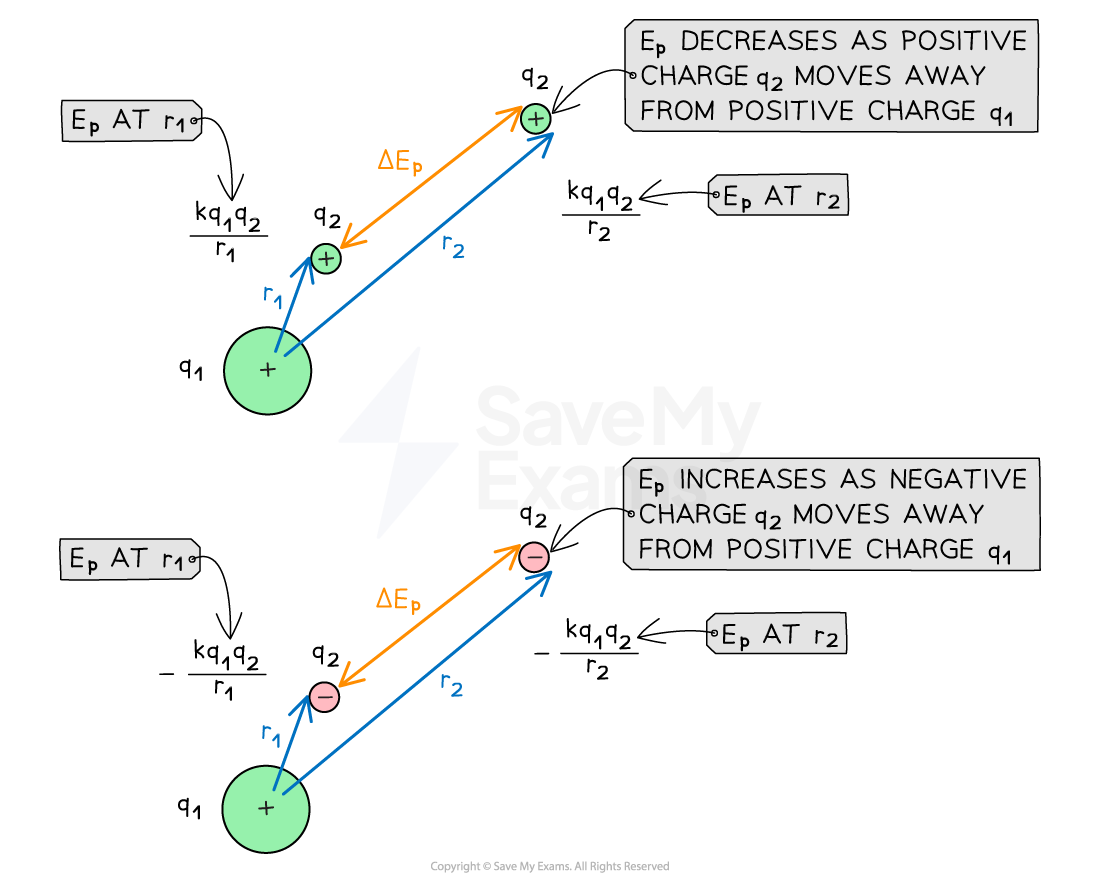
There is a change in electric potential energy when a point charge moves away from another charge
The change in electric potential energy between two charges is analogous to the change in gravitational potential energy between two masses
Comparing gravitational and electric potential energy
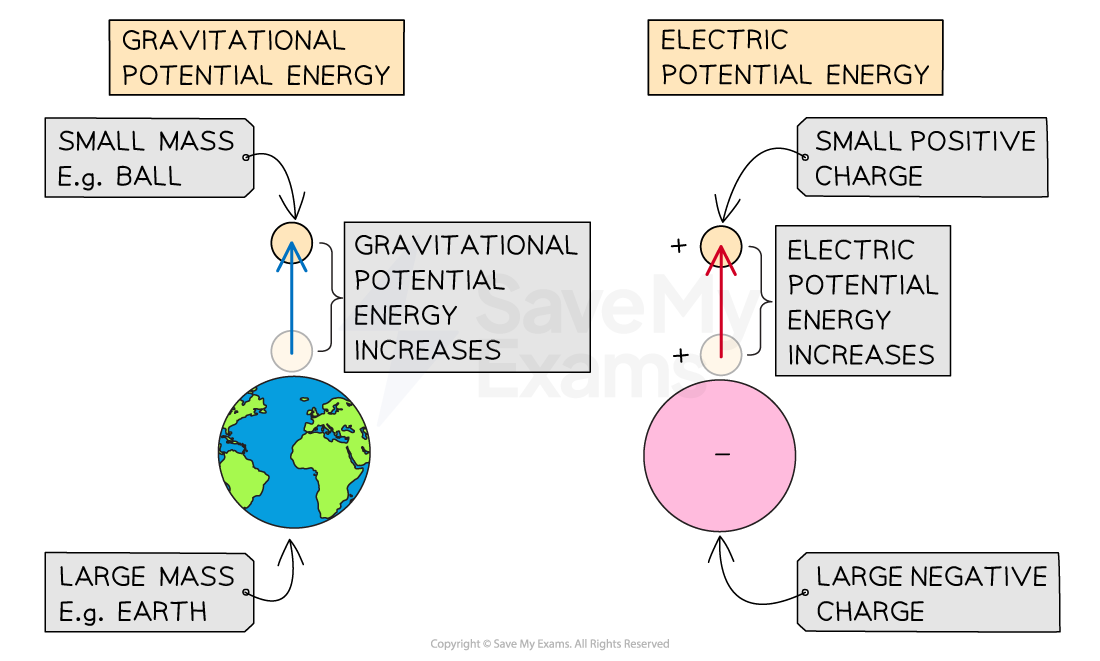
When a small mass is lifted on Earth, there is an increase in gravitational potential energy. This is similar to the increase in electric potential energy when a negative charge moves away from a positive charge
Determining work done from a force-distance graph
The work done in moving a charge can also be determined from the area under a force-distance graph
This is equivalent to the change in electric potential energy of a moving charge
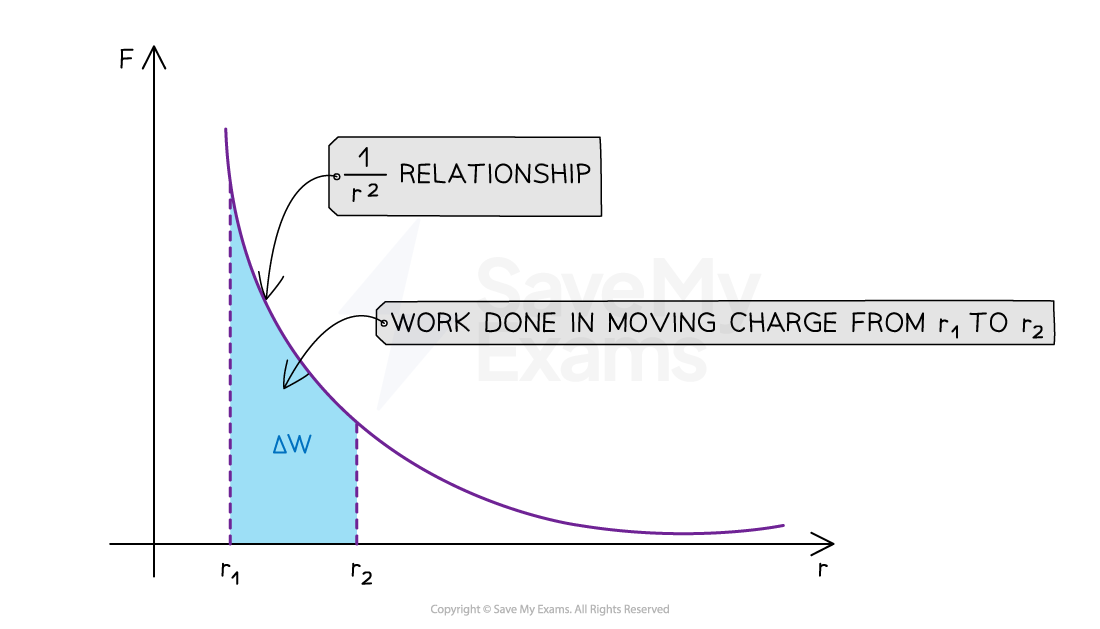
The area under a force-distance graph represents the change in electric potential energy, or the work done in moving the charge
Worked Example
An α-particle is moving directly towards a stationary gold nucleus .
At a distance of 4.7 × 10⁻¹⁵ m the α-particle momentarily comes to rest.
Calculate the electric potential energy of the particles at this instant.
Answer:
Step 1: Write down the known quantities
Distance, r = 4.7 × 10⁻¹⁵ m
Elementary charge, e = 1.60 × 10⁻¹⁹ C
Coulomb constant, k = 8.99 × 10⁹ N m2 C−2
Step 2: Determine the magnitudes of the charges
An alpha particle (helium nucleus) contains 2 protons
Charge of alpha particle, q1 = 2e
The gold nucleus contains 79 protons
So, charge of gold nucleus, q2 = 79e
Step 3: Write down the equation for electric potential energy
Step 4: Substitute values into the equation
J (2 s.f.)
Examiner Tips and Tricks
When calculating electric potential energy, make sure you do not square the distance!

Unlock more, it's free!
Join the 100,000+ Students that ❤️ Save My Exams
the (exam) results speak for themselves:

Was this revision note helpful?
Build on this topic